Why Trump Should Still Talk to North Korea - Newsweek
As President Donald Trump's party reels from a substantial blow in the midterm elections, the U.S. leader may turn to an unlikely place to reinvigorate his legacy.
North Korea's Kim Jong Un, armed with the very kind of nuclear weapons Trump seeks to deny another supreme leader in Iran, has been the subject of a presidential charm offensive in recent months. The campaign has only picked up steam in the lead-up to the vote that ultimately handed Democrats control over both chambers of Congress earlier this week.
But the president's comments mark just one of several indications that maneuvers are brewing behind the scenes. Signs of real strategy shifts have emerged from the U.S. and South Korea, where President Lee Jae Myung is also setting the stage for new overtures across the DMZ.
And with his final midterm elections now in the rear-view mirror, Trump may be more empowered than ever to pursue the kind of ambitious, unconventional diplomacy that could unlock a deal with Pyongyang and, with it, a major milestone in U.S. foreign policy.
"I think that in his last two years, Trump will be inclined to undertake big legacy projects," Victor Cha, president of the Geopolitics and Foreign Policy Department and Korea chair at the Center for Strategic and International Studies who has served in a number of U.S. official roles overseeing North Korea policy, told Newsweek.
"This includes things like the arch and renaming Dulles Airport, but I think it also means, in foreign affairs, potentially trying to do a deal with North Korea to end the Korean War," Cha said. "Whether this actually results in denuclearization is a very open question, but Trump clearly wants the Nobel Peace Prize, and we probably see achieving some sort of peace as an important step in that direction."
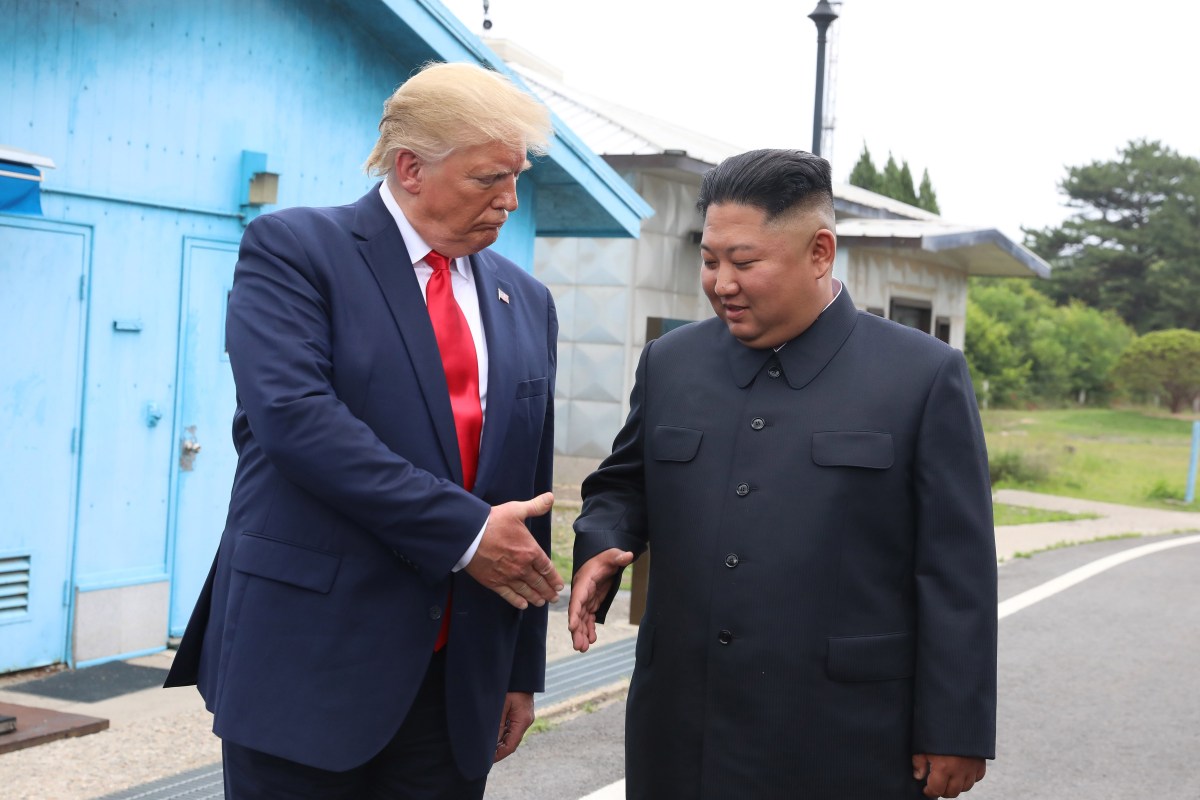
Trump has not been shy about his enthusiasm to secure a new sit-down with the North Korean leader with whom he made history in 2018 at the first-ever summit held between the two nations still technically in a state of war since their bloody 1950s confrontation. The U.S. leader's personalized style of foreign policy adds weight to the flattery.
"He happens to be a friend of mine," Trump said of Kim in September. "He likes Trump, doesn't like a lot of other people. I'm about the only person in the entire world that he likes, and I like him."
Trump again praised his dynamic with Kim last month, just two weeks before a midterm election in which many saw foreign policy on the ballot amid the domestic and global backlash of the ongoing war with Iran. Trump downplayed the notion of an imminent North Korea meeting he'd previously hoped would take place before the end of the year without outright dismissing the possibility.
"I get along with him very well," Trump said. "And I'm not sure that anybody is asking for a meeting, but my relationship with Kim Jong Un is very good."
Kim has spoken less frequently on the topic. But even the elusive leader has placed sentimental value in his rapport with the U.S. president, telling a top legislative meeting in September 2025, "Personally, I still have a good memory of the current U.S. President Trump."
Kim said at the time he would consider renewing talks with the U.S if it first abandoned its pursuit of denuclearization and instead sought "genuine peaceful coexistence." He expressed a similar position during a high-level party congress in February, asserting that if Washington were to respect North Korea's constitution and abandon a "hostile policy," then "there is no reason why we cannot get on well with the U.S."
But the most recent remarks have come from Kim's sister, Kim Yo Jong, who serves in the influential position of Korean Workers' Party Central Committee department director. She issued two back-to-back statements directed toward U.S. policy coinciding with the eve and day of the midterms.
In the first, Kim Yo Jong railed Monday against FBI allegations blaming Pyongyang for a $6 billion hack targeting cryptocurrency exchange Binance. She warned the move "confirmed Washington's hostile attitude" toward her nation.
She followed up Tuesday with a harsh reaction to the joint pledge by Japan, South Korea and the U.S. toward pursuing North Korea's denuclearization. She seemingly tied the move to the chances of securing new U.S.-North Korea talks, while leaving the door open to a change in course.
"The choice for peace includes dialogue of course, but this is not surely equated with national interests for us," Kim Yo Jong said.
North Korea's statements may not appear at first glance to be the kind of warm welcome typically associated with a willingness to rekindle discussions. Yet the leaders of both nations likely recall their last peace process began only after the exchange of nuclear threats.
And despite the joint denuclearization call criticized by Kim Yo Jong, Washington and Seoul have offered signals of a new strategy toward North Korea's nuclear arsenal. These include the South Korea Unification Ministry announcing a pivot away from "denuclearization-first" and the conspicuous absence of joint U.S.-China calls for the denuclearization of the Korean Peninsula following Trump's summit with Chinese counterpart Xi Jinping in September.
Joseph DeTrani, former CIA director of East Asia Operations and associate director of national intelligence and mission manager for North Korea, saw Lee's government as breaking away from an "unrealistic approach" and instead pivoting toward a strategy to convince North Korea "to stop building more nuclear weapons and possibly to convince Pyongyang that a good relationship with the U.S. and South Korea is in their interest."
He predicted the White House's path to another summit would find success with a similar approach.
"I believe Kim Jong Un will again meet with President Trump, as long as the president refrains from emphasizing that 'complete and verifiable' denuclearization is our goal," DeTrani told Newsweek. "It may be—and should be—our ultimate goal, but that shouldn't be the focus for another meeting."
He continued: "Rather, sanctions relief and a path to normal relations should be our focus. The goal is to get North Korea to halt/freeze its nuclear and ballistic missile programs. So, these would be unconditional talks, with the prospect of sanctions relief for North Korea."
In the seven years since his and Trump's last encounter at the DMZ, the North Korean leader has amassed new leverage in the form of nuclear and conventional military advances, as well as a historic mutual defense treaty with Russia inked in 2024, paving the way for direct cooperation between the two powers on Moscow's war in Ukraine.
And despite the lack of U.S. engagement and ongoing sanctions, Kim has hardly felt isolated. He's held two summits each with Presidents Vladimir Putin of Russia and Xi Jinping of China since 2019, and trade with both nations appears to be fueling something of an economic boom fortifying North Korea's growing geopolitical position.
"The circumstances have changed dramatically since Trump's first term," Cha said, "not least of which is the relationship between Kim and Putin where North Korea is receiving food, energy and weapons technology."
He added: "In addition, in the first term, Beijing was North Korea's lifeline in terms of circumventing UN sanctions. Now both Putin and Xi are blatantly not complying with any sanctions."
Anthony Ruggiero, senior fellow at the Atlantic Council who directed North Korea policy at the National Security Council during the first Trump administration's North Korea peace process, told Newsweek that "Kim is in a much stronger position" today, given his close relationship with Putin and Xi, and the fact that "the overall impact of the sanctions program against North Korea is much more diminished."
Meanwhile, the loss of Republican majorities in both the House and the Senate marks another added challenge. Certain sanctions on North Korea would require congressional approval to repeal.
But actionable steps exist through which both Trump and Kim may find common ground to kickstart a new dialogue. The president reserves considerable latitude on trade through the issuance of exemptions and waivers, the removal of individuals and entities from blacklists and even the suspension of some congressionally mandated sanctions under existing statutory authorities.
"Right now, the executive orders are discretionary, so he doesn't have to implement them," Ruggiero said. "He can make a statement that he's going to give negotiations a chance to continue with North Korea. I think the North Koreans may ask for other things like the end of war declaration for the Korean War, so that's another possibility."
Ruggiero saw the potential for the hosting of multiple summits, at least one of which could take place in North Korea, serving a "public relations victory for Kim Jong Un."
Rather than demanding total denuclearization from the outset, the U.S. objectives could be geared toward securing limits on North Korea's nuclear weapons and missile programs and curtailing support for Russia's war against Ukraine, while offering a White House commitment not to implement sanctions among other economic incentives, he argued.
"I think that would probably be the circumstances of a deal," Ruggiero said. "That's kind of the only thing that's really available between the two countries. There's no denuclearization here. The North Koreans are far more advanced on their nuclear missile programs. There's really no incentive for them to give that up."
Rachel Minyoung Lee, former open source analyst for the U.S. government and now senior fellow for the Stimson Center's Korea Program and 38 North project, questioned "whether North Korea would even agree to constraining some aspects of its weapons programs, considering its significantly increased leverage compared to seven years ago."
At the same time, she argued that "Trump's weakened domestic position could cut both ways."
On the one hand, "Trump's weakened position could raise questions in Pyongyang about his ability to deliver on, or sustain, commitments made at a summit," Lee told Newsweek.
In the alternative scenario, however, she said "Pyongyang may calculate that Trump, eager for a foreign policy achievement, would be more receptive to its demands."
"Even without formal U.S. recognition of North Korea as a nuclear state, Kim could see benefits in another summit, including enhancing his international standing and portraying Trump's remarks about North Korea's nuclear capabilities as tacit acceptance of its nuclear status," Lee said.
But just as the rewards of a successful agreement built on ambitious diplomacy may prove greater than the last attempt, so might the risks of another setback prove far riskier this time around.
"Kim experienced something similar following his June 2019 Panmunjom meeting with Trump," Lee said. "According to Kim, Trump had promised to suspend U.S.-South Korea joint military exercises, but the exercises proceeded a few weeks later. North Korea took serious offense to this and subsequently stepped up its missile launches."
She continued: "That was in 2019. What might Kim do now if he believes Trump has made a promise and subsequently reneged on it? Given North Korea's expanded military capabilities and greater confidence in its position, the consequences could be more serious than more missile launches."
Contact Newsweek editors for this story: Anthony Murray.