What to watch in the November night sky - GMA Network
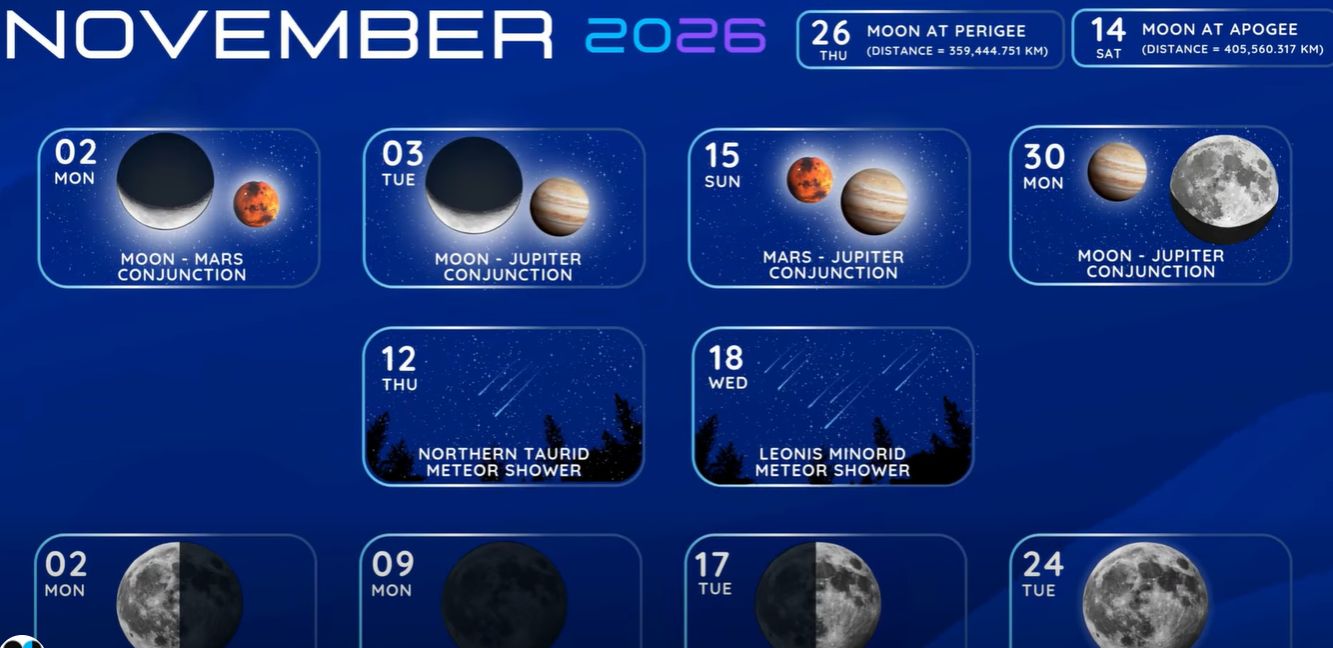
The Philippine Atmospheric, Geophysical and Astronomical Services Administration (PAGASA) on Saturday announced the astronomical events that skywatchers can look forward to in November.
According to PAGASA, several prominent constellations will be visible throughout the month, including the northern constellations Cepheus, Cassiopeia, Andromeda, Pegasus, and Pisces, as well as the southern constellations Tucana, Grus, Phoenix, Sculptor, and Aquarius.
The best time to observe these constellations will be around 9 p.m., when they reach their highest positions in the sky.
They will remain visible throughout the night until they set in the western horizon shortly before dawn, PAGASA said.
The so-called Celestial Sea, an arrangement of constellations associated with water, will also be visible throughout November.
From west to east, these include Capricornus (the Sea Goat), Aquarius (the Water Bearer), Pisces (the Fishes), Piscis Austrinus (the Southern Fish), Cetus (the Sea Monster), and Eridanus (the River).
“However, these constellations are not very bright and may be difficult to recognize, especially in areas with high light pollution,” PAGASA said.
Meanwhile, Saturn will be prominent in the evening sky, while Jupiter and Mars will appear a few hours later and shine brightly in the early morning sky.
On November 2, the waning crescent Moon will appear close to Mars in the constellation Leo. The pair will be best observed after midnight above the eastern horizon.
On November 3, the waning crescent Moon and Jupiter will also appear close to each other.
On November 16, Jupiter and Mars will make a close approach in the constellation Leo. The two planets will rise above the eastern horizon a few minutes before midnight.
On November 21, Saturn and the Moon will appear close to each other, illuminating the night sky after sunset. They will set in the western horizon at around 2:30 a.m.
On November 30, Jupiter will make another close approach to the Moon, whose visible surface will be more than half illuminated. The pair will be best observed above the eastern horizon from midnight until sunrise.
According to the International Meteor Organization, the Northern Taurid meteor shower, which has been active since October 20 and will remain active until December 10, will peak on November 12.
Around five meteors per hour may be observed during its peak.
Its radiant, or the point in the sky from which the meteors appear to originate, is the constellation Taurus. It will rise above the east-northeastern horizon at around 7 p.m. on November 11 and reach its highest position in the sky around midnight.
Meanwhile, the Leonid meteor shower will be active from November 6 to November 30, with peak activity expected on November 18.
Its radiant, the constellation Leo, will rise above the northeastern horizon around midnight, making the shower best observed until sunrise, PAGASA said.
Classified as a major meteor shower, the Leonids are expected to produce around 15 meteors per hour under dark, moonless skies. —VBL, GMA News