US midterm results: What’s next for East Asia? - The Straits Times
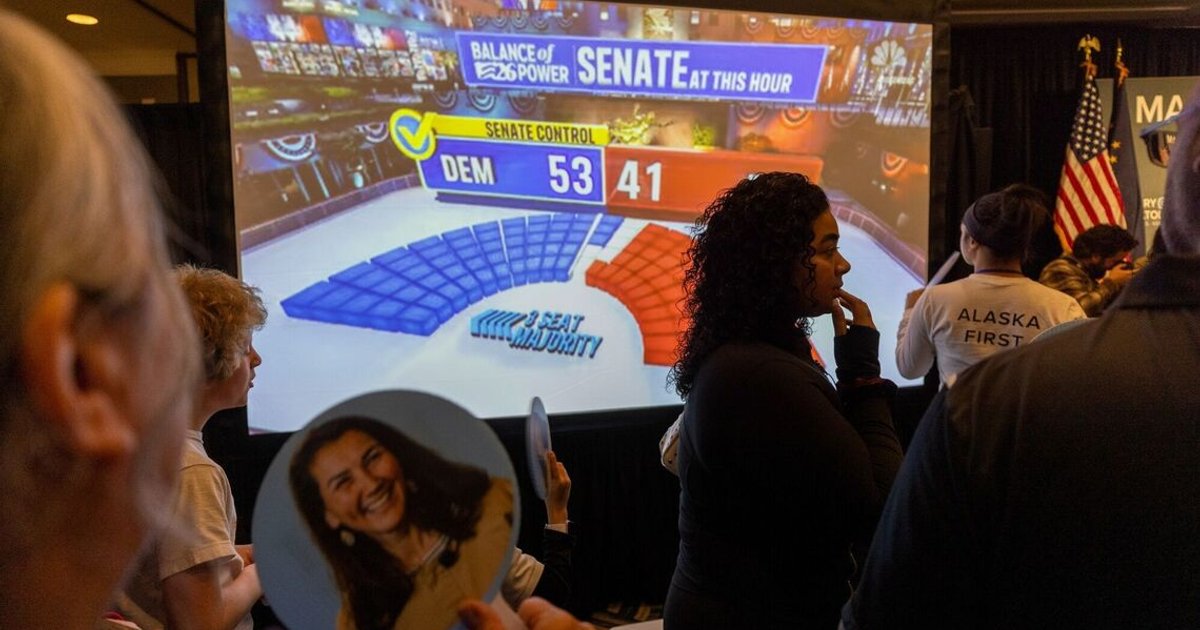
The Democrats’ sweep of both the House of Representatives and the Senate in the US midterm elections on Nov 3 has created a divided government, with consequences for President Donald Trump’s domestic agenda as well as foreign policy. Here’s a look at how US-related issues in East Asia might pan out following the “blue tsunami”.
A news broadcast displays election results during an election night event in Anchorage, Alaska, on Nov 3.
The Democrats’ sweeping victory in the US midterm elections could complicate US President Donald Trump’s efforts to strike further deals with China, as analysts warned that greater congressional pressure over Taiwan and technology restrictions is likely.
As a weakened Trump faces less political room for manoeuvre on the domestic front, questions have been raised over whether he will largely keep a current bilateral truce or adopt a tougher stance towards China in the second half of his presidency.
For now, analysts believe the rapprochement between Trump and Chinese President Xi Jinping could still hold, as both leaders have incentives to maintain diplomatic momentum ahead of their expected third meeting in 2026.
The Nov 3 elections, where Democrats flipped both the House of Representatives and the Senate, dealt a major blow to Trump’s Republican Party and set the stage for a divided US government when the new Congress takes office in January 2027.
In what would be a welcome outcome for Taiwan, the Democratic blue wave that swept the US midterm elections could see greater pressure on the White House to approve a US$14 billion (S$17.86 billion) arms sales package to the island.
President Donald Trump’s Republican administration has slowed down arms sales to self-ruled Taiwan, seeing these as a “negotiating” chip in its dealings with China, which opposes such sales as it sees Taiwan as its territory to be reunified with the mainland, by force if necessary.
Taiwan officials, meanwhile, have maintained that the island’s approach to relations with the United States is non-partisan.
Taiwan’s Ministry of Foreign Affairs told The Straits Times on Nov 5 that the island’s relations with the US are based on “a principle of non-partisan engagement, fostering broad goodwill, and active communication, which has long enjoyed consistent support from bipartisan members of the US Congress and the executive branch”.
The blue wave that swept the Democrats into power in both the US Senate and House of Representatives in the midterm elections is unlikely to ease pressure on the US-South Korea alliance, already strained by Washington’s multiple demands on Seoul.
While the results represent a political setback for President Donald Trump, a divided Washington could add to the uncertainty South Korea faces over its future dealings with the US.
Trump has repeatedly singled out South Korea, taking a transactional approach to the alliance and pressing Seoul on multiple fronts, from trade tariffs and investment commitments in the US to calls for it to help secure the Strait of Hormuz.
Analyst Troy Stangarone told The Straits Times that even with the Democrats’ significant majorities, they will still be limited in their ability to force Trump to change course without Republican support to muster the two-third majority votes needed in both chambers to override a presidential veto.
Chastened and humbled by a historic midterm reckoning, or defiant and emboldened by it?
United States security ally Japan is watching with palpable unease over how President Donald Trump will react to the decisive “blue tsunami” that swept Democrats back into control of both chambers of the US Congress following the elections on Nov 3.
Will a politically constrained White House turn its gaze abroad to chase legacy-defining breakthroughs in foreign policy, national security and trade – areas where the presidency retains broad discretionary authority? And will protracted domestic gridlock in Washington leave a dangerous vacuum in Indo-Pacific deterrence?
Officially, Japan insists the alliance remains unshakeable, regardless of what happens in the US. Chief Cabinet Secretary Minoru Kihara said on Nov 4 that the bilateral partnership “remains the cornerstone of Japan’s foreign and security policy regardless of the outcome of the elections” and is vital to “maximising its national interests”.