UOB’s Q3 net profit jumps 182% to $1.25b but misses estimates; shares fall over 5% - The Straits Times
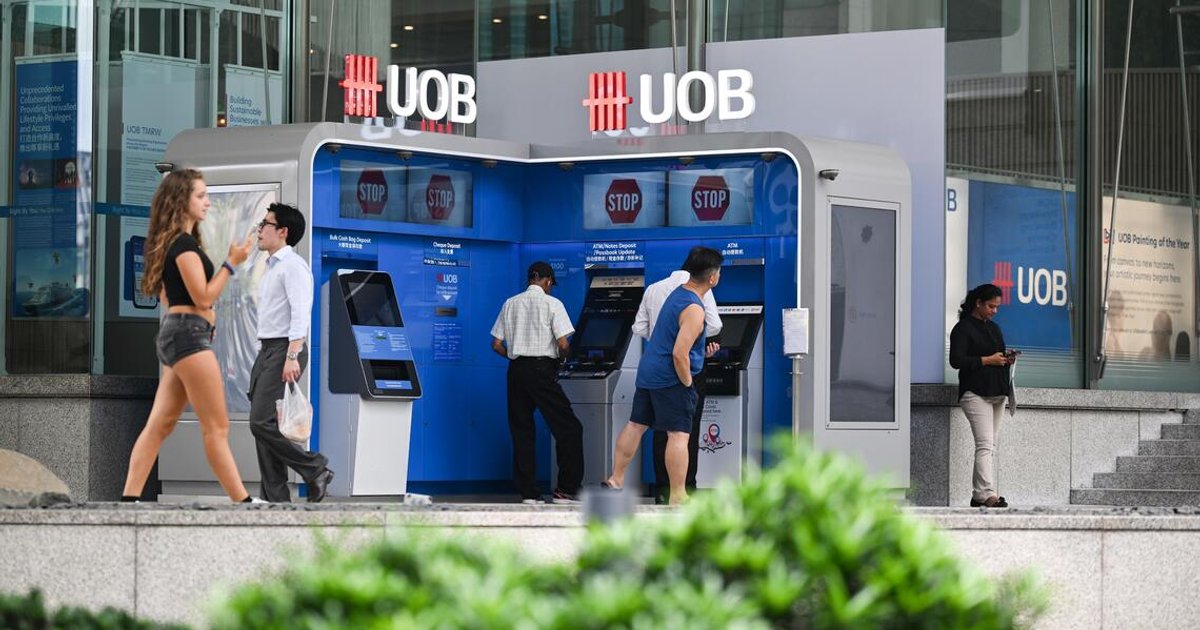
UOB is the first bank to report its third quarter earnings on Nov 4, after all three banks saw shares fall on Nov 2.
SINGAPORE – UOB’s third-quarter net profit jumped 182% to $1.25 billion from $443 million a year earlier, largely due to a sharp drop in provisions for potential loan losses.
But compared with the previous quarter, its net profit fell 15% from $1.48 billion. It also missed the $1.38 billion forecast among six analysts polled by Bloomberg.
Shares tumbled over 5% in response to the earnings performance, sliding down to $38.36, from its previous close of $40.46, during the early trading hours on Nov 4.
They fell over 6% before the noon trading break, but moderated to close 5% down at $38.44.
The jump in UOB’s net profit was a result of several factors. For one thing, UOB set aside $258 million for credit and other losses in the three months ended Sept 30, a sharp reduction of 81% from $1.36 billion a year earlier.
Net interest income, which measures the difference between what a bank earns from lending and pays on deposits, rose 1% year on year to $2.28 billion.
Net fee income in the third quarter hit a record $733 million, a 19% increase from the same period a year ago. It also marked a 10% increase over the previous quarter.
This rise came on the back of strong growth in wealth, cards and loan-related activities, UOB noted. Customer-related treasury income also reached a new high, reflecting robust client engagement and demand for hedging solutions, it added. Meanwhile, assets under management grew by 3% over the same quarter in 2025 to reach $204 billion.
UOB chief executive officer and deputy chairman Wee Ee Cheong said: “The group continued to see healthy customer activity across our businesses this quarter, with strong growth in wealth management, healthy loan growth and record fees and customer-related treasury income.”
For the first nine months of 2026, wealth income rose 13% from a year ago, while card income was up 25% year on year.
Wee said at a media briefing that the bank has also been reshaping its wholesale banking business, by investing in its transaction banking capabilities, strengthening the regional network and deepening sector coverage.
Wholesale banking loans grew 9% year on year, with trade loans recording a robust 31% growth.
Transaction banking also remained an important driver of the franchise’s performance, UOB said.
Total expenses fell to $1.6 billion, a 4% decrease over the previous quarter, in line with income moderation.
Wee said this financial performance reflects the strength of the bank’s diversified franchise and customer relationships, with over eight million customers in the region.
“As connectivity across ASEAN strengthens, customers increasingly value banking partners that can support them across their business, personal and wealth needs,” he said.
Non-performing loan ratio also fell to 1.5%, although non-performing assets rose slightly, especially in Greater China.
Responding to media queries, group chief financial officer Leong Yung Chee said: “You do see recovery in Greater China asset quality issues, but they are recovering slower than what we have seen in the US portfolio.
“We intend to manage that very actively, and we will see that gradually decline in terms of non-performing loan numbers.”
When asked about the portfolio exposure to real estate and hospitality, Leong said that it has declined.
“We are growing in some of the other non-real estate sectors such as digital infrastructure, energy sectors. These are higher-growth areas. So some of our loan growth that you are seeing in these markets are from these areas,” he said.
When it comes to artificial intelligence-related financing, Leong said the amount currently constitutes less than 5% of the loan book. These short- and long-term loans are evaluated under the bank’s credit processes and borrower profile assessments.
“(AI) is one of the areas where it’s exhibiting the strongest growth across industries. But we’re also not immune to, or ignorant about what’s happening across the AI-related financing space,” he said, referring to credit default swaps that have risen.
“We have to be very selective about which ones we do, but we cannot ignore that this is a very exciting and high-growth area right now.”
He also commented on the high interest rate environment.
“Deposit rates have all been creeping up lately, which is very good for consumers, but from a funding cost and net interest margin, it applies pressure and compression,” he said, although he noted that these will adjust when benchmark rates firm up, which takes one to two quarters before it shows up in financial results.
Wee said at the media briefing that the bank is sharpening its strategic focus, investing in capital-like businesses that broaden sources of revenue, and plans to strategically reinvest gains from recent divestments to accelerate growth.
He also said wealth is one of the bank’s key initiatives, and it is confident of achieving its ambition to double its wealth income by 2030.
“We have significant scope to deepen customer relationships across banking, investment, and wealth. Many of our customers have become more affluent with more sophisticated wealth,” he said.
He noted that UOB has increased its team of relationship managers, sharpened its focus on liability-led wealth acquisition, and added capabilities in North Asia, particularly Hong Kong.
“We are also strengthening our private banking service platform. We have established a dedicated strategic client coverage team and added three regional market heads to accelerate our transformation and strengthen regional coverage,” he said.
For 2027, UOB projected mid single-digit growth for loans, while estimating higher net interest income than in 2026, supported by balance sheet growth. It also expects mid to high single-digit growth for the fee income segment.
When asked about raising the bank’s share price, Wee said his focus is not on a single ratio, but about growing the bank in the long term in a highly competitive market. He added that UOB is disciplined in monetising non-core assets to boost the core business, and is building its people, platforms and products.
“These are all geared towards a long-term strategy. We are not selling for the sake of selling.”
For return on equity to rise to 12% to 13% in the medium term, the bank also needs to invest, he said.
“We have to hire people... we have to invest. So it’s a process. It’s not just one single point in time.”
UOB was the first bank to report third quarter earnings. All three local banks’ shares extended their losses on Nov 4.
DBS Bank and OCBC Bank shares both fell around 2% before the trading break at noon. Both pared their losses to marginal drops of less than 1% at the closing bell.
Earlier in the week, shares of all three banks fell as analysts projected that wealth management fees at Singapore banks could ease in the third quarter.
Analysts also said that investors are expected to scrutinise the banks’ exposure to AI-related financing. They are also looking out for the impact of rising bond yields on investment portfolios and capital positions.
Another issue that has come under the spotlight is the banks’ role in financing firms related to the haze that blanketed Singapore and the region in October.
On Oct 28, the Monetary Authority of Singapore said that banks should review their financing relationships with customers who are linked to activities contributing to transboundary haze. This includes limiting their exposure or cutting ties with those found to have clearly breached environmental laws.
Sue-Ann Tan is a business correspondent at The Straits Times, covering capital markets and sustainable finance.