Unpacking Carney’s big-bucks budget - Toronto Star
In today's First Up: Waymo in Canada and Cristiano Ronaldo's retirement.
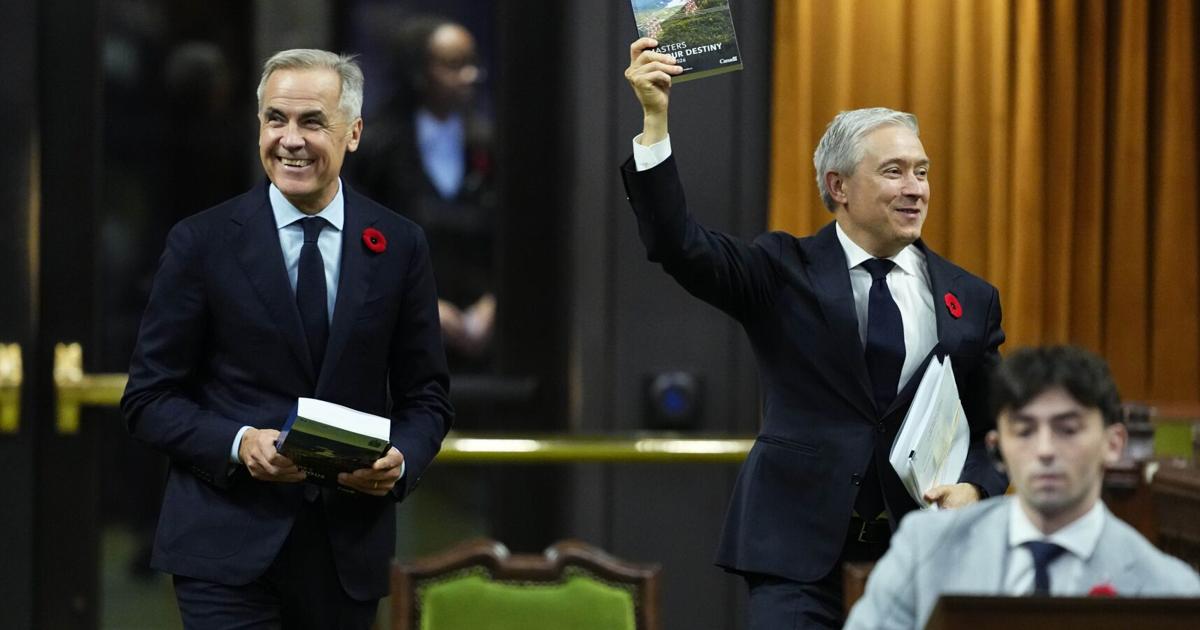
Minister of Finance and National Revenue Francois-Philippe Champagne and Prime Minister Mark Carney arrive in the House of Commons on Parliament Hill on Thursday.
This is the Friday, Nov. 6 edition of First Up, the Star’s daily morning digest. Sign up to get it earlier each day, in your inbox.
Good morning. Friday is the opening day for The Royal Agricultural Winter Fair, which has run every fall (despite its name) in Toronto at Exhibition Place since 1922. In fact, the Coca-Cola Coliseum, the current home of the Marlies, Sceptres and Tempo, was purpose-built to hold the livestock exhibition. To get there this year, a couple of goats named Sugar and Spice rode the GO Train.
As you might hear them say around the cattle pens at The Royal, let’s mooooooove along.
Prime Minister Mark Carney’s 2026 budget contains an $11.2-billion fund to “end” homelessness, billions in new funding for Indigenous infrastructure and supports, and a boost in tax benefits for low-income workers and families. “We’re focused on affordability. We’re focused on opportunity. We’re focused on sovereignty for Canada,” Carney said Thursday afternoon. The budget also presses forward with massive tax breaks for businesses, and introduces a host of new cultural initiatives, even as the deficit will remain at $62.3 billion. Tonda MacCharles and Alex Ballingall have the details.
A Waymo car by Broadview and Erindale Avenues in Toronto on Tuesday.
Is this going to be more like “The Jetsons,” or like “Blade Runner”?
That’s a question I ask myself whenever a new long-heralded technological advance finally arrives. When I was a kid, pop culture was full of futurist visions of what the 2000s (and beyond) would look like: flying cars, jet packs, talking appliances and teleportation machines. Some, like in “The Jetsons,” portrayed a happy utopia. Others, like in “Blade Runner,” foretold a dystopian hellscape. Artificially intelligent, self-aware robots might look like Data from “Star Trek,” or they might look like the T-1000 from “Terminator 2.” Our technology might serve us. Or it might demand that we serve it. Or just try to kill us all.
Then the inventions arrive, in some form or another. We’re still waiting on flying cars (though Elon Musk is apparently working on it). But we have wireless phones similar to communicators in “Star Trek,” robot vacuums that look nothing like Rosie in “The Jetsons,” and delivery apps that mimic the laziness (if not the speed and technology) of the “Star Trek” replicator.
And now we have self-driving cars. Tech company Waymo started testing its self-driving vehicles on Toronto streets this week, ahead of a planned launch of its entirely driverless taxi service here in 2028. It’s new to Toronto, but not untested: The service is already in operation in San Francisco and a bunch of other U.S. cities. I have never ridden in one. But I’ve seen driverless cars: in “The Jetsons,” “Total Recall,” “Knight Rider,” “Maximum Overdrive.” There’s a whole range of possible outcomes of the technology there, from the liberating to the horrifying.
Here in the real world, reviews from cities where it exists are more reassuring than you might expect, at least when it comes to safety. They were involved in 68 per cent fewer crashes than human drivers, according to a U.S. insurance industry study. A lot of customer reviews seem to like the novelty but complain about the price. But there are concerns beyond that about their widespread use, including the number of cars just driving around on the road empty and looking for passengers, and the effects on the livelihoods of drivers of traditional taxi, ride-hailing and delivery services. (The stability of driving careers is already precarious, as the delivery drivers who organized a labour uprising this week demonstrate).
But when I step back from the specifics, I’m still left wondering: “The Jetsons” or “Blade Runner”? Which future is this leading us closer to?
What do you think? Are you excited about a robot-driver future, or are you afraid of it? Are your primary concerns about safety, employment, a general shift to automation, or something else? What questions should we be asking as Waymo tests these cars on our streets? Let us know in the comments section here.
Abiran Thevarajah owns Crown & Clippers in Scarborough.
“I’m surprised they’re still talking about privatizing airports. No one wants that. Please listen to Canadians and the experts who say there is nothing to be gained there.” — Nicholas
“What happened in the U.S. on Tuesday should be a warning, it was the economy that was the beginning of the end for MAGA.” — Beatriz
Before you go: I enjoyed reading John Semley’s report on the unbridled joy in Philadelphia over the Blue Wave midterm election results. As it happens, six years ago today I was on the street in Philadelphia to witness the reaction when the 2020 election was finally, belatedly, called, indicating a Trump defeat. “The entire street seemed to erupt in giddiness,” I wrote back then about a protest suddenly transformed into a dance party. “A grey-haired Black woman next to me in the crowd pumped her fist in the air over and over again, spinning around, her eyes filled with tears.” The more things change…
Correction: In Thursday’s First Up, I talked about what would happen if Ontario stopped turning back the clocks and adopted permanent daylight time, as some other provinces have. But I mistakenly used the phrase “permanent standard time” instead. Adopting permanent standard time (as some experts suggest we should) would clearly not change the sunrise times on winter mornings, since our winters are already in standard time.
Thanks for starting your day with us. If you enjoy First Up, please share it with a friend. And let us know what you think of the changes we’ve made, and what you’d like to see. Email firstup@thestar.ca. I’ll see you back here Monday morning.