Toronto crime is at historic lows. Here are some of the reasons why - Toronto Star
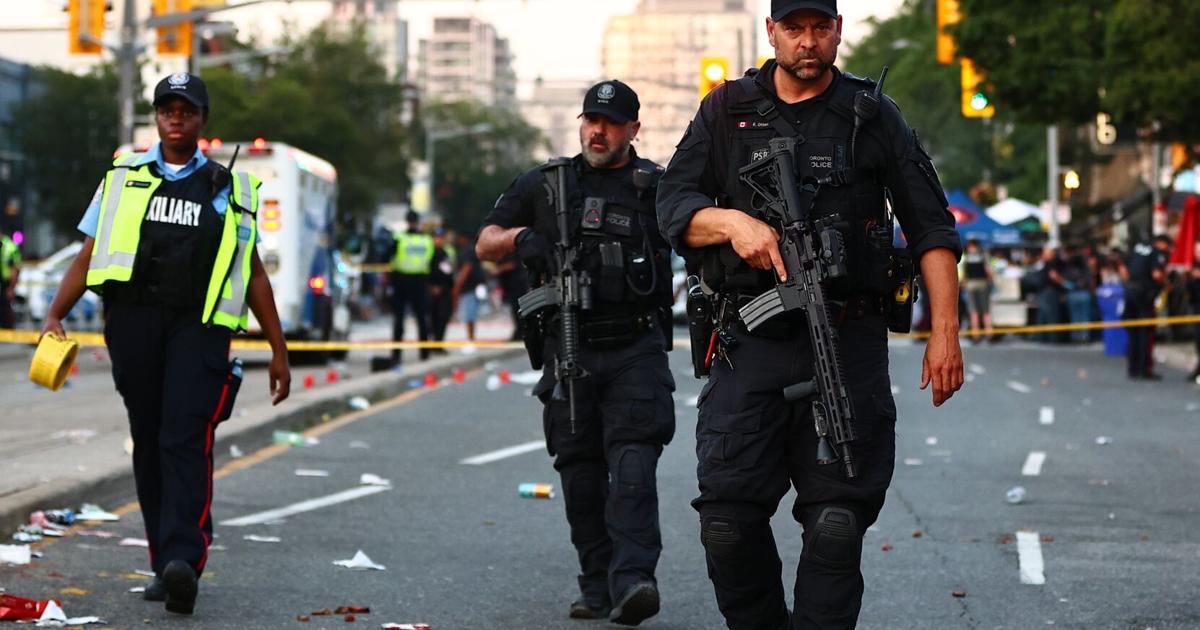
The Star talked to a number of experts and looked at several data points to try to determine why crime rates have fallen. Here's what we found.
While homicides and shootings were down, remarkably, in 2025, along with several other crimes to varying degrees, they are at a similar pace in 2026 so far, despite some high profile incidents like the Salsa on St. Clair shootings in July.
In the past two years, the number of homicides and shooting incidents are down, in Toronto, across Canada and the United States. The question is, why?
An analysis of Statistics Canada’s Crime Severity Index, police open-data portals and other statistics, shows most major crime indicators steadily falling, and generally falling over time, with the most recent numbers showing historic declines.
While homicides and shootings were down, remarkably, in 2025, along with several other crimes to varying degrees, they are at a similar pace in 2026 so far, despite some high-profile incidents, such as the Salsa on St. Clair shootings in July.
Ask any criminologist, and they’ll say it’s impossible to determine why a crime rate goes up or down in a single given year, but, by studying data over a number of years, trends can be found. The Star talked to a number of experts and looked at other data to try to determine why crime rates have fallen and found some trends, including community-focused anti-violence programs, more time spent alone, an aging population and less alcohol consumption.
Experts say lower crime rates may reflect two social shifts: young people drink less than earlier generations, and many spend more time alone.
According to Statistics Canada, the proportion of Canadians age 12 and older who have not had an alcoholic drink in the past 12 months increased from 23 per cent in 2015 to 29 per cent in 2024. And among adults who are drinking, there is a trend toward drinking less often, with the proportion of adult drinkers reporting that they drink alcohol less than once a month increasing from 20 per cent in 2015 to 27 per cent in 2024. A U.S. study published in the Annals of Internal Medicine, showed that from 2022 to 2024, Gen Z adults displayed the largest decline in any alcohol consumption, around 5 per cent, according to the study and Millennials saw a 17 per cent drop in heavy drinking.
There are some recent studies that show Gen Z is drinking more as they get older, positing that the pandemic might have delayed their consumption and now they may be catching up, but that’s a trend that bears watching.
Statistics Canada reported that Canadians aged 15 to 24 years also saw a large decline in time spent with friends, with a decrease of just over 30 per cent from 1986 to 2022. In the U.S, according to data from the U.S. Bureau of Labor Statistics’ American Time Use survey, people aged 15 – 29 spent about 45 per cent more time alone in 2023 than in 2010.
“We also look at what is referred to as the routine activities theory. And there’s a lot of evidence that the public facing activities of many young people have declined,” said Scot Wortley, a professor of criminology at U of T. “Young people are not out in public and are not engaged in face-to-face social activities as frequently as they once were, that’s going to reduce the opportunities for violent crime.”
It’s unclear what’s driving people to drink less, but it does lead to less impulsivity among young people, which could have a broad affect on certain crimes.
A global downward trend in crime is also reflected in Canada. 672 homicide victims were reported nationally in 2025, down 125 from 2024 — the largest year-over-year decline in roughly 40 years, dropping the national homicide rate to its lowest since 2014, according to Statistics Canada Police Reported Crime in Canada 2025 report. The Crime Severity Index, which measures crime volume relative to population, also dropped 4.9 per cent in 2025, another indicator of overall crime lowering across the country.
One of the reasons cited was a sharp drop in gang-related homicides nationally, from 155 in 2024 to 119 in 2025, and gang related homicides involving a handgun fell 39 per cent from 79 to 48.
Toronto police responded to gunfire at the Salsa on St. Clair street festival on the evening of July 11, which killed two and injured five.
In 2025, Toronto ended the year with 45 homicides, the lowest number in 50 years, and 2026 is trending to be even lower, with 30 for the year so far.
Toronto Police Chief Myron Demkiw has always been cautious when asked about statistics, as he’s usually asked after a particularly brazen or tragic crime. He was asked about the lower crime statistics at a press conference after the Salsa on St. Clair shooting.
“There’s no one single thing that drives them up and there’s no single thing to drive them down. What I can say is that we are more integrated today than we’ve ever been in our history in our efforts from neighbourhood perspectives,” he said.
“We are able to target the most prolific offenders more effectively today than we have been in the past,” he said.
In an interview with Newstalk 1010’s John Moore, Demkiw chalked up the success to more cops on the streets.
“Our shootings are at the second lowest number...they have been in 20 years,” he said. “What causes shootings to go up and down, what causes young people to pick up firearms and shoot at each other, or other people, is a complicated bit of work. But you know what I will say, John, when you look at the charts, you can’t help but see some connectivity to the multi-year hiring plan and our ability to put cops where they need to be.”
This was echoed by the Chief Superintendent of Detective Operations, Joe Matthews.
“We have our public safety response team, deployed intelligently throughout the city to prevent crimes (and) a centralized shooting response team that we started in 2019. Since that time, shootings have decreased,” Matthews told the Star in an August interview.
That doesn’t explain why the number spiked in 2024 — with 85 homicides — but Matthews believes that since the number has come down, that year was the outlier.
“It’s a significant drop because 2024 was a significant increase. Since 2019, if you remove that year — I know we can’t because people were victimized — but we are trending down.”
In 2025, Toronto police made the most arrests it had made in a year — over 32,000 — since 2014, another year that had a remarkably low crime rate.
The nature of crime in the city could be changing, like the recently exposed gun-for-hire gangs, who have been targeting properties like buildings and homes, as opposed to people.
The marked drop in homicides and shootings in 2025 that continues into 2026 isn’t just happening here. It’s a North America-wide phenomenon, and in the U.S., the recent lower crime numbers are being tracked and examined by the Council on Criminal Justice (CCJ), an independent and non-partisan organization that is trying to influence criminal justice policy.
As one of their recent reports, “What’s Driving the Drop in Homicide? How Low Might It Go?” states: “After a historic surge starting in 2020, the homicide rate in the United States has declined sharply. Over the past three years, homicides have fallen by an average of 16 per cent per year; this includes CCJ’s finding of a 21 per cent drop from 2024 to 2025 in a sample of 35 large cities. If a similar decline is reflected in national data, the U.S. homicide rate in 2025 would be the lowest observed since at least 1900.”
Ernesto Lopez is the senior researcher at the CCJ and he points out that similar to what we are seeing in Toronto, there have also been declines in other crimes, across the country, pointing out that robberies have also generally been falling for years across the U.S. as a specific example.
“In the U.S. homicides were really declining already. There are some exceptions, a few years jumping up, but I think that’s important because it sort of demonstrates that there are some long-term forces potentially such as an aging population, which are lower risk of committing homicide,” said Lopez.
Raju Mudhar is a Toronto-based reporter for the Star covering breaking news. Reach him via email: rmudhar@thestar.ca