Tokyo is being reshaped by a historic real estate boom - The Business Times
For years, property prices barely budged; renters could expect their costs to never rise. That era is now over
[TOKYO] The district of Katsushika seems typical of Tokyo’s unglamorous east side at first glance: a jumble of old and new shopping streets, narrow alleyways, a few gardens and temples.
Ageing workshops and factories show the area’s industrial roots. The Tokyo Detention House, which houses high-security inmates and execution facilities, looms along the Arakawa river.
It is now the unlikely epicentre of a historic property boom that is reshaping the Japanese capital.
Rents in Katsushika, one of Tokyo’s 23 wards, have surged 23.9 per cent in five years, the most of anywhere in the city, according to a Bloomberg analysis of exclusive data from property portal estie. That comes after decades where prices barely budged throughout Japan’s long battle with deflation, and a renter could expect their housing costs to never rise.
That era is over. Rents are heating up across Tokyo, particularly in the historically industrial, working-class east side, Bloomberg and estie’s analysis shows, as residents reconsider the deepening costs of living in the more desirable and upscale west.
In sales, used apartments – traditionally snubbed in favour of houses or new builds – have jumped nearly 70 per cent in two years to sit at average highs of over 120 million yen (US$760,000), despite some recent moderation. The sticker shock is especially jarring in a country still unaccustomed to inflation.
The real estate boom is also drawing foreign investors, private equity and speculators at a rate not seen in decades, heating up activity in the once-sleepy market to a level more akin to other global financial capitals.
In a recent report, UBS said that the price-to-income ratio for a skilled service worker to afford an apartment in central Tokyo outstrips Paris and London, and is second only to Hong Kong. It is also the only city measured, alongside Zurich, that faces “high housing bubble risk”.
As soaring prices push residents to overlooked areas of Tokyo, their arrival is changing the character of the capital.
“Japan is beginning to follow the path taken by Western nations, and I believe Tokyo stands at the threshold of gentrification,” said Shinichi Nishioka, chief senior economist at the Japan Research Institute, a think tank.
Shin-Koiwa in Katsushika is a stark example. Though it is just a 20-minute train ride to Tokyo Station and its surrounding business areas, its appeal had long been marred by perceptions of crime and a history of red-light businesses.
Now, its shopping arcade, or “shotengai”, has been updated with chain stores, and nearby are clusters of new apartment complexes. If the local government is successful, even more redevelopment is on the way, including a massive stadium.
In a small street off the arcade, Tetsuya Shimono has run his bar Chairs for some 18 years, creating videos on YouTube on Shin-Koiwa’s history and urban legends on the side. He said that he has seen more young families moving in, drawn by Katsushika’s generous child-raising allowances, as well as foreigners.
“People who move here from the west often tell me it’s a very easy place to live,” he noted. “I hear a lot of people say rent was the reason they came here.”
There are less-welcome effects, too. Shimono laments how independent businesses – a rice cracker store owned over generations, old coffee shops – are being pushed out as property prices rise. “Lately, even here, people are saying it’s expensive.”
When land prices collapsed after Japan’s economic crash, owning a home in a centre-west Tokyo area was not out of reach for a middle-class earner. Property stopped being seen as an asset class that only appreciated, and earthquake risks further reinforced the idea that structures were temporary.
In a phenomenon known as “toshin kaiki”, or return to the city centre, more people gravitated back toward central areas as rents and land prices came down, said Kojiro Sho, an associate professor of urban engineering at the University of Tokyo.
Now, on top of the return of inflation feeding into steeper construction and management costs, speculative investment and foreign interest in new developments are further fuelling the real estate boom.
While wages have been increasing, they have not kept up with inflation. Toshiaki Nakayama, fellow at property portal Lifull Home’s Research Institute, said that now, only “power couples” – a socioeconomic marker referring to couples who make a combined 20 million yen annually or more – or people working at select major companies with generous housing allowances can afford to live in central Tokyo.
Bloomberg and estie’s analysis shows that someone earning a typical early-career salary of five million yen per year would now find it nearly impossible to rent in central Tokyo. That income would allow for living around 33 train stations, a plunge from the 142 they could have picked from in 2020.
For an income of four million yen per year – considered a decent graduate salary – the number of train stations they could live nearby is now zero.
More people are being pushed east or even to neighbouring prefectures as a result.
The reshaping of Tokyo’s east side mirrors, to some extent, the same gentrification process that transformed places like London’s East End or parts of Brooklyn. But the trend in Tokyo is all the more notable given the psychological and historical reasons behind the geographic division.
Along Tokyo’s west is the Musashino plain, where firmer and higher ground is seen as more resilient to earthquakes and flooding. To the east are the lowlands, cut through by rivers that enabled the ferrying of goods from industrial hubs, along with the danger of flood and liquefaction.
Brothels and execution grounds were also once mostly consigned to that side, feeding an undesirable reputation. The stigma deepened in the years after World War II when the heavily bombed lowlands filled with slums and factories, while the rest of the capital recovered and western neighbourhoods housed the more affluent classes.
Nowadays, some of that spectre has been lifted by better disaster infrastructure and transport.
Among those shifting across the divide is Yukarino Ishimoto, a 26-year-old graduate from an elite university working as a consultant at a Big Four firm. Having grown up near the western neighbourhood of Jiyugaoka, known for its ersatz European vibe, she never expected to be living on Tokyo’s east side.
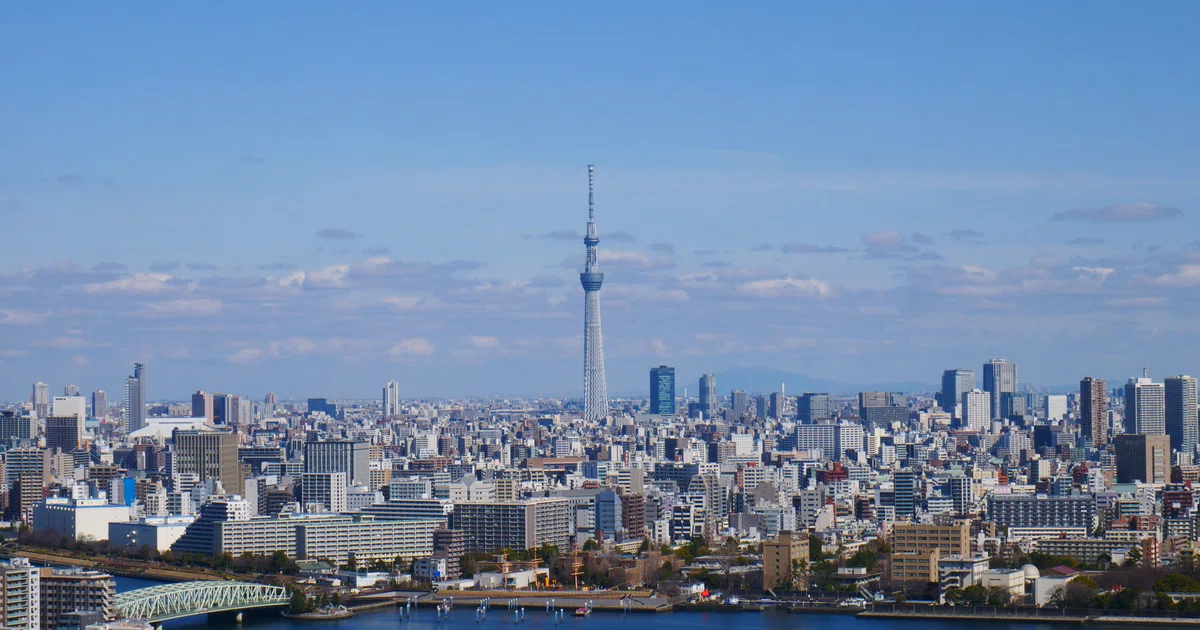
Feeling shocked at how high rents were in the capital’s prime residential districts, Ishimoto and her boyfriend, who works in finance, decided to settle in Oshiage, where Japan’s tallest tower Skytree is located. The area is famously portrayed in the movie Perfect Days as the home base of the protagonist, who cleans public bathrooms belonging to the Tokyo Toilet architectural project – all located in the west.
But there is more than just price that is attractive in Oshiage. “My boss actually lives there too, so I think there’s more than affordability that brings people out east,” she added.
East-side neighbourhoods like Oshiage are known for their “shitamachi” vibe – a feeling of nostalgia and community – that is increasingly attracting young people looking for something different to the more polished west.
Another major draw is the relatively easy commute to offices in major business districts such as Marunouchi or Nihonbashi, home to major banks and corporations.
“The area’s developed from a typical ‘shitamachi’ to a commuter town for young people,” Ishimoto explained.
The new residents in the east will deepen the process of gentrification that has been in place for at least a decade.
In 2015, Blue Bottle Coffee opened its first shop outside the US in Kiyosumi-Shirakawa, a riverside area known for its temples and Japanese garden. Now, the broader Koto ward is chock-full of Antipodean-themed coffee roasters. A visitor lucky enough to snag a seat at the area’s outpost of Koffee Mameya can spend as much as 12,000 yen for a coffee-tasting course, served by a barista wearing a lab coat.
“This street used to be full of old people visiting graves at the temple,” said Nobuo Takahashi, an elderly owner of a shop in the area selling candy and trinkets, wearing a samurai wig. “The other original shop owners have passed away and had no one to inherit their shops. It’s refreshing that young people have come in.”
Bloomberg and estie’s analysis already categorises Koto as an area of both high rent and high growth.
“I think these will be the next ‘nice places’ for people to live,” said Jorge Almazan, Keio University associate professor and co-author of Emergent Tokyo. “People are going to have to try and find better compromises.”
The Tokyo ward that posted the second-highest rent increase in the past five years is Adachi, at 17.7 per cent. There, the neighbourhood of Kita-Senju, which was the cheapest property in the local edition of Monopoly, is luring new residents due to its good connectivity.
Five rail lines converge at the suburb’s train station, which has been revitalised as a major rail interchange. Dive bars around the station have acquired a cool retro flair and the streets are thronged with young people.
Kita-Senju is now sought after by new-graduate professionals, university students and couples, said Shiro Nishino, area manager at rental agency Able. He shared that he has received mounting rental management requests as prices in central Tokyo have soared.
The worry now is that as prices continue to rise, more and more areas in Tokyo will become too expensive to sustain the sort of diversity of businesses and residents that sets it apart from other global financial capitals.
A city block in the large entertainment and business hub of Shinjuku, for example, might house businesses spanning a wine bar, a mom-and-pop vegetable shop, a sleek boutique, as well as family homes, all within steps of a train station.
“If Tokyo were to lose its defining characteristics, the city itself would lose its authenticity,” said Prof Sho of the University of Tokyo.
“Tokyo could become increasingly homogeneous in global terms, becoming harder to tell apart from places such as New York, London or Singapore, and ultimately eroding the appeal and character that give the city an edge internationally.”
Policymakers, newly confronted with the problem of unaffordability, are in the early stages of formulating responses. But while other countries have enacted forceful responses such as rent controls or crackdowns on Airbnb properties, Japan’s approach is narrower.
Chiyoda ward, the political and economic heart of the capital, last month asked developers to ban reselling condominiums within five years of purchase. In March, loan amount and floor area requirements were relaxed to increase accessibility to a government-backed mortgage programme, while the Tokyo government plans to expand affordable housing.
Despite some signs of moderating sale prices in the past few months, costs are still creeping up. East side prices still have room to trend higher; in Kita-Senju, average rent of 120,907 yen for 328 square feet in 2025 is still at the lower end in Tokyo, especially for somewhere with good connectivity.
“One concern is that rents are continuing to rise,” said Able’s Nishino. “We feel that price might be becoming a major obstacle, with more people thinking they want to live in Kita-Senju but budget-wise, they can’t.”
As the property boom holds, already visible are the places and people being left behind. Back in Katsushika, Yoshiaki Suga, a printing shop owner who has lived in Shin-Koiwa his whole life, reflects on when the old shopping street was filled with housewives shopping, or students dropping into their favourite stationery shop after school.
He knows that change is necessary for survival, but cannot help feeling a sense of loss. “It’s a kind of Showa-era nostalgia,” he said, referring to the period encompassing the post-war boom years. “It’s sad to see those memories gradually disappear.” BLOOMBERG
Decoding Asia newsletter: your guide to navigating Asia in a new global order. Sign up here to get Decoding Asia newsletter. Delivered to your inbox. Free.
China Investment Corp, PGIM’s 50% stake in Nex mall up for sale; asking about S$1.2 billion
Higher rates, weaker spending: Is the Philippines entering stagflation?