Students can qualify, but cannot pay: Doctor on why private MBBS seats lying vacant
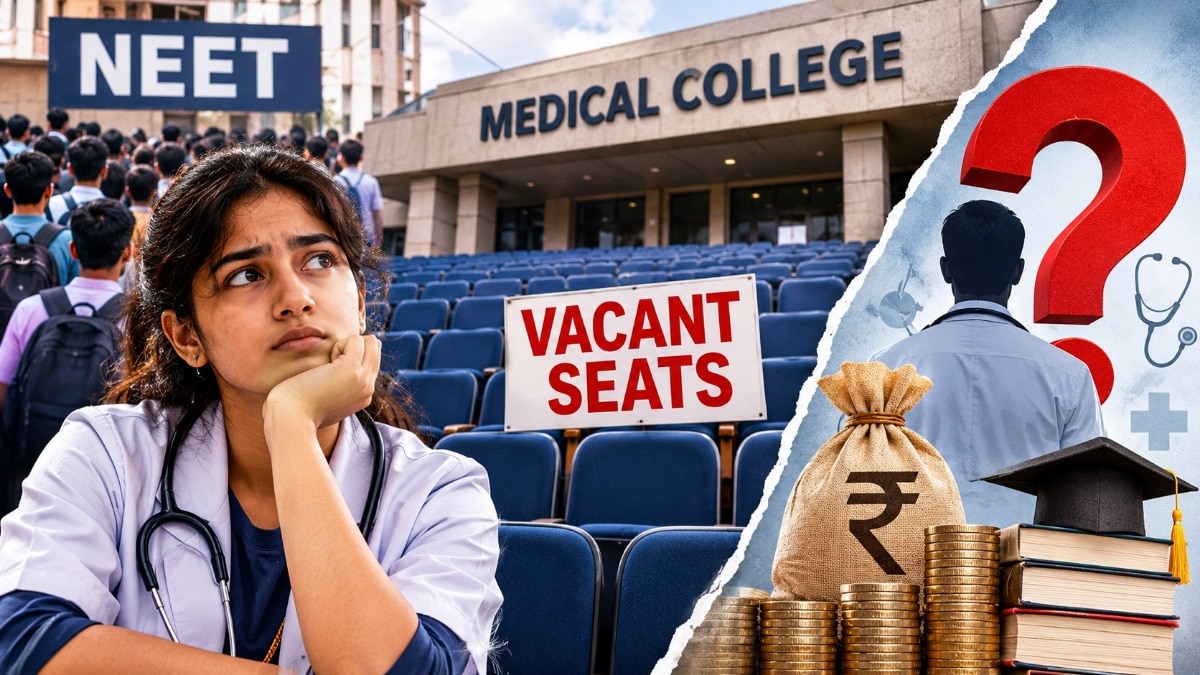
India's medical education system is facing an unusual contradiction. As many as 3,426 MBBS seats remained vacant after the third round of all-India counselling for NEET UG 2026. The vacancy number last year was 802 at the same stage, but this year it is five times more. Even after the stray vacancy round, 837 seats reportedly remained unfilled across Tamil Nadu, Puducherry and Karnataka.
In a post on X, Dr Sumer Sethi, radiologist, medical educator and founder of the Delhi Academy of Medical Sciences (DAMS) said that the vacancies have prompted some private medical colleges to offer tuition fee discounts of up to 40% to attract students.
This is happening in a country where nearly 20 lakh candidates appeared for NEET UG 2026, competing for around 1.4 lakh MBBS seats.
So, are young Indians losing interest in becoming doctors, or has the cost of medical education become too difficult to justify?
In the X post, Dr Sethi argued that the dream of becoming a doctor has not disappeared. What has changed, he said, is the financial calculations families make before committing to an expensive medical degree.
"The dream has not died. Every government seat is filled, so the demand is clearly there. What has stopped working is the math," he wrote.
One of the biggest concerns raised by Sethi is the rising cost of private medical education.
According to his post, a private MBBS seat can cost around Rs 1.25 crore when tuition, hostel, mess and other expenses are considered. The financial commitment does not necessarily end with an undergraduate degree either.
An MBBS graduate looking to specialise must prepare for another competitive examination, secure a postgraduate seat and spend additional years in training. For families financing medical education through loans or savings, this means several more years before their child starts earning a stable income.
"Today's students and parents work this out openly at the dining table. A generation ago, the white coat was reason enough to sign up," he wrote, arguing that today's aspirants are increasingly weighing the financial returns against the investment.MORE SEATS, BUT NOT MORE AFFORDABLE
India has expanded its medical education capacity considerably. The National Medical Commission approved 13,636 additional undergraduate medical seats in 2026, taking the total to over 1.4 lakh.
However, the expansion has largely been driven by private institutions. More than 75% of newly approved MBBS seats over the last three years have gone to private medical colleges.
The revised MBBS seat matrix has brought the total number of seats to 1,27,028 across government and private medical colleges, following the addition of 13,636 seats. The updated data covers 839 medical colleges across the country, including 41 newly established institutions (announced in October 2025) that have added another 3,850 seats. Here is a breakdown of the revised seat distribution.
Private medical colleges account for 46.72% of the total 839 medical colleges in the revised matrix, but offer a much larger share of MBBS seats. Together, the 392 private colleges have 76,543 seats, making up 60.25% of the total 1,27,028 MBBS seats. In comparison, 447 government medical colleges account for 64,121 seats, or 50.48% of the total.
In simple terms, although government colleges are more numerous, private medical colleges offer nearly 12,400 more MBBS seats than government institutions. This means that nearly 7 out of every 10 MBBS seats in the country are in private medical colleges.
The trend is also visible among newly established institutions. Of the 41 new medical colleges, 28 are private, accounting for 3,000 of the 3,850 newly added seats. This means private institutions contribute nearly 78% of the seats in the new colleges.
This has created an important distinction between the availability of medical seats and their affordability.
Government medical college seats remain highly sought after because their fees are substantially lower. Private and deemed universities, meanwhile, can charge annual tuition fees running into tens of lakhs.
India Today's earlier analysis of medical education also highlighted how high private fees, uneven seat distribution and limited affordable options continue to make MBBS admissions difficult, even as the number of colleges and seats increases. (Photo: Screengrab/X/DrSumerSethi) advertisementWILL FEE CUTS SOLVE THE PROBLEM?The current vacancies suggest that simply increasing medical seats or lowering NEET qualifying cut-offs may not be enough.
Sethi argued that students are already qualifying for medical admissions but are unable to afford several private seats. He called for stronger fee regulation, more government medical colleges and a clearer route from undergraduate medical education to a sustainable income.
Medicine remains a sought-after profession, but the financial commitment required to enter it is becoming a serious consideration for families.
As Sethi put it: "You can't sell a Rs 1 crore degree on passion alone."
The question, therefore, is not whether India's young generation still wants to become doctors. It is whether the country can make that ambition financially possible for more students.- EndsRead | More than 800 MBBS seats vacant after final NEET UG round. Are high fees a barrier?Read | Medical college seats are at a record high. So why is competition still so hard?Read | More MBBS seats, deeper problems: Access, cost, quality still hold students back