
Say cheese, again: Why can’t Gen Zs get enough of photo booths? - The Straits Times
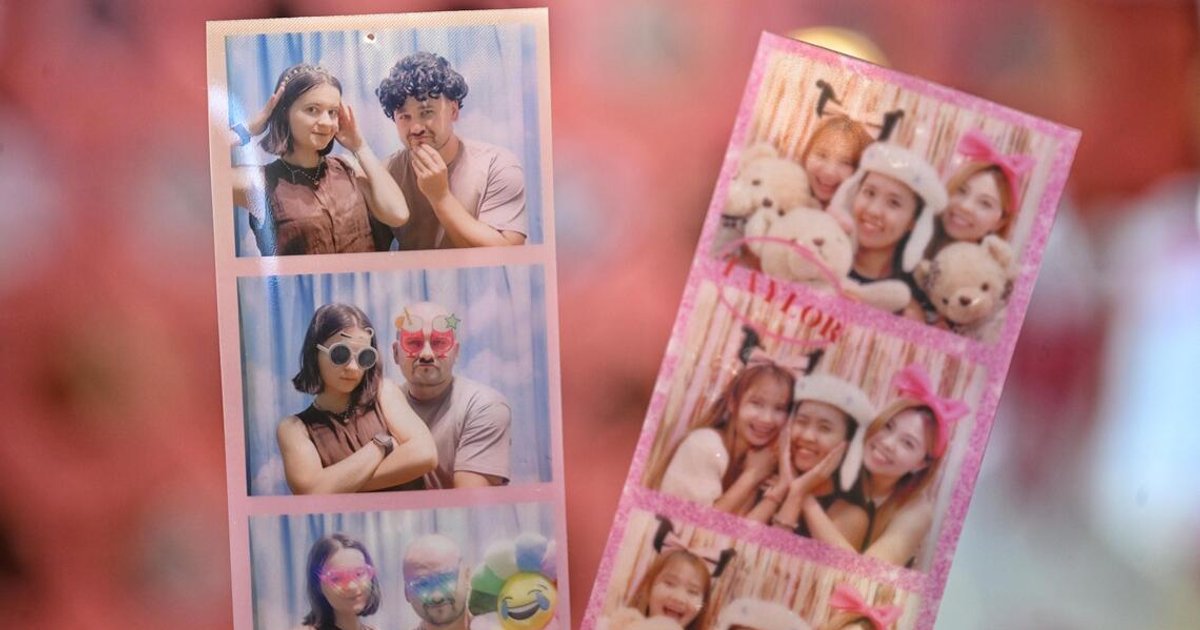
Self-photo studios have become a go-to hangout for young Singaporeans, who pay about $10 a session to take home printed photos.
SINGAPORE – From Neoprint stickers in the 2000s to themed self-photo studios today, the humble photo booth keeps coming back, and Gen Z is leading the queue.
When Keith Kok visited South Korea in 2022, he found photo booths almost everywhere he turned.
“Every 50 to 100 steps, I’d see one,” says the founder of photo-booth chain Solace Studios, now 25, who ended up visiting one every day of his week-long trip.
“When I came back to Singapore, I realised there weren’t many of these photo booths,” he says. “Four years ago, we had only self-photo studios, where you had to make a booking, then you had 15 minutes to take all the shots. It wasn’t a walk-in service like the ones in South Korea.”
At 21, he decided to start his own company offering exactly that. “It was something that I enjoyed doing, so I wanted to let others experience it.”
It took three months to get the first shop ready, including a month of renovations. Solace customises its booth exteriors in China but sources components such as cameras and printers locally.
Solace Studios founder Keith Kok (right) with his father and co-founder Noelle Kok. Keith started the business at 21 after a trip to South Korea.
His father, Solace’s co-founder, was unsure at first. “He asked, will it work? It’s only $10, how are you going to earn money from it?” says Kok. “But he also asked me how confident I was. I told him I’m sure it will work. I think after hearing that, he decided to trust me.”
Together, they put in about $75,000, half from Kok’s savings. His father, Noelle Kok, pawned a luxury watch to fund the other half.
When Solace Studios opened in Haji Lane in 2022, people queued for one to two hours for a shop with only three booths. “I didn’t expect that, because people were queueing in the hot sun just to take their photos,” the younger Kok recalls. With no budget for new air-conditioning, the team put a standing fan in each room.
Today, the brand has become ubiquitous, with about 20 locations, including pop-ups – and has plenty of competition.
Self-photo studios have mushroomed across Singapore, from Haji Lane to Orchard Plaza to even suburban malls, with many charging around $10 a session. Checks by The Straits Times showed there are at least 25 companies offering such services.
It is a revival of sorts, recalling the 2000s, when teenagers squeezed into Neoprint booths after school to make decorated sticker photos. But today’s studios are bigger and bolder, swopping plain backdrops for elaborate themed sets, from a lotus pond bathed in golden-hour light to a real car fitted with a robotic camera arm.
The elevator booth (left) was Solace Studios’ first themed booth. When it opened in Haji Lane, people queued for up to two hours, and it has since become the brand’s signature. On the right is a business class airline cabin themed booth.
Prints now range from classic strips to translucent film and stickers. Some booths have even dabbled in artificial intelligence, turning guests into cartoon versions of themselves, though these are mostly hired for corporate events, says Kok.
He is, however, firmly against the idea of bringing AI into his booths, believing it would undercut both the art and the photos. Solace releases new frames for its photo strips every month, each drawn up by an in-house designer. Kok says of AI: “For frame design, it would really insult my designer. And I think it kind of kills the meaning of photos.”
For him, the appeal of a printed photo is simple. “It was taken within that moment. You can’t retake it or try to perfect it, and I guess that’s the beauty of it,” he says. “When you hold the physical photo and look back at it, it brings back a lot of memories.”
Samer El Hajjar, a senior lecturer in marketing at the National University of Singapore’s Business School, believes photo booths as a trend reflect a shift towards spending on experiences. “Many people assume photo booths are competing with smartphones, but I don’t think that’s the case. Smartphones help us capture moments, while photo booths help us create them,” he says.
“We are seeing many young consumers spend more on activities that create memories rather than simply buying products. A photo booth is not really selling a photograph. It is selling a moment, an experience, and something people can share with others.
Finished photo strips at Another Booth.
“Ironically, as our lives become more digital, physical keepsakes can become more meaningful because they feel rare and tangible.”
He adds that unlike on social media, where there can be pressure to look perfect, photo booths tend to encourage playfulness and spontaneity. “In a world where almost every moment can be photographed, experiences that feel intentional and memorable become more valuable.”
For Anthea Lee, 19, a third-year law and management student at Temasek Polytechnic who rates photo booths on TikTok, these studios mean something more personal. She visits them at least once a month, and once a week if she can convince her friends to go along.
Anthea Lee, 19, rates photo booths on TikTok, judging them on camera quality, lighting and ease of use.
“When I was really young, I really enjoyed being in front of the camera. However, people did not have nice things to say about my looks when I was growing up, so I started shying away from the camera,” she says. “Taking my first solo booth portrait gave me a shot of confidence I hadn’t felt in a long time.”
She also sees it as a creative outlet. “Many Gen Zs bury our artistic sides to study accounting, science and engineering. Photo-boothing has become a way for my artistic side to be expressed in 10 minutes,” adds Lee, who has visited 10 photo booth studios in Singapore so far.
Her photo strips have become decor on her bedroom wall, alongside Polaroids, postcards and letters.
Anthea Lee's bedroom wall of photo strips, Polaroids and letters.
“I kind of think of my wall as a myriad of everyone who has ever loved me and everyone I have ever loved,” she says.
The growing number of studios has brought challenges. In December 2025, Solace closed its first outlet at 30 Haji Lane after rent went up and competition opened nearby.
“It doesn’t make sense for us to continue there, when we can open a new and bigger outlet in a mall,” Kok says. Solace still runs two other outlets in Haji Lane.
El Hajjar expects some studios to fall by the wayside despite strong demand. “Studios that reply solely on having a camera and a backdrop may struggle. The winners will be those that create a distinctive experience,” he says.
Customers choosing frames for their Neoprints at Haengbok Studio.
One studio that has found its niche is Haengbok Studio, whose Neoprint booth Lee singles out as a highlight. “Choosing frames with your friends and drawing on the photos adds an extra layer of activity, which makes Haengbok somewhere you take more of a pause at,” she says.
In a crowded market, Haengbok has set itself apart by looking back rather than forward. Entrepreneur Jerry Wong, 34, who runs the business with his wife, developed his own Neoprint machine instead of competing on elaborate themed rooms.
“I’ve always had a soft spot for Neoprints, and felt it would be nice to bring back that nostalgic experience in a way that could appeal to both the older generation and younger customers today,” he says. “I spent some time researching and designing the overall outlook of the machine.”
Jerry Wong, 34, owner of Haengbok Studio, with his Neoprint machine.
The gamble paid off. After closing its first Haji Lane store in February, Haengbok opened two stores, in Joo Chiat and Chinatown, each pairing photo booths with a gift shop.
“Ultimately, I hope Neoprints can connect different generations through a shared experience, and stay around for many years to come so they won’t simply disappear with time,” Wong says.


