São Paulo governor downplays Flávio’s isolation, says would work with Lula - Valor International

São Paulo Governor Tarcísio de Freitas (Republicans), who is seeking reelection, downplayed on Thursday (20) the lack of support from Centrão parties for the presidential candidacy of Senator Flávio Bolsonaro (Liberal Party, PL, Rio de Janeiro), saying the parties prioritized the race for the lower house of Congress in order to expand their federal caucuses.
Speaking during an interview conducted by Valor, O Globo, and CBN in São Paulo, De Freitas said he would have a pragmatic relationship with President Luiz Inácio Lula da Silva (Workers’ Party, PT) if both are reelected, and stressed that Brazil’s electronic voting machines are reliable. An ally of Flávio’s, the governor also defended the impeachment of Supreme Court (STF) justices, provided due process is respected.
The hour-and-a-half interview was conducted by journalists Guilherme Muniz, a CBN anchor, Vera Magalhães, a columnist for O Globo, and Marcello Corrêa, Valor’s politics editor.
De Freitas dodged the question of whether he might run for president in four years, saying 2030 is a long way off. The governor also came out in favor of ending reelection, despite seeking a second term himself in this election.
Outlining his proposals for a new term, De Freitas pledged, if reelected, to expand civic-military schools and hold a public exam to hire permanent teachers for the state school system. He said he would keep the current model for police body cameras, under which recording is activated by officers themselves, ruling out continuous recording. De Freitas acknowledged the difficulty his government has had in reducing femicide, which has risen in the state even as the rate has fallen nationally.
The governor enters the reelection race 15 points ahead of former minister and gubernatorial candidate Fernando Haddad (PT), with 41% of voting intentions versus 26% for the PT candidate, according to a Genial/Quaest poll released in late July. The remaining candidates together account for 5%. The state race is expected to be decided in the first round.
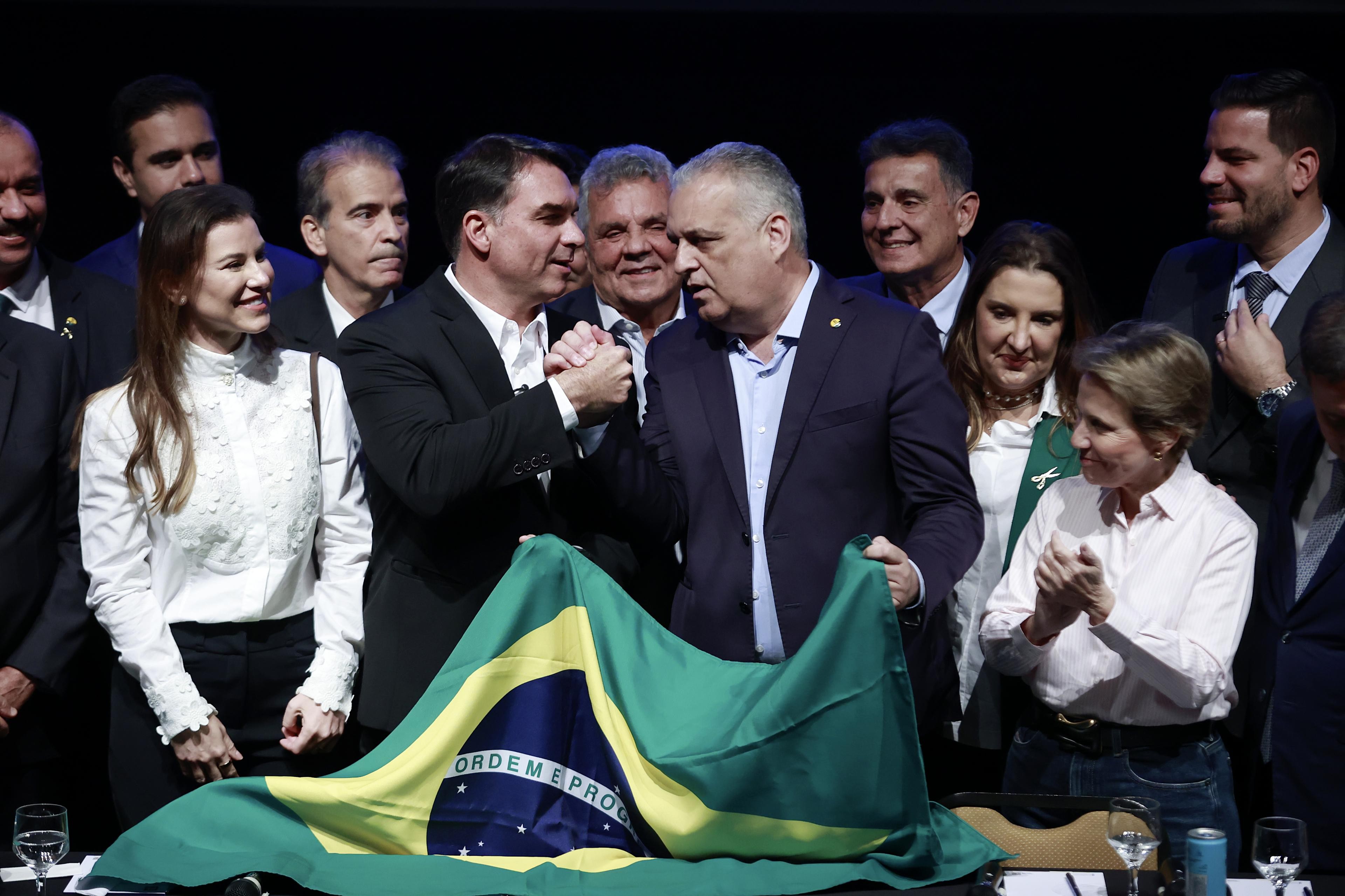
De Freitas built a coalition with 12 parties, including Progressive Party (PP), Brazil Union, and his own party, Republicans. His running mate is Felício Ramuth of the Brazilian Democratic Movement (MDB). Those parties, however, chose to remain neutral in the presidential race and declined to back Flávio Bolsonaro, his ally. At the same time, Centrão leaders such as Chamber of Deputies Speaker Hugo Motta (PP of Paraíba) and Senate President Davi Alcolumbre (Brazil Union of Amapá) have declared their support for Lula’s reelection bid in recent days.
Asked whether that political shift signaled Centrão optimism about his own reelection in the state as well as Lula’s, De Freitas played it down. “The focus of these parties, in the end, is building their caucus, so each party is prioritizing building its bench according to local realities,” he said. “When a party opts for neutrality, it’s the most comfortable choice for the caucus, because the caucus is diverse,” he said, noting that in the Northeast, for example, these parties are closer to Lula, while in the Southeast they are more aligned with Flávio.
A political protégé of former president Jair Bolsonaro (PL), the governor stressed that his campaign would serve as a platform for Flávio in the state. De Freitas also said he would try to show voters that, if the PL senator is elected, alignment between the federal, state and capital-city governments could make it easier to secure funding for the state. “Doors open up and it becomes easier for us to bring in resources. We won’t be stuck at the back of the line,” he said. “We’re going to try to make that case to voters and show that things can be a lot easier once there’s alignment.”
Seen as a potential presidential contender in 2030, De Freitas said he still expects Flávio, if elected, to “honor” his commitment to end reelection by passing a constitutional amendment.
The governor said Flávio’s gesture in signing the constitutional amendment proposal (PEC) to end reelection does not signal an open path for him to run in 2030, “but it does send a signal to the whole group.” “We can’t think about 2030 right now, it’s a long way off, and there’s still a lot of water under the bridge. We have to get through 2026 first, see how the landscape looks, and a lot can happen. If we win this election, we’ll have a term to govern and results that need to be delivered,” he said.
In a scenario in which President Lula defeats Flávio, De Freitas said he would be guided by “pragmatism” and “people’s interests.” The governor cited the Santos-Guarujá tunnel concession, in which there was dialogue with the Lula administration so that the bidding process could be carried out as a public-private partnership (PPP) run by the state government, in order to speed things up.
De Freitas sought to distance himself from criticism of Brazil’s voting system voiced by the Bolsonaro family. Flávio and former congressman Eduardo Bolsonaro (PL) have recently renewed questions about the integrity and reliability of the electronic voting machines. The governor, however, noted that he himself was elected precisely through those machines and said the system is reliable. “I have absolute confidence in the security of the voting machines,” he said. “They’re the ones that elected me,” he said. “That’s not an issue, it’s no longer an issue, and it shouldn’t be.”
At the same time, the governor—a former infrastructure minister under Bolsonaro—showed alignment with one of Bolsonarismo’s main causes, the impeachment of Supreme Court justices, despite having worked in the past to ease tensions between Bolsonaro’s political group and the Supreme Court.
Asked whether he supports impeaching justices, De Freitas avoided naming any and stressed that the debate should not be “personalized.” “We need to discuss the instrument. Is the instrument valid? It is, it exists, is it regulated? It is,” he said. “Can a president of the republic be impeached? Yes, we’ve had two who were. Well, if a president of the republic can be impeached, can’t a Supreme Court justice? Yes, as long as due process is also followed, and that’s a political process, a process that has a venue, and that venue is the Senate.”
During the interview, De Freitas also laid out proposals for a possible new term. On education, the governor said he intends to increase the number of civic-military schools but avoided giving figures and said he would need to consult school communities first. “That depends much more on the communities than on our own will.”
The candidate also pledged to hold a public exam to hire more permanent teachers in 2027 if reelected. “We held an exam for 15,000 teachers, it has been a long time since we’d had one that large. Our idea, already in the first year of the term, is to run another large exam and then smaller ones, but more frequently, to place permanent teachers within the system,” he said. De Freitas said the upcoming exam would not give any “advantage” to those currently working as temporary hires in the public school system. “Temporary staff already in the system have a natural advantage, if only because the exams have changed.”
On education, the governor also said he intends to expand full-time schools. “We ran a pilot in 400 schools, we’re testing it with foreign universities, and we’re going to expand it.”
On public safety, seen as the state’s main problem according to Quaest and Datafolha polls, De Freitas defended the use of body cameras and said he would keep the remote-activation system, despite reports that officers failed to turn on their cameras before shootings, preventing footage of deaths in police operations from being recorded.
The state prosecutor’s office has questioned the lack of body-camera footage in police operations, especially those resulting in deaths. The governor pushed back on the criticism and said that even when the cameras recorded continuously, there were problems.
“Back then we had the same complaint with continuous activation, because often the camera was off, there were claims of dead batteries. When there’s bad intent, people find a way around it,” he said. “Now we’re reducing the chances of that happening because we’ve developed a number of new features. The camera in use here in São Paulo is the same one in use in Paris, the same camera with the same features, including the same supplier.”
The governor said his government would invest in intelligence work to fight organized crime. Asked about the rise in police lethality in the state, he said the government does not want abuses or excesses in police stops but added that “strict adherence to protocols” is necessary.
According to data from the state Department of Public Security, 504 deaths from police intervention were recorded in 2023. In 2024, that number rose to 813. “We don’t want abuse or excess under any circumstances. We’ve been pushing hard at the training academies for strong adherence to protocols. When we compare São Paulo’s police lethality with that of other countries, it’s below some countries relative to the number of stops carried out.”
Asked about the rise in femicide cases in the state, even as the country as a whole has seen a decline in that type of crime, the governor acknowledged the state’s difficulties, but said the government has been acting to reduce the number of cases. “It’s an extremely difficult crime to combat, extremely difficult,” he said.
In the first quarter of this year, the state recorded a 41% increase compared with the same period in 2025, according to data from the state Department of Public Security. There were 86 cases, the highest number for a first quarter since the historical series began. “We’re preventing femicide. No woman who had a protective order, with her aggressor wearing an ankle monitor, has been a victim of femicide. This ankle-monitoring policy has helped a great deal.”
De Freitas also said the state recorded a reduction in crimes such as robbery-homicide and homicide, which he said indicates the government “is heading in the right direction” and “making the state safer,” even though the sense of safety takes time to catch up.
The candidate was also asked about the privatization of Sabesp, one of the hallmarks of his administration, and downplayed the rise in complaints against the company, particularly over higher rates. During the interview, De Freitas said the criticism was linked to the water-meter replacement program carried out by Sabesp in residences. “If you look at the complaints, most of them are about billing, improper charges. A small share is related to service delivery,” he said.
“Another complaint was about the meter swap, which caused rate-related complaints to spike. The complaints have a lot to do with the switch to digital meters,” he reiterated. “The company paused, it’s going to make adjustments, it’s going to improve its communication channel.”
Asked about problems recorded in public transit concessions, De Freitas said the government is reviewing “protocols” and said attracting foreign companies to invest in the sector in São Paulo has not been easy. “We started analyzing the market and expected to bring in a lot of companies and operators. We’re finding it’s very difficult. And we can’t leave the system in the hands of one or two operators,” he said.
De Freitas said the government decided to hand CPTM commuter-rail lines over to the private sector in order to “mobilize investment on a shorter timeline,” citing a deterioration of the train lines. “CPTM was a dependent state-owned company. Over time we saw the lines deteriorate.”
Discussing problems on CPTM Lines 11, 12 and 13, which were transferred to the concessionaire Trivia Trens but were temporarily taken back by the government after serious failures and even a fire early in the concession, De Freitas said “the problems were very serious and the company’s response was very poor.”
“We’re going to review protocols, review training, review response protocols, review a number of things that this urgent operation requires.”
Assessing the national picture, De Freitas said that both President Lula’s team and Senator Flávio’s need to discuss economic plans and lay out a direction for the country in the presidential debate. The governor, however, defended the election of Bolsonaro’s son and criticized the president’s fiscal policy.
“We need to discuss the country, which direction [to take]. On both sides,” he said, referring to the Lula and Flávio campaigns. “On our side, I’ve seen an effort to build a plan. Is anyone really going to believe that Lula, at his age, with his experience, who’s grown accustomed to using fiscal [spending], is going to make an adjustment now?” The governor then said there are assessments suggesting the country is headed toward a recession and that business owners have expressed concern about the economy.
In De Freitas’s assessment, Flávio “represents the change of direction that’s needed” and “knows there’s a path of reform and adjustment to be taken.”
As an example of the problems faced by business owners in the country, he cited retailer Casas Bahia’s recent filing for court-supervised reorganization, although the retailer’s crisis is tied not only to macroeconomic factors but also to management problems and difficulties specific to the sector. “Look at the situation facing Brazilian entrepreneurs, fighting against the wind, doing everything they can to survive, suffering under high interest rates,” he said. “They need direction.”
Despite his criticism of the Lula administration, De Freitas defended one of the federal government’s main economic initiatives, the tax reform, and said the state benefits from the measure. The governor, however, raised concerns about how the reform’s oversight council will operate. “The reform is surrounded by a lot of uncertainty.”
De Freitas said he has taken a different stance from other São Paulo governors, such as Geraldo Alckmin and José Serra, on tax reform, by supporting the measure, and highlighted the benefits of the reform for the state. “São Paulo was in favor of the reform, unlike the role the state played on other occasions, [unlike] what Alckmin did when he was governor, what Serra did when he was governor,” he said during the interview.
“São Paulo is the biggest source of the tax base, but it’s also the biggest consumer market. Destination-based taxation could benefit us. São Paulo benefits from the tax reform. And there’s long-standing market demand for simplification,” he said.
According to De Freitas, “the big question is how the two systems will coexist and how the oversight council will work.” “The oversight council has to be a body that gets things done, not a new Confaz. And the third point is the tax rate, so we don’t end up with the highest VAT in the world,” he said.
De Freitas downplayed the fact that Centrão parties within his support base have remained neutral in the presidential race and have declined to back the presidential candidacy of Flávio. In De Freitas’s assessment, the parties prioritized the race for the Chamber of Deputies, in order to expand their federal caucus.
Asked why the 12 parties supporting him are not backing Flávio, his political ally, the governor said “the focus of these parties is building their caucus.”
“So each party is prioritizing its caucus. When it chooses neutrality, it’s choosing the caucus,” De Freitas said, noting that local chapters of these parties back President Lula, who is seeking reelection, in the Northeast, and back Flávio in the Southeast. “The caucus has been the parties’ priority. Maybe it’s time we discuss political reform,” he said. “These parties are with Flávio in São Paulo. At the national level there was pragmatism at play in campaigning.”
De Freitas described political reform as a “mother reform.” Within that discussion, he said, would be ending reelection to promote alternation of power, as well as improving representation and adopting district voting, with the aim of “promoting greater alignment between politics and society, with the dominant sentiment.”
“We need to create mechanisms and regulate certain things that bring the productive sector, the vital forces, the opinion leaders, closer to decision-making, because, in a way, today there’s a very large gap between the mechanisms that have been created and the sentiment of society,” he said.
He also said that Flávio’s gesture of signing the constitutional amendment proposal (PEC) to end reelection does not signal an open path for him to run for president in 2030, “but it does send a signal to the whole group.”
“We can’t think about 2030 right now, it’s a long way off and a lot of water still has to flow under the bridge. We have to get through 2026 first, see how the landscape looks, and a lot can happen. If we win this election, we’ll have a term to govern and results that need to be delivered,” he said.
In De Freitas’s view, the 2030 race “absolutely cannot be on anyone’s mind right now.” The candidate also said he will try to show voters during the campaign that, if Flávio is elected, alignment between the federal, state and municipal governments could make it easier to bring resources to São Paulo. “Doors open up and it becomes easier for us to bring in resources, we won’t be stuck at the back of the line,” he said.
Still on the subject of Lula, De Freitas criticized the fiscal policy adopted by the PT administration and said he does not believe that, if reelected, the president will pursue a fiscal adjustment. “On our side, I’ve seen an effort to build a plan. Is anyone really going to believe that Lula, at his age, with his experience, who’s grown accustomed to using fiscal [spending], is going to make an adjustment now?” he said. The governor then said there are assessments suggesting the country is headed toward a recession and that business owners have expressed concern about the direction of the economy.
De Freitas also expressed absolute confidence in the electronic voting machines. Amid questions raised by his political ally, presidential candidate Flávio, and the Bolsonaro family about the integrity of Brazil’s electoral process, the governor said this kind of questioning should not be part of the political debate. He nonetheless reinforced his alignment with Bolsonarismo by defending the impeachment of Supreme Court justices, provided the legal process is respected. In this election, allies of the Bolsonaro family are seeking Senate seats on a platform defending such impeachment.
“They’re the ones [the voting machines] that elected me,” he said. “I have absolute confidence in the security of the voting machines. That’s not an issue. It shouldn’t be an issue. We need to talk about other issues,” he said.
On the possibility of impeaching STF justices, one of Bolsonarismo’s main causes, De Freitas said: “if a president of the republic can be impeached, can’t an STF justice? Yes,” he said. “We can’t personalize the debate, we have to discuss the instrument. And the instrument is valid.” The governor reiterated that mechanisms exist that allow for the impeachment of Supreme Court justices. “And they are possible,” he said.
During the interview, De Freitas also said the state benefits from the tax reform and reiterated his support for the measure, but raised concerns about how the reform’s oversight council will operate. “The reform is surrounded by a lot of uncertainty.”
De Freitas said he has taken a different stance from previous São Paulo governors, such as Geraldo Alckmin and José Serra, on tax reform, by supporting the measure, and highlighted the benefits of the reform for the state.
“São Paulo was in favor of the reform, unlike the role the state played on other occasions, [unlike] what Alckmin did when he was governor, what Serra did when he was governor,” he said during the interview. “São Paulo is the biggest source of the tax base, but it’s also the biggest consumer market. Destination-based taxation could benefit us. São Paulo benefits from the tax reform. And there’s long-standing market demand for simplification,” the governor said.
According to De Freitas, “the big question is how the two systems will coexist and how the oversight council will work.” “The oversight council has to be a body that gets things done, not a new Confaz. And the third point is the tax rate, so we don’t end up with the highest VAT in the world,” he said.
De Freitas also defended, during the interview, the privatization of Sabesp carried out under his administration, and downplayed the rise in complaints against the company, particularly over higher rates. According to him, the criticism is linked to the water-meter replacement program in residences.
“If you look at the complaints, most of them are about billing, improper charges. A small share is related to service delivery,” De Freitas said. “Another complaint was about the meter swap, which caused rate-related complaints to spike. The complaints have a lot to do with the switch to digital meters,” he reiterated. “The company paused, it’s going to make adjustments, it’s going to improve its customer communication channel.”
In defending the company’s privatization, the governor said that investment in sanitation in the state increased after the divestiture. Asked about problems recorded in public transit concessions, De Freitas said the government is reviewing “protocols” and said attracting foreign companies to invest in the sector in São Paulo has not been easy.
“We started analyzing the market and expected to bring in a lot of companies and operators. We’re finding it’s very difficult. And we can’t leave the system in the hands of one or two operators,” he said.
De Freitas said the government decided to hand CPTM commuter-rail lines over to the private sector in order to “mobilize investment on a shorter timeline,” citing a deterioration of the train lines. “CPTM was a dependent state-owned company. Over time we saw the lines deteriorate.”
This article was translated from Valor Econômico using an artificial intelligence tool under the supervision of the Valor International editorial team to ensure accuracy, clarity, and adherence to our editorial standards. Read our Editorial Principles.