Rooibos takes flight: 17,346 South African seeds prepare for space mission - IOL
South Africa’s indigenous Rooibos plant is preparing for an extraordinary journey beyond Earth, with 17,346 seeds set to travel to the International Space Station as part of a scientific experiment exploring how space conditions could affect their growth.
From the rugged landscapes of the Cederberg to the International Space Station (ISS), one of South Africa’s most distinctive indigenous plants is preparing to take a giant leap into space science.
The Rooibos in Space initiative has reached another milestone, with 17,346 Rooibos seeds preparing to join South African school and university science experiments on a journey to the US before their planned launch into orbit.
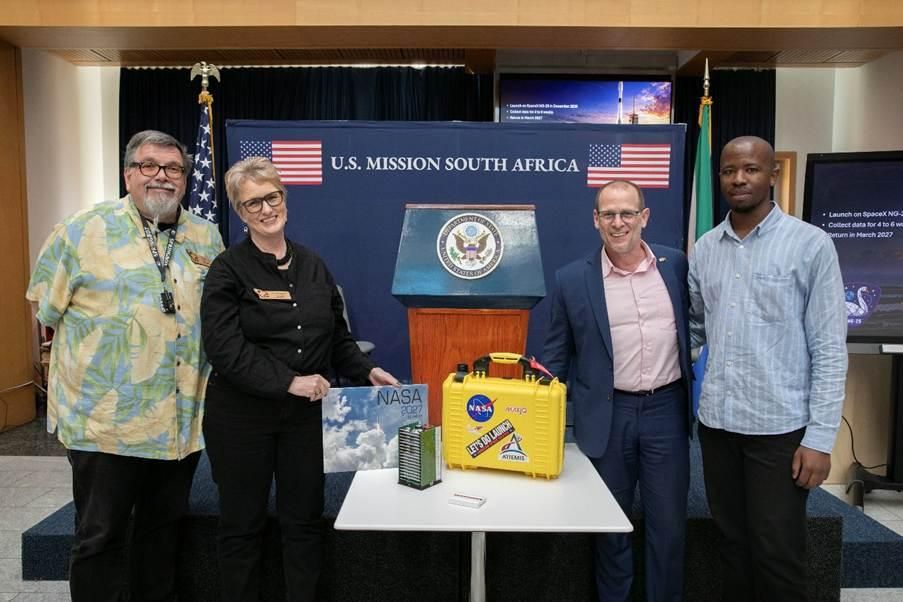
The seeds, weighing approximately 74.2 grams, will travel to Voyager Technologies in Texas, where the experiment will be prepared for spaceflight. The milestone was marked by a farewell hosted by Allison Areias, the United States Consul General in Cape Town.
For a plant so closely associated with South African heritage, the mission offers an opportunity to explore how Rooibos responds to an environment far removed from its natural growing conditions.
The experiment will expose the seeds to microgravity and space radiation before they return to Earth for further testing.
The seeds have been divided into three groups: untreated seeds, scarified seeds and seeds that have been scarified and treated with a protective agricultural coating. Scarification involves weakening or breaking the seed coat to help water enter the seed and support germination.
The different treatments will allow researchers to compare how the seeds perform after their exposure to space conditions.
The experiment will be housed in a specialised Nanolab, a compact, standardised laboratory module designed to accommodate research in space. These plug-and-play units allow experiments to take place without the need for large, custom-built equipment.
The Rooibos Nanolab is scheduled to travel to the ISS aboard the Cygnus NG-25 commercial resupply spacecraft. The mission is currently expected to launch between December 2026 and January 2027, following changes to the Voyager and NASA flight schedule that resulted in the experiment being moved from its originally allocated October flight.
The seeds are expected to spend four to six weeks in space before returning to Earth.
Once the seeds return, the experiment will continue on South African soil, bringing together researchers and learners to investigate whether exposure to space has affected the plants.
Schools in the Cederberg region, Rooibos’ natural growing area, and Parklands College will participate in planting the space-exposed seeds alongside control seeds that have remained on Earth.
Over 18 months, learners and researchers will monitor and compare germination, growth patterns and plant development as the plants mature.
The findings could offer insights into how Rooibos seeds respond to the unusual conditions of space, while giving young people the opportunity to participate in a real scientific investigation.
Learner participation is a central part of the initiative, which aims to develop practical skills in Science, Technology, Engineering and Mathematics (STEM).
The broader project has already incorporated school engagement and educational activities, including a national Mission Patch competition that challenged young people aged between 12 and 18 to design a patch representing the mission.
For Cyril Ngqwala, a Rooibos seed technician, preparing the experiment has offered a rare opportunity to combine practical knowledge of Rooibos seeds with cutting-edge space research.
“Working with the seeds from preparation through to assembling the Nanolab has been an incredible experience,” says Ngqwala.
He explains that the seeds have been prepared under different conditions so researchers can compare their performance with seeds that have remained on Earth.
“It’s exciting to think that something as uniquely South African as Rooibos is now part of a space experiment.”
Dawie de Villiers, director of the South African Rooibos Council (SARC), describes the milestone as an exciting development for the plant and the South Africans who have followed the project.
“The scientific objective is to explore what will happen to the Rooibos seeds when they are exposed to conditions beyond Earth, opening up new opportunities to learn more about this uniquely South African plant,” he says.
The initiative was conceived by the SARC and developed in collaboration with MaxIQ Space.
The mission is set to mark the first time a South African indigenous plant seed has been sent into space for this type of research.
Rooibos is uniquely adapted to the Cederberg region, where its natural growing environment has shaped its place in South Africa’s agricultural heritage.
By taking its seeds beyond Earth and returning them for observation, the project will investigate how the plant responds to conditions unlike those it experiences in its natural habitat.
The results are still to come, but the initiative has already created an opportunity to connect South African agricultural knowledge, space science and classroom learning.
For the learners involved, the experiment will bring science out of textbooks and into a living investigation. And for Rooibos, a plant rooted in the Cederberg, the journey offers a new way to explore its potential, one that begins on Earth, travels into space and ends back home, where the next stage of discovery will unfold.