
“Restaurant Prices Have Become Crazy”: How French Expats in the US Are Feeling Runaway Inflation - Le Figaro
Pour sauvegarder un article vous devez être connecté, vous pourrez ainsi les consulter sur tous vos appareils.
With the war in Iran, soaring prices are undermining the American dream for French people who have chosen to settle across the Atlantic.
With the war in Iran, soaring prices are undermining the American dream for French people who have chosen to settle across the Atlantic.
For the roughly 300,000 French people living in the United States, the situation is clear: Life has become expensive — very expensive, in fact. Like millions of people living in the United States, Renaud has felt the full brunt of inflation, which has accelerated in recent months. “We saw the effects immediately after the war against Iran broke out,” says the Frenchman, who has lived in the United States for 27 years and is based in Maryland.
When he goes grocery shopping, Renaud holds his breath. “As a true Frenchman, I can say that the price of duck breast, which you can find in the better stores, has nearly doubled,” he says. In general, meat prices have skyrocketed. “At Whole Foods, the cut of beef I used to buy has gone from €25 to €33 per kilo,” he adds. “When my French family comes to visit, they are increasingly shocked by the prices.”
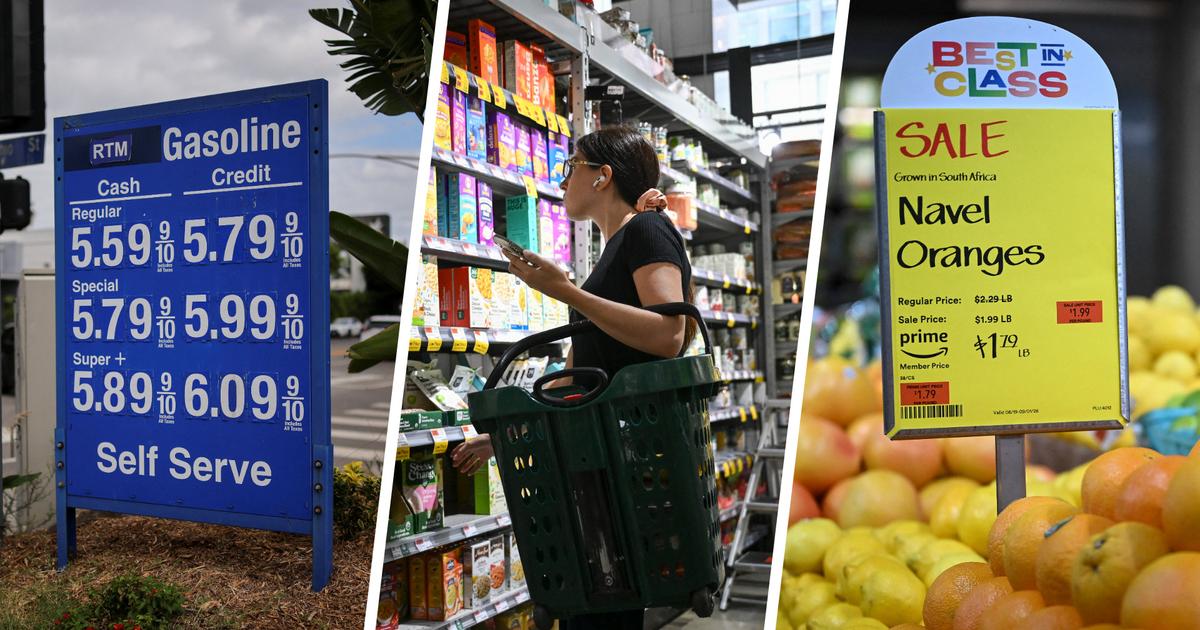
This painful trend has continued for several months: The inflation rate, which U.S. President Donald Trump had promised to curb, accelerated in the spring, reaching 3.4% in August, up from a year earlier. And purchasing power, which became a central theme in American politics after the 2024 presidential election, is once again a major issue in the midterm elections. In recent months, gas prices have been the most visible blow to purchasing power in the United States. They rose by about 30% this summer compared to last year. But for French respondents, familiar with the cost of a liter of gas in France, a gallon remains quite affordable at more than $4 (about €1 per liter).
Still, the cost of filling a grocery cart has skyrocketed. This is putting a strain on the daily lives of French people who have chosen to live the American dream. This increase is also being felt in restaurants. Renaud gives the example of his favorite spot in Baltimore, where “fish and chips” has gone from $15 to $25. This father of two, who is married to an American woman, now prefers to cook at home.
“Especially when you are familiar with American-style service, which is culturally very different from the French art of dining,” jokes an IMF executive in Washington, D.C., who explains that you often have to stop the server from clearing the plates before you have even taken your last bite. In the nation’s capital, he says, “restaurant prices have become outrageous.” But for French nationals working in Washington, whether at international institutions like the World Bank or on expatriate contracts for French companies, living conditions remain favorable.
The soaring prices are nevertheless reflected in the cost of round-trip flights to France, which are taking an increasingly heavy toll on their wallets. French people who have lived in Washington the longest recall nonstop flights home during peak season costing €600. Today, the cost is often over €1,000. Domestic flight prices have also risen recently. Airfares rose by 20% in one year, as of this spring, according to the Labor Department.
The same goes for health coverage, a major cultural difference from France: The United States has no universal health insurance. Individuals without employer-provided coverage must purchase insurance themselves through a complex system of public and private platforms that varies by state. “The decline in purchasing power has resulted in a spectacular increase in premiums; that is perhaps the most striking thing,” Renaud says, noting that his bill has risen by $350 a month in barely a year, not to mention an annual deductible of $8,000.
In this context, the 50-year-old says Trump’s remarks about Americans’ purchasing power have shocked even his own supporters. In May, the U.S. president said he was not concerned about inflation when negotiating with Tehran. “The only thing that matters when I’m talking about Iran — they can’t have a nuclear weapon. I don’t think about Americans’ financial situation, I don’t think about anybody,” he said.
Faced with soaring prices, some are even taking the risky step of going without health insurance. “I have not had any coverage for nearly eight years, and I pay full price at the doctor’s and the dentist’s,” says a young French woman living in New York. It has worked for her, despite the risk of an accident. The cost of living has also skyrocketed in the largest city in the United States in recent years, with rent up an average of 30% from pre-COVID-19 levels.
Of course, salaries are much higher. “And they’ve more or less always kept pace with inflation,” says Florent de Felcourt, who arrived in the United States in 2005 and founded a bakery chain that employs nearly 200 people in the Washington area. “Housing prices were rising, and wages were keeping pace; they were aligned.” But today, he says, that mechanism has broken down. “Inflation is now causing real unease, and it feels like it is here to stay.”
For this business owner, internal costs have risen even further this year. This includes energy costs — for the ovens that run continuously — and the cost of transporting raw materials, such as the flour the company sources from France and Utah. It also includes the group’s health insurance, which rose 7% in one year. But de Felcourt says the biggest change is in the stores: “Customers are much more price-sensitive now, whereas they did not pay attention to prices in the past. There is a shift in behavior that I’ve never seen before.” The bakery chain has therefore decided to offer a promotion, lowering the price of croissants from €4 to €2. The American dream simply cannot do without French pastries.
