Regis Korchinski-Paquet’s mother defends her account of balcony death under questioning at inquest - Toronto Star
Claudette Beals told inquest she wants 'the truth to be known,' and says police shouldn't respond in cases of people in mental health crises.
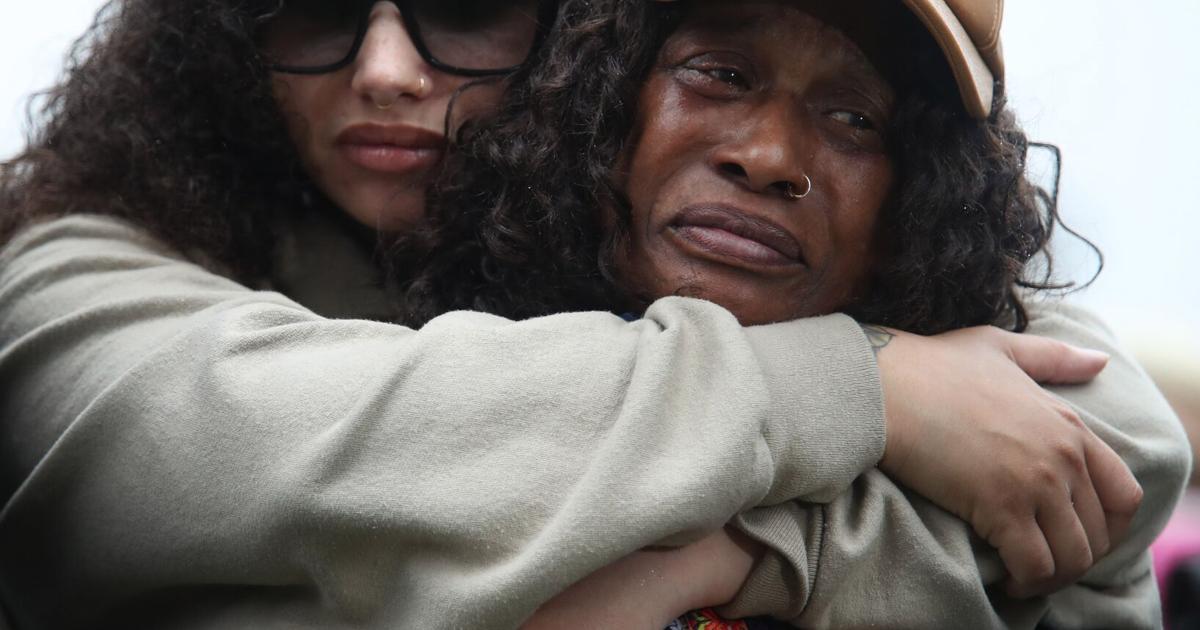
Regis Korchinski-Paquet’s sister Renee consoles their mother Claudette Beals in May 2020.
Claudette Beals stood by her account of her daughter’s death under cross-examination Tuesday, defending her version of events which differs from earlier police testimony.
Questioned at the inquest into the death of Regis Korchinski-Paquet in May 2020, Beals said that based on her memory, she disagreed with the police’s account of events and questioned the purpose of the inquest.
“I don’t trust the police, at all,” Beals said on Tuesday. “I want the truth to be known.”
Korchinski-Paquet, 29, died after falling from her High Park apartment balcony during a police call, raising concerns about how officers handle calls involving mental health and epilepsy.
Gary Clewley, counsel for Shane Beaudoin, the second officer to arrive on scene, pressed Beals on the events of that day, in the apartment she lived in with her two adult children.
“When I went in, they were pushing Regis,” Beals said, describing the actions of police officers who were in the unit at one point along with herself. She first raised the new allegations during the inquest last week.
The two officers who arrived first on the scene; constables Adam Vandenbrink and Beaudoin, previously testified their recollections of the day to the jury, both saying that Korchinski-Paquet walked to the balcony herself.
While CCTV from the apartment hallway has been viewed as an exhibit during the inquest, there is no camera footage from inside the unit.
When asked by Clewley why she left the unit if she saw officers pushing her daughter, Beals said it was “because the police officers told me to leave.”
Beals previously told the inquest that moments later, she heard her daughter scream “Mom, help,” over and over, with each cry growing louder.
She told Clewley that she didn’t rush back in to help at the time because she assumed police officers were handcuffing her daughter.
Claudette Beals, centre, seen at the funeral service for her daughter, Regis. Beals was questioned by lawyers as part of the coroner’s inquest on Tuesday.
After Clewley’s questioning, Beals requested a short break, adding that she didn’t know she was “going through a court case” or that the inquest was supposed to “make police look better.”
“I thought this was for change,” Beals said. Jurors in a coroner’s inquest do not assign blame or legal responsibility but can issue non-binding recommendations meant to prevent similar deaths.
Under questioning in the afternoon from counsel for the Toronto Police Association, Beals said that she would have acted differently on that day based on her learning from the inquest.
“I would never have called police,” Beals said, adding that she didn’t see her daughter as dealing with a mental health crisis at the time, an opinion that she’s now changed.
Over the past two weeks, jurors examining Regis’ final moments learned that she was diagnosed with epilepsy and had a history of seizures sometimes followed by erratic and aggressive behaviour, a state known as postictal delirium.
Answering questions from the Black Action Defence Committee and the Empowerment Counsel and the Mental Health Advocacy Coalition, Beals said mental health and crisis workers should respond to similar calls instead of police.
“I don’t agree with the police showing up for any of it,” she said. “I felt that they were absolutely no help, and I wished that they would never ever have showed up,” Beals said.
The inquest has the central goal of establishing what happened to Korchinski-Paquet and determining if police and first responders need to change how they handle similar incidents, according to Ontario coroner David Cameron.
Toronto police faced criticism over their handling of the call in the wake of the Afro-Indigenous woman’s death, which came on the heels of the Minneapolis police killing of George Floyd and amid an international reckoning over racism and policing.
A criminal investigation by Ontario’s police watchdog, the Special Investigations Unit (SIU), cleared Toronto police officers of wrongdoing in the fall of 2020.
Gabriel Hilty is a staff reporter with the Toronto Star. He can be reached at ghilty@thestar.ca.