Ramayana: Ravana's 10 heads are at war with each other and Yash makes it fascinating
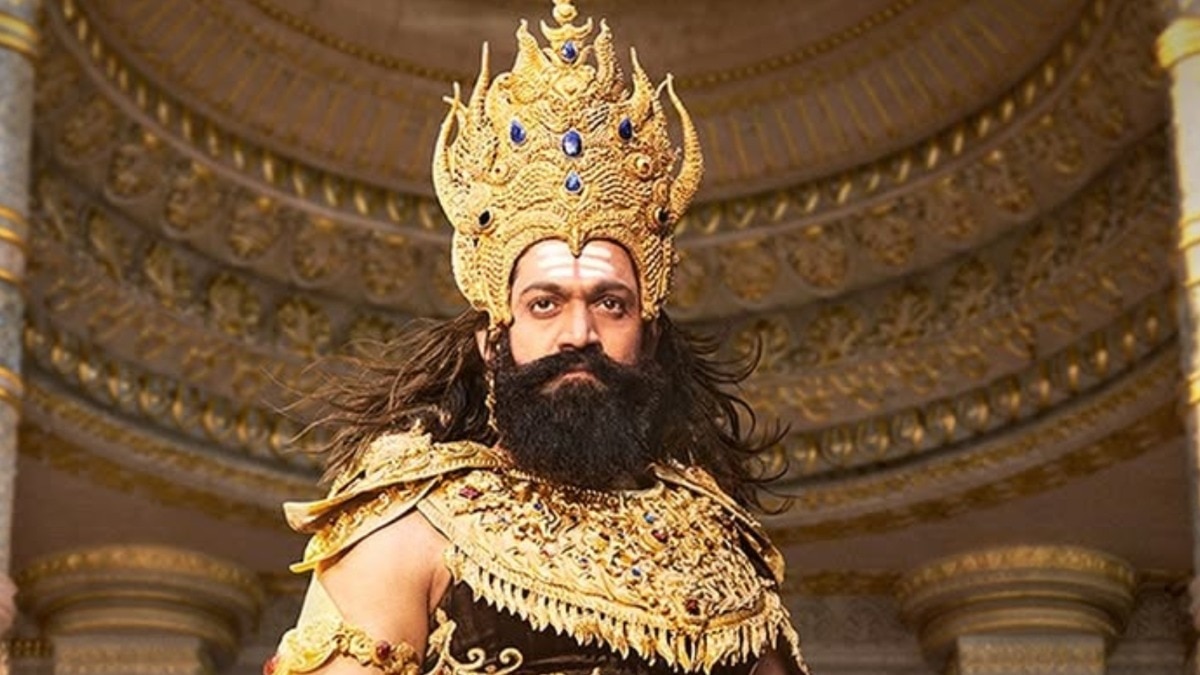
Perhaps one of the most striking attributes of Ravana is his ten heads. Across several on-screen adaptations of Ramayana, the Lanka king has been portrayed as a towering, formidable figure, with his ten heads arranged horizontally to amplify his imposing presence. The sight alone is enough to evoke fear and awe.
But Nitesh Tiwari's Ramayana offers a strikingly different interpretation of the ten-headed Ravana, one that challenges familiar visual representations and makes us look at the character afresh. Yash's commanding portrayal takes that vision several notches higher, amplifying the sense of wonder, menace and sheer scale. It is an interpretation that doesn't merely rely on the spectacle of ten heads but makes the imagery itself an experience.
Ramayana opens with an elaborate episode tracing Ravana's origins and his quest for immortality from Lord Brahma. Before he becomes the formidable king of Lanka, he is Dashanan (meaning the one with 10 heads), a young man whose formative years are shaped by poverty, displacement and a struggle for identity.All about Ravana's backstory
In one of the film's striking early moments, Dashanan is seen playing the veena inside a dingy cave, seemingly unfazed by the suffering around him. His mother, Kaikesi (Shobana), however, refuses to let him remain oblivious. She takes him around and makes him witness the misery of their asura clan, which she attributes to Lord Vishnu. She also makes him understand that his destiny lies in protecting his people and restoring their pride.
Her words leave a lasting impression on Dashanan. He sets out on years of severe penance, determined to obtain boon(s) from Lord Brahma. When Brahma finally appears before him, Dashanan asks for immortality. Denied that wish, he settles for a boon that makes him invincible. Armed with this extraordinary power, he returns to Lanka, challenges its reigning king and takes over the throne.Dashanan becomes Ravana. Yash as Ravana in Ramayana. (Photo credit: Movie still) A staunch devotee of Lord Shiva, a learned man and a formidable ruler, Ravana rises to become one of the most powerful beings across the three worlds. His knowledge, ambition and extraordinary abilities make him a force to reckon with. Eventually, circumstances lead him towards a confrontation with Lord Rama, setting the stage for the epic battle we know.
But before that conflict unfolds, the film gives us a glimpse of a king who seems to have everything going his way. He tastes success, commands respect and believes he is beyond defeat. And therein lies the tragedy of Ravana.
What begins as a quest to protect his people and reclaim their dignity gradually turns into an obsession with power. The boon that he sought as a means to become invincible eventually becomes the very thing that feeds his arrogance. When there is no one left to challenge you, when every victory reinforces your belief that you are above everyone else, invincibility can become a dangerous gift.
Power, after all, does not always corrupt through the pursuit of more. Sometimes, it corrupts through the belief that you already have everything.The Surpanakha chapter changes everything
In one of the film's defining moments, Ravana confronts his sister Surpanakha's husband, Vidyutjihva (Vivek Oberoi), over his inappropriate behaviour. The two get into a fierce fight, which seems to be heading towards reconciliation when they embrace. But what initially appears to be a moment of forgiveness takes a chilling turn. Ravana tightens his grip around Vidyutjihva, squeezing him until he takes his last breath.
It is a disturbing moment because Ravana has a choice to make, even in that brief instant when he could have let go. He chooses not to. He chooses death over mercy. That moment marks a significant turning point in Ravana's journey. His rage, arrogance and growing belief in his own power begin to take centre stage.
When Lakshman cuts off Surpanakha's nose after she tries to pursue Rama romantically, Ravana is consumed by rage. But before he can wage war against Rama, he finds himself fighting a battle within. This internal conflict is where Nitesh Tiwari's interpretation of the ten-headed Ravana becomes particularly fascinating.The idea of Ravana's 10 heads
Instead of presenting the ten heads as merely a physical manifestation of his power, Tiwari takes us deep into Ravana's psyche. We are introduced to ten distinct personalities, each with its own temperament, world-view and understanding of right and wrong. They become voices in Ravana's head, pulling him in different directions and forcing him to confront the consequences of his choices.
Some of these personalities are particularly intriguing because they represent what Ravana might have become had he chosen a different path. Others are unapologetically sinister, encouraging Ravana to give in to his rage and kill Rama. Each has a perspective, an argument and a reason to be heard.
We encounter a musician Ravana, a sage Ravana, a cursed Ravana, a divorced Ravana and several other interpretations of the Lanka king. They are not simply different versions of the same man, they represent the many contradictions that make Ravana such a fascinating character. His devotion, scholarship, ambition, resentment, ego and appetite for destruction co-exist within him, constantly competing for control.
And suddenly, the ten heads begin to make sense in an entirely different way. They are no longer just an imposing visual feature designed to make Ravana look larger than life. They become a window into his fractured psyche, his conflicting impulses and the many sides of a man who cannot seem to reconcile his greatness with his growing darkness.
The war between Rama and Ravana, then, begins much before the two meet on the battlefield. It begins within Ravana himself.Yash brings the imagination alive
If Nitesh Tiwari is the architect of this mind-bending interpretation of the ten-headed Ravana, Yash is the one who brings it to life with remarkable conviction. What could have easily been reduced to a visual-effects spectacle becomes an intriguing character study, thanks to the way the film imagines Ravana's many selves. In contemporary terms, it almost feels like watching a man hold nine different conversations with himself, each voice fighting to take control of the tenth.
And that is what makes this interpretation so fascinating. We have seen Ravana's ten heads depicted as a symbol of his immense knowledge, power and ego. But Ramayana gives them a personality, a voice and, most importantly, a conflict. It makes us wonder whether Ravana's greatest battle was ever against Rama or whether he was always fighting the many versions of himself.
That could just be the most ingenious thing about this interpretation. Rama may eventually defeat Ravana on the battlefield, but long before that, Ravana is already at war with himself. And Yash and Nitesh Tiwari make sure we witness every bit of it.
Ramayana: Rise of Legend is currently running in theatres. India Today gave the film a four-star rating in its review.- EndsALSO READ | Ramayana review: Ranbir's Rama, Yash's Ravana in a spellbinding epic for the ages
A proud South Indian, especially Chennaiite, with love for films, food and cricket. She loves entertainment. In life also. Cries in theatres, watches films alone and always takes back some lessons. Hills over beaches for her. If not for films, you can see her obsessing over food videos and making organic soaps. Also, a Senior Assistant Editor at India Today Digital covering South films.