Ramaphosa pledges to cut red tape after Durban businesses raise concerns - IOL
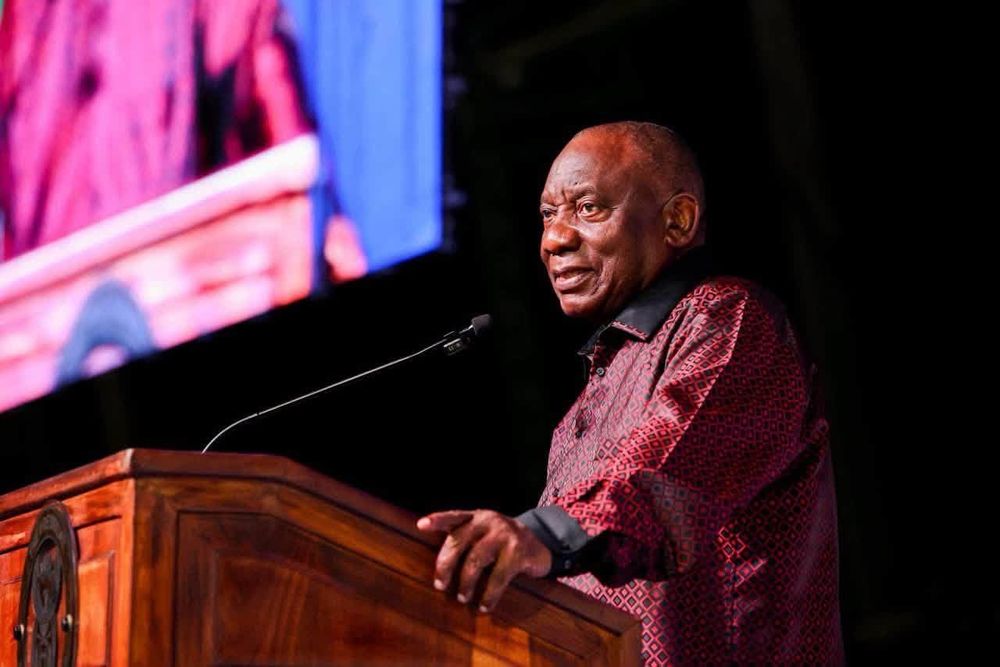
President Cyril Ramaphosa addresses the Durban Chamber of Commerce and Industry’s 170th Annual Gala Dinner at Suncoast.
President Cyril Ramaphosa has pledged to remove bureaucratic obstacles holding back businesses, after Durban business leaders raised concerns about illicit imports, unreliable infrastructure and regulations affecting companies in distress.
Ramaphosa was speaking at the Durban Chamber of Commerce and Industry NPC’s 170th Annual Gala Dinner at the playTSOGO Globe at Suncoast on Wednesday evening.
KwaZulu-Natal Premier Thamsanqa Ntuli, Economic Development, Tourism and Environmental Affairs MEC Reverend Musa Zondi, eThekwini Municipality Mayor Cyril Xaba, members of Parliament, and other dignitaries attended.
Durban Chamber of Commerce and Industry NPC chief executive Palesa Phili told Ramaphosa that cheap imports, counterfeit products and illicit goods entering Durban through the port were severely affecting local industries.
She called for his intervention on regulations governing industries in distress, saying these needed to be reviewed to protect businesses affected by cheap imports.
“It really needs to be reviewed so that we can make sure that we safeguard industries that are in distress, that are affected by cheap imports coming in,” Phili said.
“But also, we really need to be very strong and aggressive when it comes to counterfeit and illicit goods because of the destruction that it’s having on our economies.”
Phili also called for reforms to support small, medium and micro enterprises (SMMEs), saying they faced obstacles including unreliable electricity and infrastructure, red tape, limited access to finance and labour-market regulations.
“We need SMME reforms, Mr President, so that our SMMEs can be able to create those much-needed jobs,” Phili said.
She said SMMEs employed about 80% of the population in emerging markets such as Brazil and China, compared with about 60% in South Africa.
Reflecting on Durban’s resilience, President Ramaphosa acknowledged that businesses and households continued to face serious difficulties, particularly as a result of unreliable municipal services.
He said the condition of infrastructure, the cost of electricity, crime and inefficiencies in logistics were discouraging investment and constraining economic growth.
“These are not challenges that can be resolved through good intentions alone,” Ramaphosa said, adding that they demand capable leadership, sound management, and sustained action.
He said reliable municipal services were the foundation of economic development, while public institutions needed to be accountable, efficient, and responsive to citizens and businesses.
He said the government was identifying areas where the time needed to obtain permits and licences could be reduced, and where unnecessary administrative stages could be removed.
Ramaphosa said the government was responsible for providing infrastructure, services, institutions and policy certainty, while business had to invest, innovate and create employment.
He added that investment and economic prosperity depended on social stability. Business and investment cannot thrive amidst violence, intimidation, lawlessness or fear, he said, referring to the July 2021 unrest as a reminder of the cost of instability.
Premier Ntuli noted inheriting an administration struggling to restore confidence after the July unrest.
He emphasised listening to business leaders, who stressed that restoring confidence requires safety and responsive governance rather than speeches. During subsequent outbreaks of violence, the business community actively partnered with the government to keep the city moving and protect livelihoods.
“So let me make this declaration before His Excellency, the President of the Republic, before this chamber, and before the people of KwaZulu-Natal: Durban will never burn on my watch, not again, not while I hold this office. We will protect every factory, every shop, every port and every livelihood in this city because to burn Durban is to burn the bread of millions. Ngeke kwenzeke, it will not happen,” Ntuli said.