Prime ministers are remembered for one or two big mistakes. Albanese might have just made his
You have reached your maximum number of saved items.
Remove items from your saved list to add more.
You've used all of your gift articles. 3 more will become available on the 1st of every month.
In her droll memoir Bossypants, comedian Tina Fey addressed the practice of “airbrushing”, whereby a photograph of a celebrity is digitally augmented to look attractive for a magazine cover, sometimes to unrecognisable extremes.
Fey wrote that airbrushing was “an appalling and a tragic reflection on the moral decay of our society ... unless I need it, in which case, everybody be cool”.
Prime ministers are often remembered for one of two things they found forgettable. Jamie BrownThis quote sprang to mind during the week amid accusations of prime ministerial pork barrelling. As with airbrushing, pork barrelling requires some sleight of hand. Prime Minister Anthony Albanese is facing criticism for procuring a $6 million federal grant for the Marrickville Golf Club in his Sydney electorate of Grayndler, through an invitation-only process. The process deciding the grant was never meant to be merit-based – it was an election promise, to be funded from the public purse if Labor won the 2025 election.
Compounding the original sin, Albanese either erred or deliberately misled the public when he said, in September, that the grant was for the (very worthy) cause of stopping raw sewage from flowing when people used the club loos. That lent the grant a certain moral force, you might say.
The checks and balances in our democracy paid for themselves during the week when it emerged, via the interrogation of bureaucrats in Senate estimates, that none of the $6 million grant money was used for sewerage works. Actually, those works were carried out with money from a separate, state government grant. The federal money that Albanese secured for his constituents will pay for other works, including a renovation of the clubhouse and a new pro shop.
The politics of golf courses are a separate story of their own - in NSW, Premier Chris Minns’ government is redeveloping part of the Moore Park Golf Course in Sydney’s east, claiming back green space for the public to enjoy.
With increased urban density, it’s difficult to justify why such plush lands should be the private preserve of the wealthy few.
The Marrickville Golf Club is not flash. It sits on a public course beloved of inner-west dog walkers. The clubhouse has become a popular spot for families to eat and socialise, while their kids spill out onto the parklands next to the Cooks River. That it needed a new sewerage system is not in dispute. But most taxpayers would assume that all federal grant money is awarded according to some sort of merit-based, competitive process.
It’s not too much to expect. That was why “sports rorts”, which contributed greatly to the unpopularity of then-prime minister Scott Morrison’s government, seemed so egregious. That scandal centred on a $102.5 million community sports grants program. Sports Australia had drawn up merit-based rankings of the most worthy upgrade projects across the country, as the basis for the money’s allocation.
The auditor-general found, in his 2020 report, that Morrison’s government had discarded those rankings and distributed the money with a bias towards marginal and Coalition-priority electorates. Then-sports minister Bridget McKenzie resigned after it came out that she was a member of the Wangaratta Clay Target Club, which received $36,000 in Commonwealth grants.
Back in 2020, when he was opposition leader, Albanese was one of the loudest voices condemning what he called “this tawdry rort” that meant “legitimate sporting clubs” had missed out “in favour of the political process”. He said it justified the need to set up a federal anti-corruption commission.
Embarrassing, then, that the Centre for Public Integrity found the Albanese government gave three-quarters of grants under its $560 million, invitation-only infrastructure program to Labor-held electorates, including the $6 million to the (soon to be less) humble Marrickville Golf Club. Pork barrelling is bad; in case I need it, in which case, everybody be cool.
Albanese did not apologise for the error he made in telling the public the grant was for sewerage. To be fair to him, the scope of the golf club works seems to have changed along the way, as different bits of funding became available. But Albanese didn’t cop to it, not really. He told parliament during the week that “it was not correct” to say the money had been for sewerage.
The passive voice is a happy refuge for the accountability-averse. It’s so much easier on the ego to say that mistakes were made, than it is to say “I made a mistake”. The Coalition used the whole issue to add flourishes to the picture it is painting of the PM – that he has “a difficult relationship with the truth”, and doesn’t take responsibility even when caught red-handed. As evidence for their case, they cite the tax changes made in the budget, some of which the PM had previously sworn off, and his pledge to cut power bills by $275.
“He said he didn’t mock the Japanese prime minister, when he did,” Opposition Leader Angus Taylor told parliament during the week.
“He said he didn’t fall off a stage when he did. He said his $6 million grant to the Marrickville Golf Club was to fix sewage flows when it wasn’t. He said the relevant program wasn’t invitation-only, when it was.”
Apart from it being the right thing to do, there is another reason, purely political, for a leader to accept when she or he is wrong. It projects security. If you are insecure in your position, or in your role, any admission of error will feel like a threat. A secure leader can say they messed up, and take accountability for the mistake, knowing that one error is not a reflection on their worth.
That becomes harder to do the more mistakes you make, and impossible to do if the mistakes are actually deceptions – such as former prime minister Julia Gillard’s promise of “no carbon tax”. That was probably a truthful statement at the time, but her later reversal turned it into something easily characterised as a lie.
But you can see why politicians hate to admit errors. They are often remembered unfairly, with vast areas of their legacy obscured by the mistakes they made. They spent their time in office doing what they thought was best for the country, but in the public mind they are often reduced to their worst moments.
Gillard is best remembered for the carbon tax “lie” (and her misogyny speech, which was actually one of Tony Abbott’s worst moments).
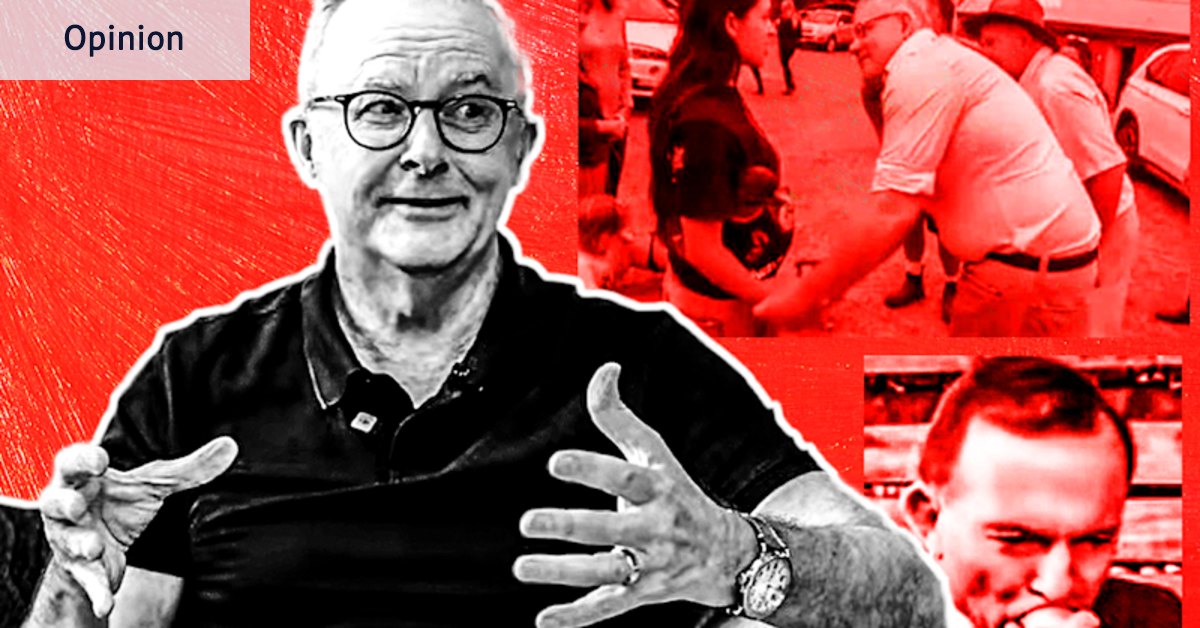
Morrison is remembered for his insistence he didn’t hold a hose, mate, doubling down on his indefensible decision not to return from a Hawaiian holiday as deadly bushfires raged. The image of a fire victim refusing to shake Morrison’s hand, and him forcing her to do so, crystallised the negative impression.
Abbott is remembered (among many other things) for knighting Prince Philip and eating an onion – a photographer catching the latter made it impossible to shake off the oddball impression it created. Keating, for tax reform, deregulation and the recession we had to have, and John Howard, for gun control and the Tampa.
All these incidents are brushstrokes which eliminate nuance and detail, the things that float to the surface in the minds of ordinary voters who don’t follow political minutiae.
As Albanese gears up, in the new year, to fight a third election, he must be thinking – and perhaps worrying – about the few incidents that will define him when he leaves office.
And hoping they’re not his mistakes.
You have reached your maximum number of saved items.
Remove items from your saved list to add more.
You've used all of your gift articles. 3 more will become available on the 1st of every month.