Opinion | As a former UN ambassador, I know one way we could tell Donald Trump what Canada stands for - Toronto Star
Mark Carney has called the current crisis a point of rupture, and he is right. Someone completely new has moved in next door.
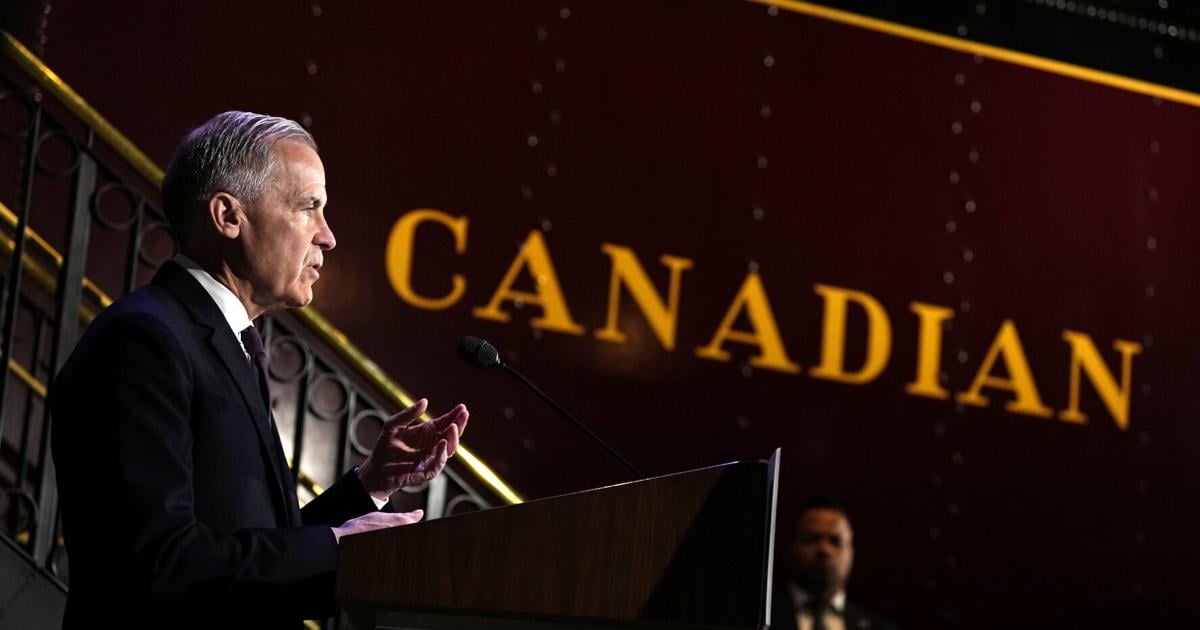
Prime Minister Mark Carney makes an announcement regarding the Canada Strong Fund, the country’s first sovereign wealth fund, at the Canada Science and Technology Museum, in Ottawa, on April 27, 2026.
Bob Rae teaches and writes on law and public policy. He has served as Ontario’s 21st premier, leader of the federal Liberal party and Canada’s Ambassador to the United Nations. He is the editor of "Reclaiming Canadian Sovereignty in a Ruptured World" (2026).
His face and voice are everywhere by design. His every move, shout, and social media outburst is amplified, the endless stream of bile, insults and toxicity all part of the plan.
Our temptation may be to shut ourselves off, to find a quieter, saner place where we can detach from the interminable ranting — but we do not have the luxury to ignore this. We have to deal with it, because in very real and substantive ways, U.S. President Donald Trump is trying to wear us down and beat us up, twist the knife and turn the screw.
Like it or not, what Mr. Trump thinks and does matters. His are not the ravings of a madman; they are the basis of policy. While his views are not shared by all his fellow citizens, Mr. Trump is still the president of the most powerful country on the planet, which happens to be our next-door neighbour. And he is convinced that the only path to American prosperity and dominance is “America First.”
For a long time we deluded ourselves into thinking that somehow Canada could find shelter underneath America’s umbrella without really being seen — that we could slip in unnoticed. Mr. Trump has made it clear that he is not interested in this dynamic.
When Canada signed its first free-trade agreement with the United States in 1988, many of us were opposed; we argued it would make us more dependent on the U.S. market with no real guarantee of protection against this vulnerability.
So here we are. The path we chose has led us into the wilderness.
Prime Minister Mark Carney has called this crisis a point of rupture, and he is right. Someone completely new has moved into the house next door. He is not Franklin D. Roosevelt, or John F. Kennedy, or Ronald Reagan, or Barack Obama, or Joe Biden. He is a predatory hegemon whose regime in its second incarnation has demonstrated unprecedented corruption and a compulsion to destroy the co-operative ways of being and co-existing that have undergirded Canada-U.S. relations for decades.
Many Canadians still believe “there’s a deal to be done” on trade, a deal that would preserve many of the features of CUSMA (our third trade agreement with the U.S., which allowed a significant majority of goods to go back and forth across the border tariff-free) while instituting some minor changes in America’s favour.
This is a significant misread of what Mr. Trump is all about. He is not a free-trader. He believes in tariffs, protectionism and “America First.” For him, there is a winner and a loser in every economic transaction, someone who comes out on top and someone else who comes out on the bottom. This is an iron law for him — no exceptions.
It is clear in what he says, in what he blasts out on Truth Social and in what he does. Mr. Trump doesn’t like us. He has no soft spot for us. He doesn’t appreciate it when we try to placate him. He wants to take over our country and get rid of the border in a way that goes far beyond the aims of free-traders.
That is what the “Lake America” travesty is all about: Mr. Trump wants our water. He wants our resources, and he will invent some 159-year-old argument about the border to pursue this goal. He is not the first U.S. president to have thought this way — but he is ready to take us to the mat. Further talk of the logic and mutual advantages inherent in what we have built together seems increasingly naive. Mr. Trump is not interested, and he is not listening. Some Canadians may want to revive the past, but it takes two to make a partnership.
Canada, then, must pursue a different path, one designed to obliterate trade barriers between the provinces, allow us to pursue unashamedly our national interest in dealing with the U.S. and force the Americans to understand the high price they will pay for Mr. Trump’s extravagant (and unachievable) objectives.
Things will get worse before they get better. If we follow a new path, many jobs will be lost, but others will be gained. It will be hard going, and not everyone will be happy with the results. Yet those who say the better alternative is to accept the Trump administration’s premises are sadly mistaken. Mr. Trump is offering us nothing. He is not interested, and he does not care. When Mr. Carney quips that the president only signs deals in pencil, he is right.
Now, as we seek to reassert our sovereignty and chart a more independent path forward, the key question is: What, exactly, do we want to use our sovereignty to achieve?
We need to appreciate that when Mr. Carney first spoke of taking a more engaged, multilateral approach to our problems, many countries were not convinced he was completely serious. Canada has abandoned peacekeeping. Canada has set its already low budget for international aid even lower. When the U.S. invaded Venezuela in January, our response was tepid. When the U.S. and Israel attacked Iran in February, we were equivocal. We have failed to advance the fight against climate change. When one of our citizens, a judge on the International Criminal Court, was sanctioned by the Trump administration, we stayed mute.
So the jury is out as to how we will move forward in the face of a corrupt U.S. government that tears up treaties, makes a mockery of international law and clearly has a different concept of the relationships between might and right, and between law, morality and self-interest.
One step Canada could take: we should be clearer in stating what our country is for and what it stands against in a world turned upside down. We should be clearer that we want to turn it right side up. And we should be clearer about the words we profess to believe in and our path forward.
That is why, after editing and writing the introduction for a new book on Canadian sovereignty, I decided to lay out a five-point Canadian Declaration of Defence of Sovereignty, Democracy, Human Rights and the Rule of Law.
1. We commit to defend Canadian territorial integrity and democracy and to face with determination any attack, economic or otherwise, on our country from any hostile force, including the U.S.
2. We commit to resist such attacks and to increase our capacity to defend ourselves from them — economically, politically and militarily.
3. We understand that we can succeed in defeating such aggression only if we are willing to extend economic, political and military support to other countries and jurisdictions facing similar attacks and threats.
4. We seek neither land nor wealth from this resistance but call upon aggressors to stop attacking their own people, as well as their neighbours and allies. We call upon the citizens of aggressor nations to join with us to stop these egregious attacks.
5. We remain deeply committed to international law, human rights and the rule of law in Canada and around the world; and we remain deeply committed to the Constitution, the United Nations charter and other agreements and treaties we have signed, including the Paris Agreement on climate change.
Canada’s fight for its sovereignty is not about pursuing a narrow nationalism. Rather, it’s about recognizing that the fight for freedom and agency is, at the same time, a fight for solidarity.
Error! Sorry, there was an error processing your request.
There was a problem with the recaptcha. Please try again.
You may unsubscribe at any time. By signing up, you agree to our terms of use and privacy policy. This site is protected by reCAPTCHA and the Google privacy policy and terms of service apply.
Bob Rae teaches and writes on law and public policy. He has served as Ontario’s 21st premier, leader of the federal Liberal party and Canada’s Ambassador to the United Nations. He is the editor of “Reclaiming Canadian Sovereignty in a Ruptured World” (2026).
Opinion articles are based on the author’s interpretations and judgments of facts, data and events. More details