
Ong Teng Cheong 'stress-tested' EP scheme, showed that establishment figure can act independently: Jayakumar - CNA
The former senior minister recounts how younger ministers spoke up against Lee Kuan Yew's original proposal for the elected presidency, and his willingness to modify it.
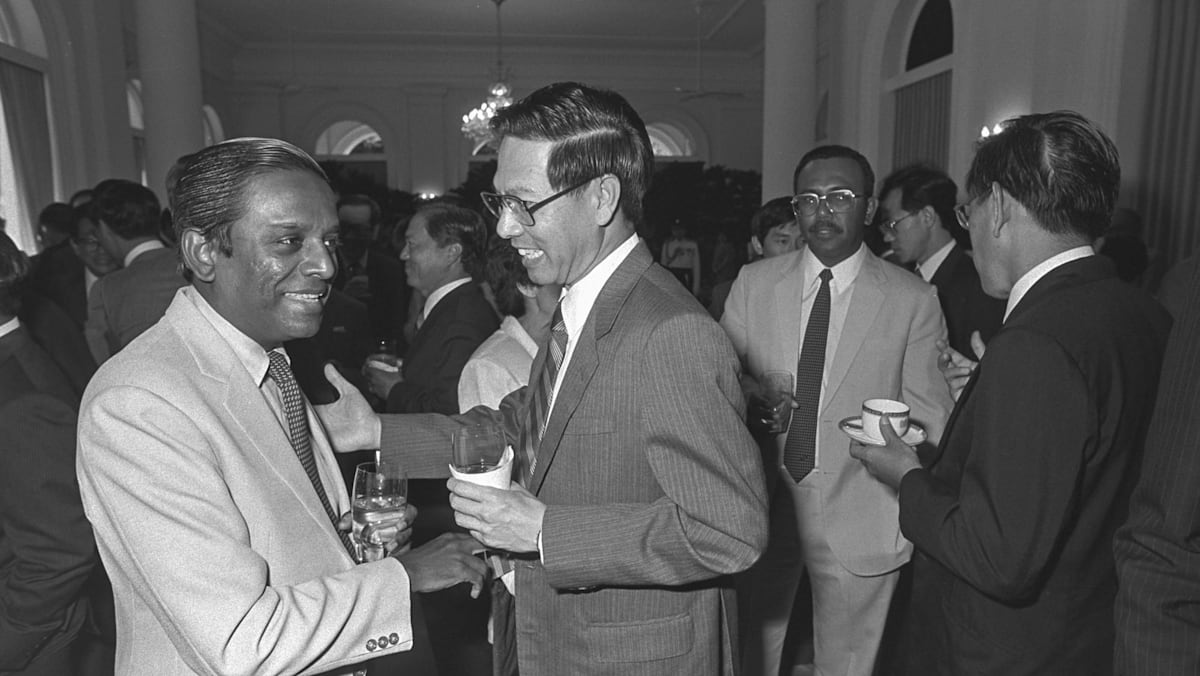
Minister for Law and Home Affairs S Jayakumar and Second Deputy Prime Minister Ong Teng Cheong at a reception during the swearing-in ceremony of ministers of state and parliamentary secretaries at the Istana State Room on Sep 13, 1988. (Photo: National Archives of Singapore)
This audio is generated by an AI tool.
Fabian Koh 29 Oct 2026 06:00AM (Updated: 29 Oct 2026 09:06AM) Bookmark Bookmark Share WhatsApp Telegram Facebook Twitter Email LinkedIn Set CNA as your preferred source on Google Add CNA as a trusted source to help Google better understand and surface our content in search results. Read a summary of this article on FAST. Get bite-sized news via a newcards interface. Give it a try. Click here to return to FAST Tap here to return to FAST FAST This is the second of three articles from CNA’s interview with former Senior Minister S Jayakumar, who recently launched his book Creating Three Unique Singapore Laws: An Inside Story. The book chronicles how the elected presidency, Group Representation Constituencies and Non-Constituency Members of Parliament were established through constitutional amendment.
SINGAPORE: The late Ong Teng Cheong "stress-tested" the elected presidency through disagreements with the government, and his term showed a president from the establishment can act independently, said former Senior Minister S Jayakumar.
“He was from the establishment. He had been deputy prime minister and became elected president. He took the role seriously and in the course of his term of office, there were some issues on which there were disagreements (with) the government,” Professor Jayakumar told CNA in an exclusive interview.
The interview took place at the Old Parliament House, now The Arts House, where laws were debated and passed.
CNA Games Guess Word Crack the word, one row at a time Buzzword Create words using the given letters Mini Sudoku Tiny puzzle, mighty brain teaser Mini Crossword Small grid, big challenge Word Search Spot as many words as you can Show More Show Less Prof Jayakumar launched his book, Creating Three Unique Singapore Laws: An Inside Story, in August. It traces how the elected presidency, Group Representation Constituency system and Non-Constituency Member of Parliament scheme came about.
Mr Ong, a former deputy prime minister, served as president from 1993 to 1999. He died in 2002.
The elected presidency was written into law in 1991, giving the president additional powers, including safeguarding the reserves and key public sector appointments. Before Mr Ong, the president was elected by Members of Parliament rather than voters in a nationwide election.
On Jul 16, 1999, towards the end of his term, Mr Ong held a press conference to announce he would not seek re-election and to raise challenges he faced working with the government.
He expressed disappointment over what he saw as insufficient cooperation from civil servants on certain matters, along with concerns over a possible drawdown on the reserves.
At a parliament sitting afterwards, then-Prime Minister Goh Chok Tong and then-Finance Minister Richard Hu both “took pains to deal with every one of Ong Teng Cheong’s points”, Prof Jayakumar said.
“They explained it in a way to show that the facts as presented showed that there was a misunderstanding by President Ong Teng Cheong, who did not come back to rebut it,” he said.

