
Modi's Diwali location is never incidental: Here's why
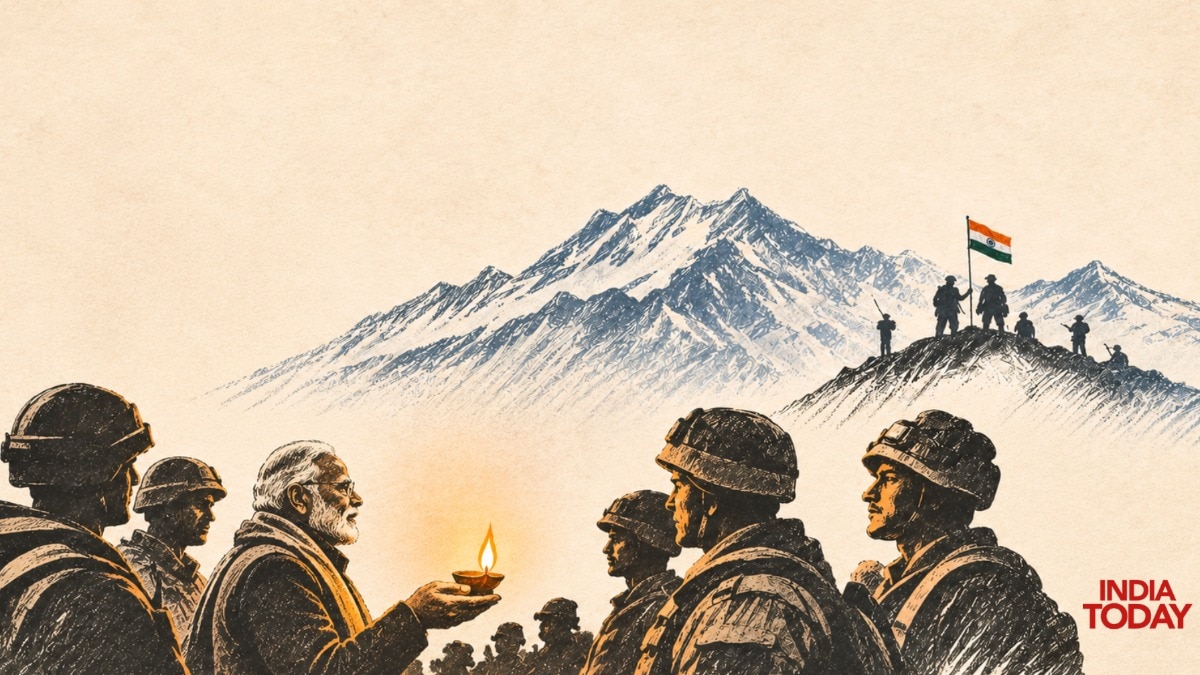
Siachen, Dograi, Gurez, Harsil, Rajouri, Longewala, Kargil, Sir Creek, INS Vikrant. Ask most Indians about these places and they’ll tell you about a war, a border dispute or some headline about the armed forces. But for Prime Minister Narendra Modi, they’ve become something else: Diwali destinations, where he celebrates the festival with soldiers. A look at the 12 locations where PM Modi has celebrated Diwali with the armed forces since 2014, and the security developments surrounding those visits
Think about that for a moment. For 12 consecutive years, the PM has spent Diwali with soldiers, going from one corner of the country to another. And if you line up all those locations together, a story starts to emerge. He has gone from glaciers and mountain passes on the borders with Pakistan and China, to a creek in Gujarat, and finally to a made-in-India aircraft carrier in the Arabian Sea.
It’s also, in a way, a journey through the security challenges India has faced over the past decade.IT BEGAN ON THE GLACIER
It all started on October 23, 2014. Modi travelled to Siachen Base Camp for his first Diwali as Prime Minister. Just weeks earlier, Chinese troops had transgressed into the Chumar area of Ladakh, right when Chinese President Xi Jinping was visiting India. His message to the soldiers was simple: “The whole nation stands with you.”
The next year, he turned to the western front. He visited the Dograi, Barki and Asal Uttar war memorials in Punjab, on the 50th anniversary of the 1965 war. These were reminders of battles fought against Pakistan, and of the soldiers who had defended the country.
Then, a year later, the focus shifted back to the mountains. Weeks after the Uri attack and the Army’s surgical strikes across the Line of Control, Modi arrived at Sumdo in Himachal Pradesh, near the China border, to spend Diwali with the troops guarding it. His tone with them was one of gratitude, but it followed a much sharper message to Islamabad days after Uri, when he declared that the soldiers’ sacrifice “will not go waste.”
The following year, he was in Gurez Valley, another sensitive sector along the LoC. And in 2018, he went to Harsil in Uttarakhand to meet the Army and ITBP personnel guarding the China-facing frontier.THE BORDER BECAME THE MESSAGE
In 2019, he chose Rajouri, less than three months after the abrogation of Article 370. It was also Infantry Day, the day that marks the arrival of the first Indian troops in Srinagar in 1947. He then went on to visit Pathankot Air Force Station, which terrorists had attacked in January 2016.
And then came Longewala. It was November 14, 2020. The Galwan clash was still fresh, the eastern Ladakh standoff was still on, and just a day earlier, Pakistani ceasefire violations had killed 11 people, including five soldiers. Against that backdrop, Modi celebrated Diwali at the historic Rajasthan battlefield. Without naming China, he said: “Expansionism is, in a way, a mental disorder and reflects 18th-century thinking.” And he warned Pakistan that India would give a “prachand jawab” if tested.
In 2021, he went back to Nowshera, recalling the brigade’s role in the 2016 surgical strikes. “I will remember that day forever,” he told the soldiers.
At Kargil in 2022, his message was about the fight against terrorism. “Diwali is the festival of the end of terror,” he said.
In 2023, he travelled to Lepcha in Himachal Pradesh, at a time when India and China were still negotiating over unresolved issues along the Line of Actual Control.TO THE SEA
Then 2024 happened, and the shift in geography was hard to miss.
Modi celebrated Diwali at Lakki Nala in Sir Creek, a tidal estuary between Gujarat and Pakistan’s Sindh province. He met personnel from the three armed services and the BSF at a floating border outpost and said: “Today, no one can dare raise their eyes towards Kutch and Sir Creek.”
That Diwali also saw another important development. Indian and Chinese troops exchanged sweets along the LAC after completing disengagement at Depsang and Demchok.
And then, in 2025, he took the celebrations to INS Vikrant, India’s indigenous aircraft carrier, off Goa and Karwar. This came months after Operation Sindoor, during which the Navy had deployed a carrier battle group in the northern Arabian Sea. Modi praised the coordination among the three services, saying it had “compelled Pakistan to surrender."
Now think back to Longewala in 2020. There, he had spoken about the combined strength of the Army, Navy and Air Force. Five years later, he was making a similar point from the deck of an aircraft carrier built in India.
So for 12 years, the Prime Minister has chosen to spend the festival away from home, with the men and women guarding India’s borders. He has travelled across the edge of the Indian map, and the message has travelled even further, across the globe.- Ends
Aakash Sharma is a Special Correspondent with India Today TV. He works on social media information ecosystem, disinformation and identification of co-ordinated campaigns.
Vijayesh Tiwari is a Correspondent with India Today, where he is part of the Open-Source Intelligence (OSINT) team. His work focuses on geopolitics, strategic affairs, climate, and public policy, drawing on open-source research, geospatial intelligence, satellite imagery, and data driven journalism.


