Merz says next German president 'must be a woman' — report
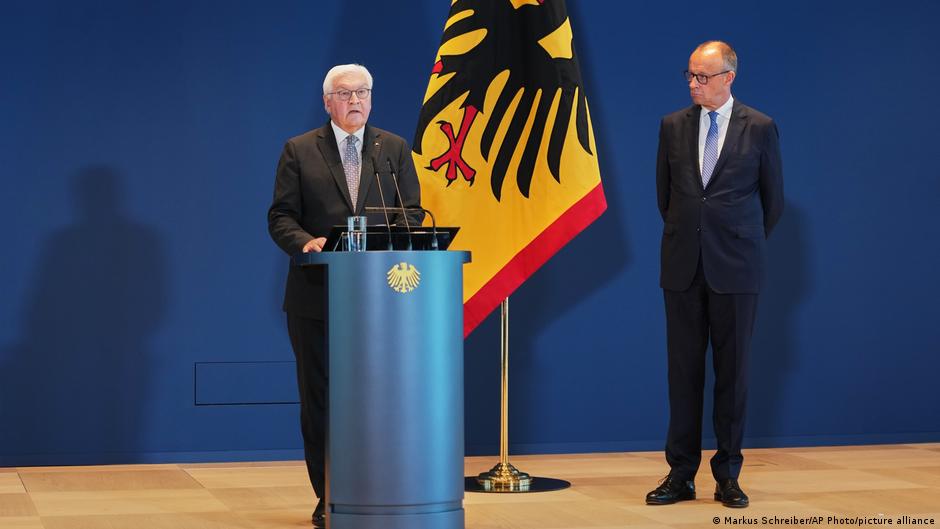
German Chancellor Friedrich Merz has spoken out in favor of having a woman succeed Frank-Walter Steinmeier as Germany's president.
"I will propose a consensus candidate to the party, a candidate from the political center," Merz said at a non-public meeting of local Christian Democratic Union (CDU) chairs in Berlin, participants told the German DPA news agency.
"I am firm in my belief that it must be a woman," he reportedly added.
Germany's federal president is the country's official head of state, as opposed to the chancellor, who is the head of the government.
Current incumbent Steinmeier, a former Social Democrat (SPD) foreign minister, became president in 2017 and his second term will end in March 2027.
Bavarian premier Markus Söder recently proposed Ilse Aigner from his Christian Social Union (CSU), the CDU's Bavarian sister party.
But the CDU itself may propose an alternative candidate from within its own ranks, with current parliamentary speaker Julia Klöckner, Families Minister Karin Prien and former CDU leader and Defense Minister Annegret Kramp-Karrenbauer all having been mentioned.
The CDU's top leadership is expected to propose a candidate on November 9.
German Chancellor Friedrich Merz says Germany must speed up its development of artificial intelligence capabilities to protect its "digital sovereignty" in an era of rapid change.
Speaking at a conference on AI in Berlin, the chancellor said countries risked surrendering control to outside providers by failing to keep pace.
"That is why we must, at all costs, avoid becoming entirely dependent on third parties when it comes to developing and using this technology," he said. "And that is why the issue of digital sovereignty in the context of AI becomes a truly existential question."
Merz stressed that people and their dignity must remain central to political efforts to manage rapid technological progress, saying AI development should be guided by human values.
He also said adapting to AI-driven changes required "an enormous technological and organizational effort, a far-reaching modernization of our state and our economy."
Merz pointed to Germany's strength as a business location and home of industrial engineering. He also said international cooperation was crucial, and that Berlin would seek to work with like-minded partners such as France and Canada to share knowledge and diversify supply chains.
Merz appointed a minister for digitalization and modernization last year after taking office. Although many German companies have adopted and integrated AI technology, critics say Germany has been too slow to build the digital infrastructure and skills needed to exploit it fully.
Alexander Zverev officially rose to the No. 1 spot in the men's tennis rankings on Monday, becoming only the second German man to hold the title after Boris Becker 35 years ago.
"Today is a historic day for German tennis," said German Tennis Federation President Dietloff von Arnim. "Sascha has earned this spot at the top of the world rankings through extraordinary perseverance and hard work."
The 29-year-old beat Flavio Cobolli to win the French Open title in June, before going on to lift the US Open trophy after defeating Ben Shelton in September.
He also reached the final at Wimbledon this year, ultimately falling to Jannik Sinner, and the Australian Open semifinals.
He is the 30th male player to reach No. 1, and the oldest in more than 50 years to top the rankings for the first time.
"I had to wait," said Zverev, who reached the top spot more than four years after becoming No. 2. "But sometimes you've got to wait for the best things in life. I'm super happy, super thrilled."
Sinner, who had been holding the No.1 spot since April 13, dropped to second, ahead of Carlos Alcaraz.
Germany's far-right Alternative for Germany (AfD) party has confirmed that a summit with Russian and American advisers "at the highest possible level" is being planned.
The AfD's foreign policy spokesman, Markus Frohnmaier, said the meeting is likely to take place in Abu Dhabi in early 2027 and will focus on restoring Russian gas deliveries to Germany.
DW understands that AfD leaders Alice Weidel and Tino Chrupalla would attend the meeting if US envoys Steve Witkoff and Jared Kushner were also present.
Such a meeting would represent a major PR coup for the far-right party, which remains shunned by most of Germany's political establishment despite leading national opinion polls.
"The focus here will be on discussions with the American side, as well as the Russian side, particularly with regard to economic partnership, energy partnership and also the Nord Stream question," Frohnmaier told journalists in Berlin.
According to Frohnmaier, Kirill Dmitriev, a special adviser to Russian President Vladimir Putin, is coordinating with contacts in the US administration.
Dmitriev greeted Witkoff, US President Donald Trump's Middle East envoy, when he arrived in Russia for talks last month.
Dmitriev has also been cultivating contacts in Germany. He and Frohnmaier met at an economic forum in St. Petersburg earlier this year.
In September, Dmitriev described the anti-immigration, anti-EU AfD as "the hope for Germany" during regional election campaigns. The party wants to end sanctions on Russia and halt weapons deliveries to Ukraine.
While the Abu Dhabi summit is expected to focus on business and economic ties, Frohnmaier said such formats can "establish a framework for dialogue" and help "work toward peace."
German President Frank-Walter Steinmeier attended the opening of a new Jewish Academy in Frankfurt on Monday.
The €40-million ($45-million) educational institution, which was inaugurated under tight security, is to be a "place of dialogue," Steinmeier said.
He denounced antisemitism and said it must be "put in its place, without loopholes or reservations," whether it comes from the left or the right of the political spectrum.
The president also warned against what he described as the increasing political exploitation of hatred toward Jews.
"All parties have a duty to confront antisemitism throughout their entire sphere of influence — from the party leadership down to the rank and file and among their supporters," he said. "Antisemitism must not be allowed to influence government work anywhere in Germany."
The academy's opening ceremony was also attended by the president of the Central Council of Jews in Germany, Josef Schuster, who described the center as a "milestone" that would be "dedicated to the full diversity of Jewish thought and Jewish experiences."
He said Jewish life in Germany was under greater threat than at any time since the Holocaust, with an "explosive rise" in antisemitism since the Hamas-led terror attack on Israel on October 7, 2023.
He said the new center could play a role in turning this around, stressing the importance of openness, enlightenment, dialogue and "education, education and yet more education."
The academy is funded by the federal government, the state of Hesse, the city of Frankfurt and the Central Council of Jews.
It is aimed at a wide audience and offers a range of programs and events, including international conferences, educational courses, and panel discussions.
The German Retail Association says society as a whole has a responsibility to prevent the kind of violence that followed youth protests in several German cities on Saturday.
In Frankfurt, rioters threw stones and petrol bombs, smashed shop windows and looted businesses. Violent confrontations were also reported in other parts of the country.
"We must not tolerate a social climate in which retailers cannot always be certain, wherever they are, that they can go about their business unhindered," association boss Stefan Genth said.
"This applies to society as a whole. We are all called upon to act," he said, adding that it must be clear that violence, or the threat of it, has no place in Germany.
Tens of thousands of young people demonstrated across the country over the weekend calling for better education funding and measures to bring down the cost of living. The protests were largely peaceful, although in some cities they were followed by rioting and looting.
Genth said it was alarming "that some retailers in certain locations felt compelled last Saturday to take extra security measures or, in some cases, to close their shops entirely."
Chancellor Friedrich Merz is to tell a conference of local party leaders of his conservative Christian Democratic Union (CDU) that he saw a positive aspect to weekend youth protests, while condemning violence that occurred in their aftermath.
"I take above all a positive message from the weekend: The young generation is politically engaged and is concerned about its future," he is to say, according to a speech released beforehand to news agencies.
In the planned speech, Merz says the government is making efforts not to burden the younger generation with the costs of an aging society.
"That is why we are carrying out pension reform for young people, why we are concerned about our security, and why we are preparing our economy for the digital future," Merz's speech runs.
However, the chancellor has harsh words for those who rioted and attacked police on the sidelines of the mostly peaceful protests.
"Violence has no place on our streets, and my government will show no tolerance in this regard," the speech says.
"Anyone who attacks police officers and emergency service personnel and loots shops is attacking our freedom, mocking society and the legitimate interests of young people," the chancellor emphasizes in the speech.
"The offenders will feel the full force of the law."
Tens of thousands of young people demonstrated across Germany over the weekend, mostly peacefully.
However, several of the protests were followed by sometimes severe riots, such as in Frankfurt, where stones and petrol bombs were thrown, shop windows were smashed and looting took place.
More than 100 police officers were injured.
The trade union IG Metall, which represents workers in the metalworking, electrical, steel, automotive and industrial manufacturing sectors, has called on thousands of employees to walk out at more than 2,000 workplaces nationwide by the end of the week.
A number of companies are expected to be affected, including carmakers Opel and Rolls-Royce, consumer goods giant Procter & Gamble, e-mobility supplier Vitesco, Daimler Truck AG and precision engineering firm Paul Beier GmbH.
The union, Germany and Europe's largest, is calling for a 5% pay rise over a 12-month period, along with job and site security.
Employers have put forward an offer of a one-off payment next year and a pay rise of 1.3% in July 2028, citing Germany's economic woes and cost pressures on industry to justify not meeting the union's demand.
Education Minister Karin Prien has said the violence that occurred in the aftermath of youth protests on Saturday evening was in part an indication that the integration of people of migrant background into German society could be improved.
Prien told broadcaster Deutschlandfunk said that the "for the most part peaceful demonstrations" had been followed by rioting by left-wing radicals "but also by others who probably come from migrant milieus."
She said that recognizing this fact was not about stirring up resentments, which she called "politically wrong," but about facing reality and getting a picture of why people resort to such means.
"And if they come from migrant milieus, we should be worried about it and look at the causes," said Prien, a member of Chancellor Friedrich Merz's conservative Christian Democrats (CDU).
She said one question was why integration succeeds less well in some groups than in others.
"And it's not about the question of a passport. It's about the question: Why have people not been integrated into our society and what can be done so it works better in future," she said.
Her comments came despite the fact that authorities in Frankfurt, which saw the worst of the violence, said that most of the people they arrested in connection with rioting over the weekend were German citizens.
Prien's remarks came after archconservative Interior Minister Alexander Dobrindt of the Bavarian Christian Social Union (CSU) said the "peaceful demonstrations were hijacked toward the evening by violence-prone left-wing groups and migrant anarchists," without offering evidence for who was behind the violent turn in the demonstrations.
Dobrindt's comment was, however, called into question by Defense Minister Boris Pistorius of the center-left Social Democrats (SPD), the junior partner in Germany's federal coalition government.
"What are migrant groups, then? Are these people living in Germany in the third generation who are German nationals? Where do we stop differentiating here? I think this is going in the wrong direction," he said.
Pistorius said, however, that whoever had been responsible for the rioting had to be punished for it.
His intervention comes as the far-right Alternative for Germany (AfD) continues, without evidence, to blame migration for most of the country's problems, with Dobrindt seeming to adopt some of the populist party's anti-migrant rhetoric.
A 34-year-old man accused of having killed two people while racing with his car through a pedestrian zone in the eastern city of Leipzig in May is going on trial on Monday.
The accused has also been charged with 85 counts of attempted murder.
State prosecutors argue that the man planned the attack with the intent of killing people with his car, which reached speeds of up to 90 kmh (56 mph) during the rampage.
A 63-year-old woman and a 77-year-old man were killed in the incident.
The accused is said to have checked into a psychiatric clinic of his own free will a month before the attack and to have been discharged at his own wish a few days prior to it.
However, a psychiatric assessment has found no indications of diminished capacity on his part.
The trial has been scheduled to last until July of next year.
German natural gas storage facilities are currently only around 61.2% full, according to figures from a European platform that monitors storage levels. AGSI.
That falls well short of the 70% targeted by Sunday.
However, a spokeswoman for Economy Minister Katherina Reiche said there was no cause for concern.
"Germany's gas supply is secure for the coming winter, even with the current storage levels," she said.
"Based on the current assessment, we expect Germany to get through the winter in good shape. Security of supply depends not only on storage levels, but also on actual gas withdrawals, ongoing gas imports and additional precautionary measures," the spokeswoman said.
But Sebastian Heinermann, Sebastian Heinermann, managing director of the Initiative Energien Speichern (Energy Storage Initiative), a mouthpiece for the sector, said the current storage levels were a "serious warning." "Germany is entering the heating season with smaller safety reserves. This increases the vulnerability of the gas supply, particularly in the event of exceptionally low temperatures or additional disruptions to gas imports," Heinermann said.
The Economy Ministry has said the war in Iran, which has brought a partial blockage of the Strait of Hormuz, a vital transport route for global gas and oil, was one factor behind the current low storage level.
However, it says Germany now has more options to access additional gas than was the case in 2022, when the gas supply from Russia was cut off amid Moscow's launch of its invasion of Ukraine.
The German and British defense ministers are also expected to focus on artificial intelligence as a field for enhanced military cooperation at talks on Monday.
"By jointly testing, developing and, finally, introducing AI in our armed forces, we want to deepen our cooperation and keep pace with those who want to hurt us," UK Defense Minister Wes Streeting wrote in the daily Frankfurter Allgemeine Zeitung ahead of talks with his German counterpart, Boris Pistorius.
"Our opponents' readiness to harm us is not new. What is new is their abilities to do so. This demands an answer from all of us in Europe," he wrote.
Representatives from government and industry from both countries are to meet in the spring of next year to push ahead with the implementation of these plans, he wrote.
Two years ago, Germany and the United Kingdom agreed to cooperate more closely on military matters in the so-called Trinity House Agreement.
A year later, both countries announced that they would be focusing more on cyber defense as part of this cooperation.
A two-day conference in Berlin that will look at ways of enhancing Germany's digital infrastructure, particularly in the field of artificial intelligence (AI), is to be opened by the minister for digital affairs, Karsten Wildberger, on Monday morning.
More than 1,000 guests, including digital ministers from Europe and Canada, are expected to attend the summit, which this year will focus largely on the uses and safety of AI and new developments in the field.
Chancellor Friedrich Merz is scheduled to hold a speech in the afternoon and to meet with a robot from the German company Neura Robotics.
The company develops robots that can see, hear and feel and are potentially utilizable in both industries and households.
The event is being held for the 19th time since its inception in 2006 as the National IT Summit. It did not take place in 2021, an election year in Germany.
Guten Morgen from DW's newsroom in Bonn as the first, chilly week of November gets underway.
That wintry cold makes a report that gas storage levels are well below what they should be at the start of the heating season sobering reading.
Meanwhile, an annual digital summit in Berlin that will look at ways of boosting the field of artificial intelligence (AI) in Germany and Europe is also kicking off.
It is set to bring a hopefully friendly encounter between Chancellor Merz and a humanoid robot from the German company Neura Robotics.
AI will also be on the agenda at afternoon talks between Defense Minister Boris Pistorius and his UK counterpart Wes Streeting, as the two discuss enhancing German-British military cooperation.
Please read on for more content — not AI-generated, we promise — on these and other stories.