Make no mistake. Albanese’s subtle RBA sledge is calculated populism
Anthony Albanese’s decision to criticise the Reserve Bank’s use of its sole “blunt instrument”, interest rate rises, confirms the prime minister and his government are feeling the pressure over the economy.
With the bank expected to raise interest rates for the fifth time this year next Tuesday (and the 17th time since Labor took office), Labor’s management of the economy is under scrutiny like never before and Treasurer Jim Chalmers, in particular, is feeling the heat.
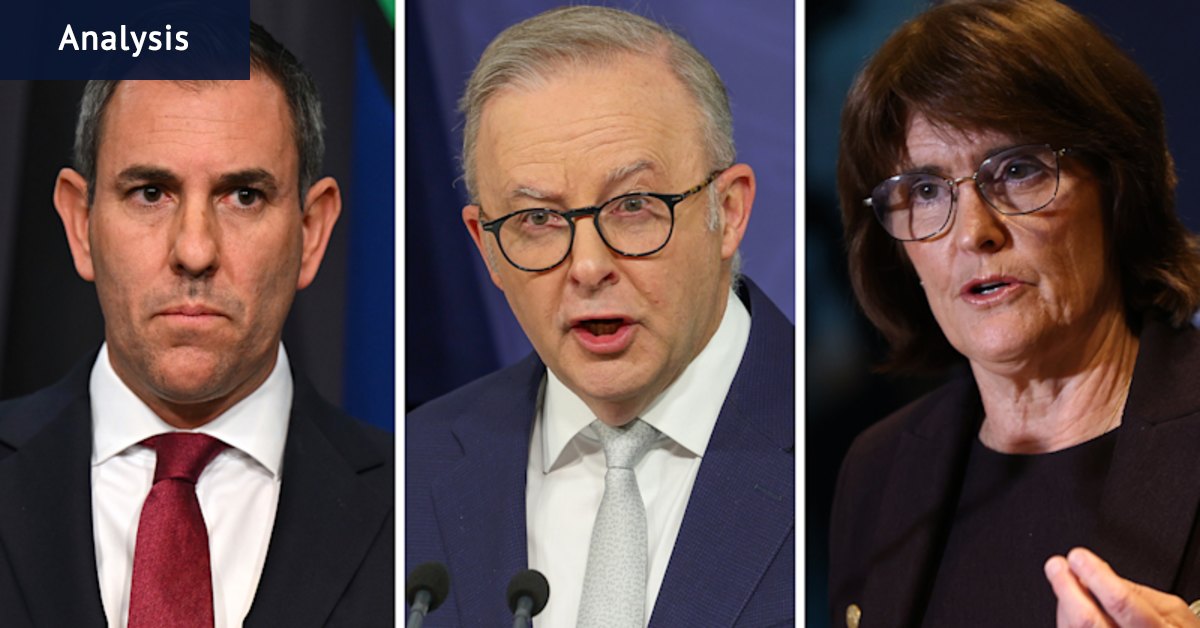
Treasurer Jim Chalmers, Prime Minister Anthony Albanese and Reserve Bank governor Michele Bullock.AAP, Dylan Coker, Dominic LorrimerDay after day in question time, the opposition targets Chalmers and (optimistically) suggests it’s time for Albanese to give his treasurer the flick.
That’s not going to happen, but Albanese’s near-unprecedented intervention in this masthead – criticising the bank’s series of interest rates, the only tool at its disposal, to try to bring price growth under control – is a deliberately populist move, and one designed to take the heat off Chalmers.
Reserve Bank governor Michele Bullock has herself used the term “blunt instrument” to describe the bank’s power to raise or lower the cash rate, depending on economic circumstances, to control price growth.
Albanese’s intervention is surgical but, coming from the leader of the country, it carries weight: the prime minister chose to use the same term as Bullock to ensure he can’t be accused of going too far or too hard in his criticism of the independent body. But his comment still clearly signals he is unhappy about the decisions the bank has taken and their impact on households.
And that subtlety will be lost on many, if not most voters; instead, what the average person will hear is the prime minister criticising an institution that is making most Australians’ lives more difficult by hiking rates and over and over again.
That is exactly what Albanese wants them to hear.
Mired in unpopularity, facing growing calls to cut government spending and with seemingly no near-term end to the international factors contributing to inflation, the prime minister has flicked the switch to populist.
Not coincidentally, the Australian Council of Trade Unions has been criticising the RBA for months about its consistent rate hikes, warning of the deep stress it is placing on households, the flow-on impact of increasing unemployment and the fact that rate rises are not addressing the root causes of inflation, some of which come from overseas.
Many Labor MPs agree with this criticism and are concerned the series of rate rises are badly hurting their constituents and, in turn, sinking their chances of being re-elected when Australians next go to the polls in about 18 months time.
Even Bernie Fraser, the former governor of the RBA under Paul Keating, suggested to Chalmers recently that he needed to not be “quite so polite” to the central bank because the series of interest rate rises “won’t do much to solve the inflation problem”.
Labor does need to cut spending growth too and, in his interview, Albanese signalled there will be cuts in the mid-year budget update, due in early December. He signalled the government was intent on pursuing new measures to promote economic growth, another rhetorical shift from the prime minister.
Chalmers had a reasonable point when he asked his opponents during an appearance on the Inside Politics podcast to nominate where they would start cutting spending. Opposition leader Angus Taylor has started the process of outlining where a future Coalition government would find savings.
But Albanese has no intention of letting it get to the point where a Coalition government is a realistic prospect, and his populist turn on the RBA is designed to do just that, by sidelining criticism of the government and starting a new conversation about how the central bank is to blame.
The RBA governor and her board are independent and are unlikely to change their minds on a rate rise, especially this close to next Tuesday’s meeting. Australians can likely still expect another rate rise next week.
But for Albanese, it’s a win-win situation: either the bank raises rates, and he can claim to be on the side of households that are struggling with the cost of living, or (however improbable it might be) the bank puts off a rate rise next week, and the prime minister can claim some of the credit for staying their hand.
It’s smart politics on the part of Albanese. With Christmas approaching, Australians just want a bit of economic relief.
However, to fix the problem, the prime minister is going to have to do more than just jawbone the central bank.
Cut through the noise of federal politics with news, views and expert analysis. Subscribers can sign up to our weekly Inside Politics newsletter.
You have reached your maximum number of saved items.
Remove items from your saved list to add more.
You've used all of your gift articles. 3 more will become available on the 1st of every month.