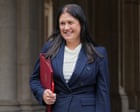
Keisha Lance Bottoms leads 8 Black women who won statewide in Georgia - USA Today
Black women in Georgia made history on Nov. 3, and not just because Keisha Lance Bottoms will soon be the nation's first Black female governor. A record-obliterating eight Black women won statewide office in the Peach State.
In addition to Bottoms, former Fulton County judge and Biden administration USDA official Penny Brown Reynolds was elected as Georgia's secretary of state, and current Georgia state representative and former prosecutor Tanya Miller will now serve as the state's attorney general.
Lydia Powell was elected as Georgia state schools superintendent; Katherine Juhan-Arnold as agriculture commissioner; Keisha Sean Waites as insurance commissioner; Nikki Porcher as labor commissioner; and Sheila Edwards as a state public service commissioner.
All eight women are Democrats. And, they are all replacing Republican White men, a first for a state which President Donald Trump carried by more than 2 percentage points in the 2024 presidential race.
As a result, 10 of Georgia’s 15 top statewide elected officials will soon be Black.
"Georgia, we sent a message loud and clear. That we want a leader who will put Georgia first and who will stand up to all the chaos coming out of Washington, DC," Lance Bottoms said during her election night victory speech. "But even more importantly, you sent the message that in these times of division and acrimony, you believe in something foundational, and that is hope."
Georgia House Minority Leader Rep. Carolyn Hugley, a Black woman, is also poised to become the state speaker of the House as Democrats will take over for the first time in more than 20 years.
"The South is the new battleground, and it starts right here in Georgia," Hugley told supporters during an online meeting on Sept. 23. "The map of opportunity runs across the South, and the road to a Democratic South runs through the Georgia House Caucus. What happens here in November will tell the story of what is possible for state legislators across the region."
Hugley told USA TODAY that Bottoms and the other seven victorious Black women know that with "history comes great responsibility and all of these wonderful, talented women know that and they are ready to go."
"It is remarkable. Black women have definitely reached a point where they can not only run and be taken seriously for leadership positions in major parties," Gillespie said. "It's both surprising and not surprising because Black women make up a larger share of the electorate, so your average Democratic voter in Georgia is likely to be a Black woman."
Miller said in her victory speech she will fight for all of Georgia.
"Whether you live in Atlanta or Albany, Savannah or Rome, Macon or the mountains of North Georgia, you deserve an attorney general who will protect your family, your rights, and uphold the Constitution," Miller said. "The people, that is my solemn obligation to put the people first. We will follow the law, but we will not follow political orders, because the attorney general of Georgia is not the personal lawyer of the president."
Georgia's new statewide leadership comes as the state is transitioning into a majority-minority population, according to 2025 U.S. Census figures. People of color (Blacks, Hispanics, Asian Americans) now make up nearly 51% of the state's population. Whites now comprise 49%, down from 65% in 2000, Census statistics show.
Progressive activists in the state say that sufficient turnout from the state's non-White majority can ensure Democratic victories.
"It’s no coincidence they won," said Helen Butler, executive director of the Georgia Coalition for the Peoples' Agenda. Butler's Atlanta-based nonprofit was among many conducting voter drives across Georgia. "Numbers make a difference."
Before the 2026 midterm elections, women held 77 of the Georgia General Assembly's 236 seats, accounting for 32.6% of state lawmakers, according to the Center for American Women and Politics at Rutgers University. That included 12 women in the 56-member state Senate and 65 women in the 180-member state House.
The diverse voter growth has been an ongoing trend for the last six years, Ranada Robinson, senior director of research and strategy at Georgia Alliance for Progress, a progressive advocacy organization, told USA TODAY.
More than 4.1 million ballots have been cast in the state in the 2026 midterm election, Georgia Secretary of State Brad Raffensperger announced on Nov. 3. That's slightly higher than the 3.9 million votes counted in the 2022 midterms.
The most common Democratic voter in a Georgia primary election is a Black woman, and Black voters have been the state Democratic Party's majority primary voters since 2010, according to Emory's Gillespie and Charles Bullock, a longtime political science professor at the University of Georgia.
"Most votes come from Black women and, to some extent, these are women getting behind other women. Black women have never had this much influence on a state in the history of the United States, up until this point," Bullock said. "This is not only a partisan transformation, but a racial and gender transformation, too."
What likely occurred in Georgia was a very strong turnout among Black voters, and a good percentage of moderate white, Latino, Asian and young voters choosing Democrats, according to Bullock. And that benefited the Black female constituency seeking state offices.
"Many people have said for years that Black women are the lifeblood of the Democratic Party, whether they are candidates, activists or volunteers. And now they are becoming officeholders," Bullock said.
The Atlanta metro area, with 6.5 million residents, accounts for about 57% of Georgia's overall population of 11.3 million, Census figures show. Gillespie added that the Black women who won statewide positions also demonstrate "the political strength of the greater Atlanta metro area."
Reynolds told WSB-TV a day after being declared secretary of state-elect that she understands the "historic moment and seriousness" of what she and her colleagues accomplished.
While roles like state insurance and labor commissioner might be more low-profile, Reynolds' role as secretary of state will be in the spotlight in 2028, particularly as Trump's effort to overturn the 2020 election centered on getting Raffensperger to find him "11,780 votes" to reverse his narrow loss in the state.
"But I have to get past history now and think about the future," Reynolds said. "To be the person who has to oversee our elections, particularly our 2028 presidential election, it’s a serious matter."
Former Georgia state House minority leader Stacey Abrams blazed the trail the winning candidates followed. Abrams became the first Black woman to run for governor as a major-party candidate in any state as the Democratic nominee in 2018 and 2022, losing to Republican Gov. Brian Kemp by 1 percentage point in 2018 and by 7 percentage points in 2022.
She is now one of the nation's more prominent voting rights advocates, having formed organizations to combat voter suppression, including Fair Fight Action, Fair Count and the Southern Economic Advancement Project.
"There's no doubt that Stacey Abrams helped to mobilize the Black vote not only in Georgia, but in other states for many years, that we’re now finally seeing the fruits of her effortsand others who have organized voters to get to this moment," said Caroline Heldman, a politics and gender studies professor at Occidental College in Los Angeles.
"Look at what happened in Georgia? I mean, can you imagine little Black girls knowing their governor's name is Keisha?" Heldman said. "It could inspire a new generation to run for public office."
Abrams, in a social media post on Nov. 4, said victories in the South and across the country "transformed what we imagine for America." Abrams said she was grateful to the "countless organizers and volunteers" who made it happen.
"But the victory we seek is not merely an election; it is a reclamation of our power and our voices – and that requires bold action by our newly elected leaders and persistent, lasting engagement by the Americans who voted in the millions for change," Abrams said.
However, Bullock, the Georgia professor, said what happened in Georgia is not an established trend.
"We have to go through several more voting cycles," Bullock said. "And if the Democrats can hold on to these offices, then yeah, we will look back at 2026 to where it all started."