Inside the fierce fight to be Toronto’s mayor: the ground war, the tight polls and those negative ads - Toronto Star
The final days of the Toronto election and the water proposal that dealt a decisive blow to Brad Bradford.
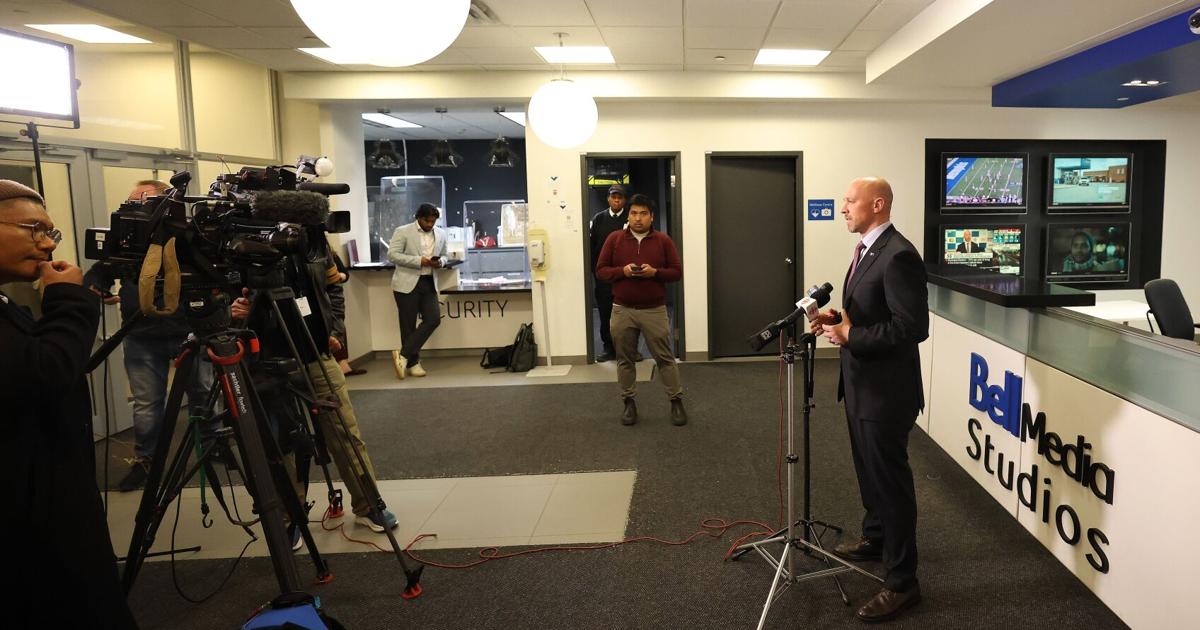
Brad Bradford talks to media after the final mayoral debate on Oct.22, after which his team felt buoyant at their candidate’s chances of winning the election.
As Brad Bradford walked off the debate stage at a Scarborough TV studio four days before the Toronto election, the mood on his team was buoyant.
After months of relentless campaigning, their candidate appeared to have momentum behind him. Some public polls showed he had closed the gap on Olivia Chow, and the race was now a dead heat. And while his team had expected the incumbent mayor to try to land a knockout punch in the final debate, hosted by CP24, she went after him, but they didn’t believe she had dealt a decisive blow.
“It felt like months and months of hard work (were paying off),” said Mike Van Soelen, Bradford’s campaign co-chair. “We were feeling good.”
That night would turn out to be the high-water mark of Bradford’s campaign. Three days later, on the eve of the election, his team’s optimism was fading. By Sunday, pollsters once reporting a Bradford surge were pumping out unanimous results: Chow was ahead. While Bradford’s team held onto hope, some feared the door to victory had closed.
They were right. On election day, the mayor won by a comfortable margin of about 13 percentage points.
Like much of what happened during the campaign, the two candidates’ teams disagree on what caused what appeared to be a late swing in the final days — and even whether Bradford was ever within touching distance of a win. Each side says it was the other campaign that leaned harder into negative messaging.
Van Soelen was certain there was a shift, which he described as the result of a “negative onslaught” of online comments and ads that hit Bradford in the 72 hours after the debate. Van Soelen took that as a sign the attacks Chow’s team unleashed in the campaign’s final stages were taking hold. Those attacks accused Bradford of buddying up with a Trump supporter, threatening to close libraries — and even suggested he would pollute children’s drinking water.
Chow’s camp “went decidedly negative” and beat Bradford in the final days, Van Soelen said. “It came so fast and furious … It was effective.”
But Chow’s team rejects the claim that they went negative. Instead, they say the campaign had a consistent mix of positive and critical messaging throughout the race. What changed in the final days, they say, was that voters started paying attention to the election. When they did, they didn’t like what Bradford was offering.
“Nothing actually changed in the last 10 days of the campaign. There was never a period where Brad’s campaign had successfully narrowed the gap to the point where they were going to win on election day,” said Karla Webber-Gallagher, Chow’s campaign manager.
“As people got to know him, his unfavourables went way up and his favourables started to slide.”
On the Friday before election day, Chow made her closing argument to voters. It was an optimistic message. Standing in front of the rental building in St. James Town where she grew up after immigrating from Hong Kong, she recalled how the neighbourhood shaped her principles.
“Our city has changed a lot. But in all the important ways, I have not,” Chow said. “I’m still the kid from St. James Town who is in awe of our city and loves its people, and who has dedicated herself to helping others, to lifting people up, and listening.”
Meanwhile, her campaign had aimed a sharp attack at a central plank of Bradford’s platform.
Just over a week out from the Oct. 26 election day, Chow’s campaign started running an ad on Facebook and Instagram that opened with a child getting a glass of water at the family kitchen sink. But as she brings the glass to her lips, there’s something wrong: the water is filthy.
An ad on Facebook by Olivia Chow’s campaign in the final week of the 2026 municipal election about Brad Bradford’s proposed water utility plan played on voter fears.
“Our water should never be for sale,” intones a voice-over. A headline about the deadly Walkerton water disaster flashes on the screen, before the closing tag line: “We can’t trust Brad Bradford with our water.”
The ad garnered nearly a million impressions, according to an expert analysis of the Meta ad library, and was the strongest version of an attack Chow had been making for weeks against Bradford’s plan to turn Toronto Water, a city division, into a utility with an independent board, like Toronto Hydro.
Bradford said the plan would help cut rates and other taxes, offset by debt-financing. Several legal and government finance experts described it as high risk.
Immediately after Bradford announced the proposal on Sept. 28, Chow criticized the plan and for the next four weeks accused Bradford of wanting to surrender control of Toronto’s water to the province, and open the door to privatizing some of North America’s cleanest drinking water.
Olivia Chow held a press conference on Oct. 21 with environmentalist David Suzuki to blast Brad Bradford’s water proposal.
Throughout October, the proposal also came under fire from GTA bureaucrats, the union representing workers at treatment plants, which published a legal analysis, and former mayors including David Miller and John Tory. Toward the final days of the campaign, Chow also tapped trusted environmental titan David Suzuki to speak out when he was in town.
According to an Oct. 20 poll conducted by Pollara, and commissioned by CUPE Local 416, which had endorsed Chow, 62 per cent of Torontonians said they are concerned about the possibility of Toronto Water being privatized. It matched results from another poll commissioned by TCEU Local 416, which also published an open letter with 15 incumbent councillors who opposed the plan across the political spectrum.
Chow’s campaign co-chair Andrew Bevan agreed when asked whether their campaign ramped up attacks approaching election day against Bradford’s water proposal.
Bevan speculated that Bradford proposed the idea as a way to generate potential revenue to pay for his other campaign promises, but “it meant going down an avenue that I think there was no appetite for whatsoever.”
Bradford repeatedly rejected Chow’s assertions about privatization as “fear-mongering” and said he had no intention of selling off the water system. His team thought the drinking water ad was dishonest.
“Are they proud of themselves?” said former campaign spokesperson Laryssa Waler in an interview this week. “That they had to lie about poisoning children to win?”
Webber-Gallagher disagreed that the ad was misleading or hyperbolic.
She said there was “plenty of evidence” that a proposal such as Bradford’s could pose a safety risk.
According to some on Bradford’s team, they started to sense a shift in their favour the final week of September, when they started rolling out major policies.
The following Tuesday, long-shot candidate Chris Alexander, seen as a distraction to Bradford’s campaign, dropped out. Bradford’s campaign thought their candidate did well in three straight head-to-head debates against Chow that week.
They also saw encouraging signs in advance voting, which started that Tuesday. There was high turnout in wards expected to lean toward Bradford, including Eglinton-Lawrence, home to a large population of Jewish voters, many of whom were perceived to be angry at Chow over her handling of the fallout of the Oct. 7, 2023 massacre in Israel and the Gaza War.
In retrospect, some of those signs were false positives. Election results released this week showed Chow won the advance polls by 9.8 percentage points, winning 18 of 25 wards.
Chow’s campaign says they spent the final weeks doing what they had since she started campaigning in early September — mixing positive messages highlighting what they saw as the mayor’s trustworthiness and contrasting that with what they described as Bradford’s dishonesty. While there was criticism of their opponent, “it was always done in an overarching frame of (Chow’s) relentless positivity about both the campaign and the city,” Bevan said.
During her campaign, Olivia Chow also included positive messages such as pledging a reduced fare cap and a fourth year of fare freezes.
She made optimistic speeches in the final days where she talked about her vision for Toronto surrounded by supporters and families. She ran ads touting endorsements from politicians, her plans to keep TTC fares low and feed school kids, and a 30-second spot telling residents she wouldn’t stop fighting until the city “works for you.”
She also held a press conference outside a library, warning that Bradford could close libraries if he were elected, and held another outside an apartment in his ward where she had accused him of neglecting tenants.
Her critiques of Bradford included ads accusing him of “flipflopping” on key issues, highlighting his support for data centres and cautioning that his proposal of an independent budget review could lead to service cuts.
One ad that received tens of thousands of impressions in the Chow campaign’s final days said he had been holding events with Donald Trump supporters, highlighted his campaign manager’s work for Conservative Leader Pierre Poilievre and referenced an endorsement from “far-right extremists” that Bradford had disavowed.
A screen capture from a video by Olivia Chow’s campaign targetting Brad Bradford for his relationship with Salman Sima in the 2026 election.
Bradford’s camp says it wasn’t until the final days that they started to feel the sting of Chow’s attacks.
According to internal campaign data viewed by the Star, on the Friday before election day, they estimated there were 4.1 negative online comments to each positive comment about Bradford. Chow’s ratio was 4.6 to 1. By Sunday, Bradford’s negatives had shot up, to more than eight unfavourable comments to every one positive.
Webber-Gallagher said she believed voters started to tune in to what had been a “sleepy” election; reports of the polls getting closer also snapped the public to attention.
By that point, Chow had done “a good job of setting the stage for the campaign to be about trust and (for voters) to have this idea that Bradford was potentially unreliable,” she said.
Webber-Gallagher argued that it was Bradford’s campaign, not Chow’s, that was based on negativity. One of his core themes was that the city wasn’t working, and voters were right to feel unsafe, despite some statistics showing crime rates have fallen.
ABC Toronto, a municipal advocacy group that backed Bradford, ran ads before the campaign calling Chow a “failed mayor” who, they claimed, didn’t do enough to prevent poverty and crime.
Bradford was trying to paint Toronto as “Gotham” and saying, “we need Batman,” Webber-Gallagher said. His message was that the city was in rough shape, “that you were going to walk out of your house and horrible things were going happen to you.”
Bradford’s campaign argues they were the ones who had the more positive message, particularly in the final days.
In his closing argument, he pitched a vision of positive change that could make Toronto a “beautiful and formidable city.”
While Chow’s team says her tactics didn’t turn more negative, her campaign did increase its advertising in the closing stages, which Webber-Gallagher said was always their plan.
Political consultant Harneet Singh, whose company, EOK Consults, tracked both campaigns’ spending on Meta, found that Chow spent twice as much as Bradford in the final 30 days of the campaign. This ramped up dramatically in the final week, he said, with Chow’s team spending more than triple what her opponent spent.
“We saw historic levels of spending on digital ads,” said Singh, who said he thought ads by the Chow campaign were uncommonly negative for an incumbent.
Waler said that because her candidate was up against a veteran politician with tremendous name recognition they had to hit the accelerator on his campaign as soon as possible, leaving them little money at the end. Chow, meanwhile, didn’t start campaigning in earnest until after Labour Day.
Waler said she felt their efforts pulled in the maximum amount of votes they could. Most any other year the 404,013 votes Bradford got would have been enough to win. But Chow received far more, 532,201, a record-breaking turnout Waler said no centrist or conservative could ever match in Toronto until they have a true answer to Progress Toronto, the influential third-party advocacy group that backed Chow.
“We could have the better platform, win every debate — all (Chow) had to do was keep her head above water and Progress Toronto would do the rest,” she said.
Progress Toronto’s efforts were part of Chow’s formidable ground game, which Bradford has cited as a factor in her win. Her attacks, combined with a get-out-the-vote effort “that had basically every organization, every volunteer with the unions go out and pull votes” was effective, he said on a talk show a day after the election. “We had like a thousand volunteers. But they had (10 times that).”
Saman Tabasinejad, executive director of advocacy group Progress Toronto, said its volunteers targeted areas where Ana Bailão defeated Chow in 2023, covering them collectively with 50,000 flyers.
Progress Toronto’s executive director, Saman Tabasinejad, said it has as many as 3,000 volunteers in its registry, of whom about 360 worked regularly during the election, door-knocking for local candidates and spreading flyers around the city. She said the group — registered as a third-party advertiser in the election — also spent about $11,000 on digital ads. Chow’s campaign said it had more than 2,000 volunteers.
Progress Toronto had a sophisticated information-spreading system. Each neighbourhood in the city got bespoke leaflets: in Scarborough, for example, residents received flyers about Bradford’s support of data centres. The group also didn’t shy away from visiting houses with Bradford signs in their lawns.
Digital advertising and “flyering” ramped up considerably in the last two weeks of the campaign. In particular, Tabasinejad said, volunteers targeted areas where Ana Bailão defeated Chow in 2023, covering them collectively with 50,000 flyers.
“The water issue was too hot, it boiled over,” said Tabasinejad. “He couldn’t handle it or figure out how to turn down the temp. We were relentless with it.”
Meanwhile, ABC Toronto — initially hailed as the right-of-centre answer to Progress Toronto — pursued a different strategy. While it also endorsed a slate of candidates, including Bradford, it did not register as a third-party advertiser. Instead, once the election started, it pivoted to paying to promote issues-based messaging that deliberately avoided supporting or critiquing candidates.
The group’s executive director, Kelly Aizicowitz, said ABC is discussing areas for improvement, but that the board “feels pretty good” about its efforts. Come the next election, in 2030, she said they might try to get more boots on the ground.
“This was our first kick at the can,” said Aizicowitz. “Progress Toronto has been at this since 2018. They’ve had the time to build.”
While the water issue created a vulnerability for Bradford, Van Soelen said the campaign didn’t regret pitching it. “The idea that if we hadn’t put forward water there wouldn’t have been an equally energetic push on some other aspect of our agenda is foolhardy,” he said.
David Valentin, principal at polling and research firm Liaison Strategies, said a lot of factors ultimately contributed to Bradford’s loss but the water utility in the closing weeks served as a last-minute wedge issue.
“I think both candidates have engaged in what I consider to be hyperbole,” said Valentin. “And that’s par for the course. That’s just politics.”
Ben Spurr is the Star's city hall bureau chief, based in Toronto. Reach him by email at bspurr@thestar.ca or follow him on X: @BenSpurr.
Mahdis Habibinia is part of the Star's city hall bureau, based in Toronto. Reach her via email: mhabibinia@thestar.ca
Ben Cohen is part of the Star's city hall bureau, based in Toronto. Follow him on X: @bcohenn.