I will always defend the right to be a bigot. It’s hypocrisy that annoys me more
You have reached your maximum number of saved items.
Remove items from your saved list to add more.
You've used all of your gift articles. 3 more will become available on the 1st of every month.
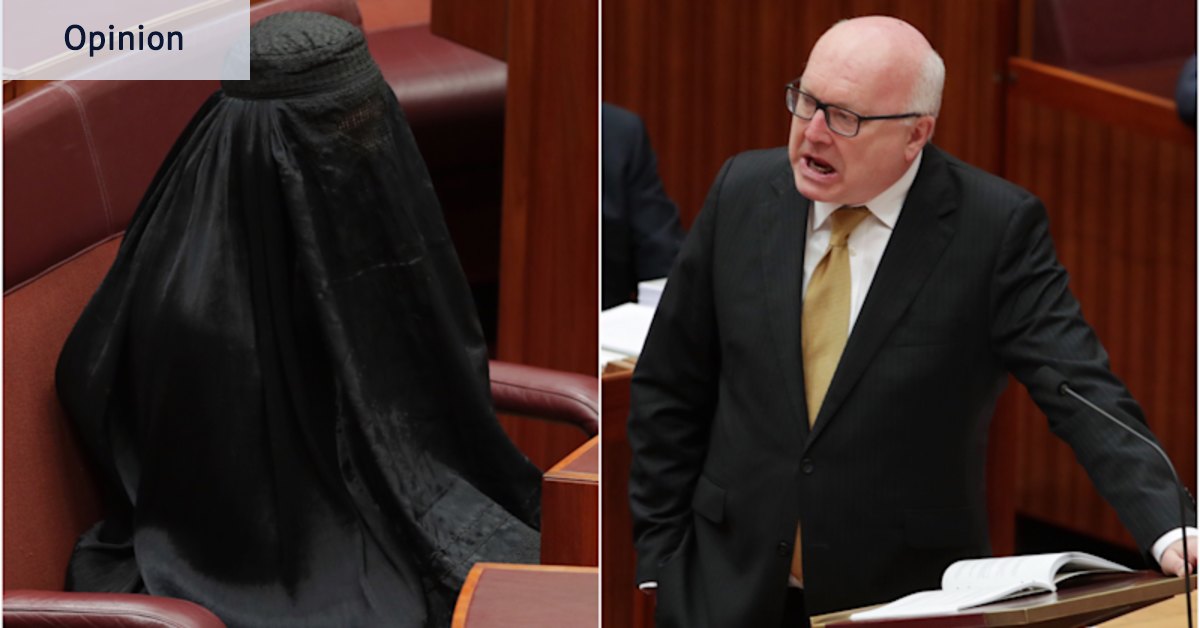
During the 18 years I spent in parliament, nothing I said won more praise than the brief spontaneous speech I made in August 2017 when Pauline Hanson walked onto the Senate floor wearing a burqa. Her motives were obvious – to demean Australia’s Muslim citizens by ridiculing a cultural practice that is important to many of them. As a display of ignorance, prejudice and bigotry, it could not have been more blatant: Hanson doesn’t do dog-whistling. It astonishes me that, more than nine years later, complete strangers still occasionally approach me on the street and at airports to congratulate me on that speech and even, sometimes, to ask for selfies.
Senator Pauline Hanson wears a burqa during question time in August 2017. Andrew MearesBy contrast, nothing I ever said attracted more derision than the blunt observation I made during the debate on section 18C of the Racial Discrimination Act, that “people do have a right to be bigots”. The outrage of the left was characteristically Pavlovian. The reaction of many on the right was just as hostile, for different reasons. Some were annoyed that my frankness had spoiled the chance of reform. (It didn’t – there was always a rock-solid Senate majority against amending the section.) Others were aggrieved that they thought I was referring to them. (No comment.) One prominent figure at the Institute of Public Affairs – whose influence had largely driven the Tony Abbott government to this ultimately fruitless exercise – even promoted the conspiracy theory that I had made the remark deliberately in order to kill the debate. That attributes to me a level of Machiavellian subtlety I honestly don’t possess. But kill it it certainly did.
While no serious person denies that what I said was legally accurate, I’ve sometimes been asked: how could someone who won such accolades for denouncing Hanson’s bigotry have said people have a right to be bigots?
That question reveals a profound misunderstanding about freedom of speech: what I said about burqas and what I said about bigots are two sides of exactly the same coin.
That was never better illustrated than by UK Prime Minister Andy Burnham during question time in the House of Commons last month. Hanson’s soulmate Nigel Farage rose to ask the prime minister the kind of nakedly Islamophobic question we often hear from Hanson. Burnham began his answer by quieting the loud jeering that erupted from MPs across the chamber. “There’s a lot we disagree on but he has a right to say it,” the PM said, before demolishing Farage and condemning the attitudes that underlay his question.
Philosophers, jurists and political leaders as various as Voltaire (via biographer Evelyn Beatrice Hall: “I disapprove of what you say but I would fight to the death for your right to say it”), John Stuart Mill (in chapter two of On Liberty), Oliver Wendell Holmes Jr (in numerous Supreme Court opinions on the First Amendment) and Barack Obama (who reacted to a racist slur against black basketball players by saying, “When ignorant folks want to advertise their ignorance … you just let them talk”) have, down the ages, made the same point.
I think being on the same side of the freedom of speech argument as Voltaire, Mill, Holmes and Obama puts me in pretty good company. And while we belong to different political traditions, Burnham’s response to Farage was exactly the same as my reaction to Hanson.
If only Australia’s Labor politicians had as much spine as their comrade at Westminster.
In recent years our parliament has not been the steadfast protector of freedom of speech that it should be. Nor have other institutions that ought to be among its most jealous guardians – the universities, the media, most of the commentariat. While routinely averring their commitment to free speech, they are only ever vigorous in its defence when the speaker says something they approve of.
The one institution that has, quietly but powerfully, consistently defended freedom of speech is the High Court.
Pauline Hanson and Mehreen Faruqi in the Senate in 2020.Alex EllinghausenOn Thursday the court granted leave to appeal the Federal Court’s decision in the Faruqi v Hanson case. Activists and commentators, ignorant of the legal issues in question, will predictably take sides on purely tribal grounds, barracking for Senator Faruqi or Senator Hanson as if this were a political contest.
The court, with reassuringly Olympian aloofness from public controversy, will pay no heed to those intemperate voices. It will methodically consider 18C in accordance with the jurisprudence it has developed over the past three decades, which recognises that, by necessary implication, freedom of political communication is an intrinsic feature of the system of parliamentary democracy the Constitution establishes.
Interestingly, among conservative lawyers, there are divided opinions. Recently, in duelling articles in Spectator Australia, the respected barrister Louise Clegg welcomed the appeal as an opportunity for the court to strike down s18C as a violation of the implied freedom. The University of Queensland’s James Allan – who shares Clegg’s loathing of the provision – took the opposite view. Allan – probably Australia’s most entertaining law professor, and certainly its most iconoclastic – is unalterably opposed to any expansion of Commonwealth power by the device of constitutional implication, even if that means using it to strike down so illiberal a provision.
I’ve got a lot of skin in the game when it comes to 18C. I’ve lost a fair bit of skin, too. It isn’t a natural human instinct to defend the right of people to express views that offend or infuriate us just as strongly as we would defend the rights of those who say things that gladden our hearts. But unless you’re equally willing to do both, you can’t be taken seriously about freedom of speech.
George Brandis is a former high commissioner to the UK, and a former Liberal senator and federal attorney-general. He is now a professor at the ANU’s National Security College.
You have reached your maximum number of saved items.
Remove items from your saved list to add more.
You've used all of your gift articles. 3 more will become available on the 1st of every month.