Hubble telescope could crash on Earth. Nasa racing to save aged observatory
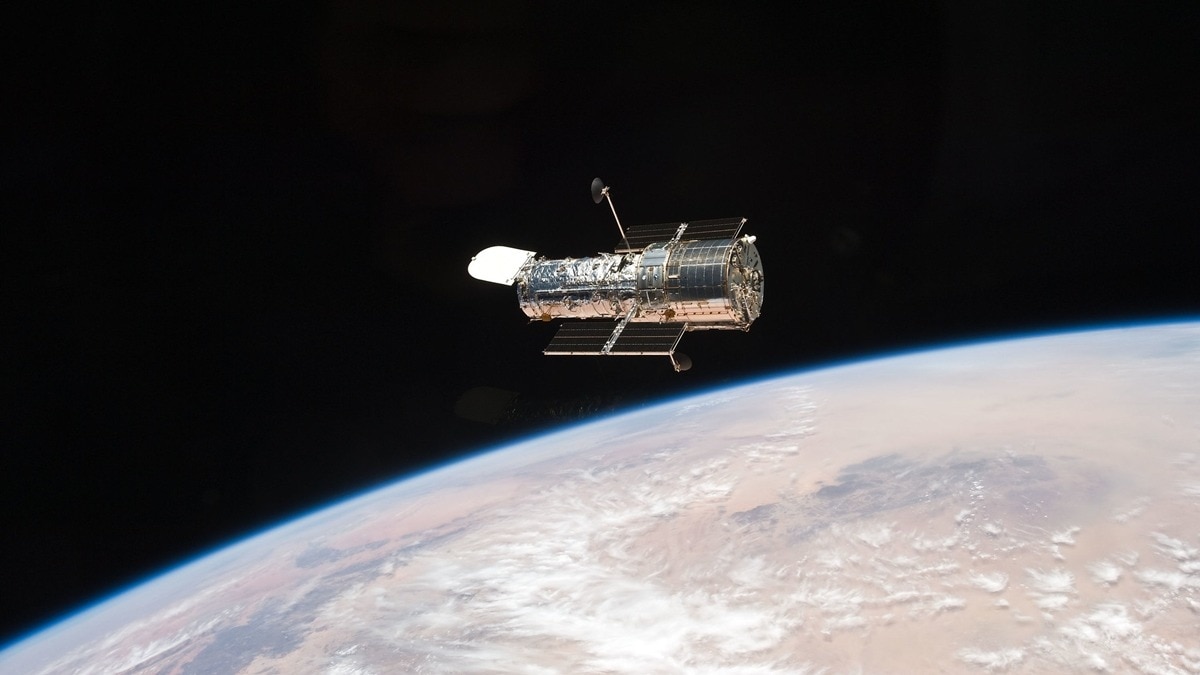
Nasa is exploring ways to save the Hubble Space Telescope from an eventual fiery plunge into Earth's atmosphere, as the iconic observatory slowly loses altitude after more than 35 years in orbit.
The space agency is seeking ideas from private companies to either push Hubble into a higher orbit, service and upgrade it, or find a way to safely retire it when its scientific mission ends. An image shows the Hubble Space Telescope being deployed on April 25, 1990. (Photo: Nasa)
The announcement comes amid another unplanned return of Nasa's Neil Gehrels Swift Observatory, a space telescope that spent nearly 22 years studying cosmic explosions.
Hubble, however, differs in the fact that the famed observatory still has years of scientific work ahead.
Nasa's latest assessment suggests it could fall back to Earth in 2033 or 2034 if no intervention is made.WHY IS HUBBLE TELESCOPE FALLING?
Hubble orbits Earth at an altitude of around 540 km, where the atmosphere is extremely thin but not entirely absent. Even this faint layer of gas creates resistance as the telescope moves through space. Pspspsp! Just in time for Halloween, NASA’s Hubble and James Webb Space Telescopes recently stared at an eerie star-forming scene within the Carina Nebula, a massive gas and dust cloud located approximately 7,500 light-years away from Earth. https://t.co/JL97aLGaAG— NASA Webb Telescope (@NASAWebb) October 30, 2026Over time, this drag slows Hubble down and gradually lowers its orbit.
Unlike some satellites, it does not have a propulsion system capable of regularly pushing itself back to a higher altitude.
Nasa estimates that any mission designed to raise Hubble's orbit would need to take place by 2032, leaving a limited window to develop and execute a rescue plan.HOW CAN HUBBLE BE POSSIBLY SAVED?
One possibility to save one of Nasa's most successful telescopes is to send a spacecraft to push Hubble into a higher orbit, allowing it to continue operating for several more years. An image shows the Hubble Space Telescope being serviced by astronauts. (Photo: Nasa)
This would mirror the Swift Boost mission that was meant to push the Swift Telescope into a higher orbit. The mission, however, was abandoned after the spacecraft meant to do the job ran into issues in orbit.
Nasa is also exploring whether a commercial spacecraft could similarly try to visit the telescope, service it or improve its capabilities.
A third option is to safely dispose of Hubble once its scientific work is complete, either by guiding it into a controlled descent or moving it to a safer orbit.
These are still proposals, not approved missions.
Nasa issued a request for information on October 29 to understand what private companies can offer and whether their ideas are practical and affordable.
Private space giant SpaceX is also conducting a study to see if it is possible to re-boost the flying observatory and give it new life. Nasa too has asked for additional information about commercial capabilities available to re-boost a satellite in orbit. An image from Hubble Space Telescope of NGC 4449, a dwarf galaxy. (Photo: Nasa) WHY HUBBLE TELESCOPE NEEDS TO BE SAVED
Launched in 1990, Hubble has transformed our understanding of the universe, capturing distant galaxies, observing stars being born and dying, and helping scientists estimate the age of the universe.
It is a joint project of Nasa and the European Space Agency (ESA), with operations overseen by Nasa's Goddard Space Flight Center.
Nasa is also developing its next flagship space telescope, but extending Hubble's life could give scientists more time to make discoveries before a new generation of observatories takes over.- Ends