EXPLAINER - What does Democratic control of Congress mean for Trump? - The Express Tribune
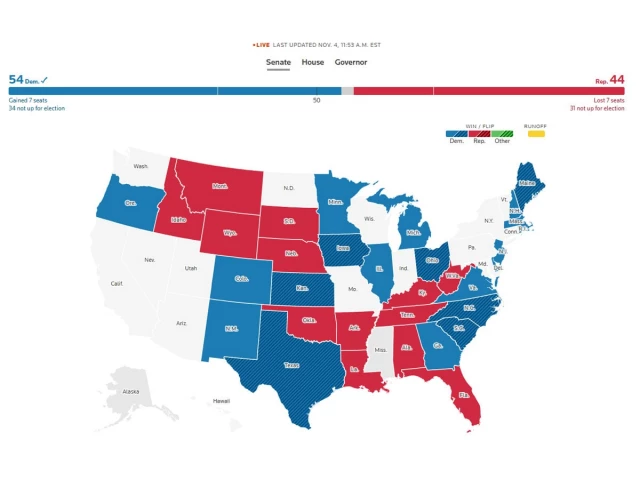
Democrats’ victory in the US midterm elections has handed them control of both chambers of Congress, setting up a period of divided government that could complicate President Donald Trump’s agenda during the final two years of his term.
Democrats on Tuesday secured a majority in both chambers of Congress, winning a projected 54 seats in the Senate and 224 seats in the House of Representatives.
When the new Congress convenes in January 2027, Trump will face a Democratic-controlled House of Representatives and Senate, limiting his ability to advance legislation and potentially complicating his administration’s spending priorities.
One of the biggest changes will be Democrats’ control of congressional committees in both chambers.
Committees can hold hearings, request government documents, and summon officials to testify. They can also issue subpoenas, although disputes over their authority and executive privilege can lead to legal challenges.
Scott Lucas, a professor of international politics at the Clinton Institute, University College Dublin, said that Democrats are more likely to focus on investigations and accountability.
A demonstrator wearing a frog costume and holding a "CLEAN HOUSE" banner near the White House in Washington, DC, during the US midterm elections on November 4, 2026. Photo: Reuters
These could include inquiries into Trump's stockholdings, potential insider trading involving his family, and the wealth he has accumulated while in office.
“What Democrats can also do because they now control the committees in both houses is have hearings for accountability,” he said.
Lucas also expects renewed scrutiny of the files related to convicted sex offender Jeffrey Epstein, with victims’ families and many Democrats saying the Justice Department has yet to release all the files required under a law passed last year.
“I think you'll see hearings reopen on the Epstein files,” he said.
Other possible inquiries could focus on federal agencies and whether they have been weakened or pressured by the administration, "like the Justice Department to restore the independence of those agencies,” Lucas said.
Democrats will be able to introduce legislation reflecting their own priorities, including proposals on health care, education, and immigration. Lawmakers could also seek legislation to address potential conflicts of interest involving elected officials.
“For example, trying to seek accountability on stockholdings might be a bill that you see very clearly so that representatives don't have conflicts of interest,” he said.
“They could proceed with proposed legislation on health, on education, to push back on the immigration crackdown.”
Supporters react after media outlets projected Democratic Senate candidate James Talarico's victory in Austin, Texas. Photo: Reuters
However, passing such measures will be difficult if Trump opposes them.
“Donald Trump has already been ruling through executive orders, and there is only one major bill that he has passed ... but Democrats can propose their own legislation. They can put forth their own priorities.”
“Now all of that legislation could get vetoed by Trump, of course, and you need a two-thirds majority to override that,” Lucas explained.
A presidential veto can be overturned only if two-thirds of members voting in both the House of Representatives and the Senate support the measure.
This means Democrats would need Republican support to enact major legislation over Trump's objections.
Lucas said some Republicans may become more willing to cooperate with them, as the election result could weaken Trump's influence over his own party and encourage some Republican lawmakers to distance themselves from the president.
Democrats will have greater influence over federal spending, including the defense budget, military operations, and foreign military assistance, as Congress controls government appropriations.
They could use budget negotiations to scrutinize Pentagon spending, demand greater transparency over military operations, including the ongoing Iran war, and seek changes to defend funding priorities.
However, the president retains authority as commander-in-chief, and funding already appropriated under existing laws can generally continue to be spent.
Lucas, however, said he would be surprised if Democrats deliberately pursued a government shutdown, describing such a move as irresponsible.
"I'd be very surprised if Democrats go for shutting down the government. That won't be responsible.”
Instead, he expects Democrats to wait and see how Trump responds to the new balance of power.
“I think they will wait to see if Trump wants to shut down the government, which is very possible if he feels he's not getting his way,” Lucas said.
Last year, the country witnessed the longest government-wide shutdown in history of 43 days, from Oct. 1 to Nov. 12, 2025, ending after Congress passed a funding measure that Trump signed into law.
A Democratic-controlled Senate will have the power to scrutinize and reject Trump’s nominees for federal judgeships, Cabinet positions, ambassadorships, and potential Supreme Court vacancies.
Democrats could also use oversight hearings to scrutinize senior administration officials.
Lucas suggested that Defense Secretary Pete Hegseth could face particular scrutiny if the months-long Iran war continues.
“They may open up hearings on certain officials like the Defense Secretary Pete Hegseth, especially if the Iran war continues to go so badly and he keeps urging the military,” Lucas said.
He also pointed to the possibility of congressional scrutiny of senior Justice Department officials.
“I think they will push back on other officials, maybe short of impeachment, like the head of the Justice Department, Todd Blanche, because he's effectively Trump's lawyer,” he said.
Democrats charge that Trump has weaponized and politicized the Justice Department, using it as a tool to target his political enemies.
Democrats could technically launch another impeachment process against Trump, as the House has the power to impeach a president with a simple majority.
But removing him from office would be much harder. Conviction in the Senate requires a two-thirds majority of senators present.
Trump was impeached twice during his first term, in 2019 over his dealings with Ukraine and in 2021 over his role in the events surrounding the Jan. 6 attack on the US Capitol. The Senate acquitted him in both cases.
Lucas does not expect Democrats to make impeachment their priority.
Senator-elect from Kansas Hamilton in Overland Park, November 3, 2026. Photo: Reuters
“Remember, you need a two-thirds majority to convict in the Senate, so you would need 67 seats. At most they're going to have 56 and more likely it's going to be around 54, maybe 55.”
Current projections put Senate Democrats at 54 seats.
Lucas said the emphasis would be on holding officials accountable rather than trying to remove Trump from office.
“I look for them more to go for those hearings for accountability rather than impeachment when it comes to Trump.”
The new Congress is scheduled to begin its term on Jan 3, 2027. Republicans retain control of both chambers until the current congressional term ends.
Democratic control will not automatically reverse Trump’s executive actions or remove his constitutional powers. However, it will give the opposition party greater authority to investigate his administration, challenge his legislative priorities, and influence federal spending.
The next two years could thus see increased congressional scrutiny, prolonged negotiations over government funding, and a more contested relationship between the White House and Capitol Hill.
Comments are moderated and generally will be posted if they are on-topic and not abusive.
This material may not be published, broadcast, rewritten, redistributed or derived from. Unless otherwise stated, all content is copyrighted © 2026 The Express Tribune.