Decoding the Triyamphawai Text: Unveiling the Secrets of the Niche Wall Surface and Frame Edge Area of the Large Mold Somdej Wat Rakang - Thairath English
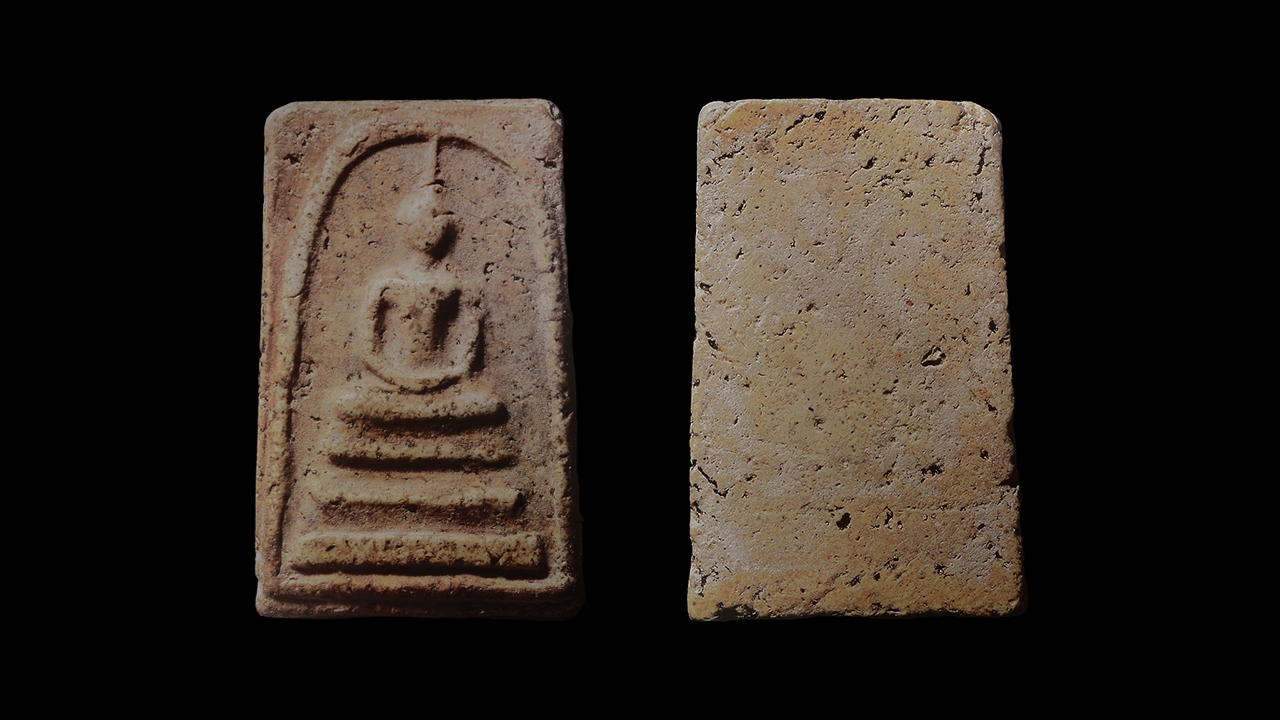
Somdej Wat Rakang’s large mold amulet designed by the venerable Somdej Phra Phutthachan (Toh Prommarangsi) is a mold with extensive intricate details.In the design process,there is a harmonious blend of ancient Thai art with Western artistic influences introduced to Thailand at that time. The design conceals various low-relief sculptural details. Now, “The Science of Somdej” invites readers to explore the Triyamphawai text to unravel the secrets of the “niche wall surface” and “frame edge area,” referencing the first volume of the "Priyortthathibai" amulet explanatory text as follows...
Triyamphawai states that the “niche wall surface area” refers to the area inside the niche frame between the Buddha image and the base, and the arch outline line (the split rattan arch). The niche wall surface is fairly smooth but not uniform like a drumhead, showing natural streaks from plaster shrinkage over time.There are minor marks but nota rough texture like the skin of a kaffir lime or wave-like ripples, which are characteristics of some fakes. When adjusting the lines to the same level as the Buddha image, one can observe the surface of the niche wall is slightly tilted inward from the frame edgeson all sides,sloping gently toward the Buddha and base, but this slope is nearly level. At the inner edge of the arch line, it blends into the niche wall surface and is not sharply defined likea wall foundationstanding on concrete that clearly separates the niche wall surface from the arch line. This is characteristic of a niche that has beencarefully carved deeply and clearly...
Meanwhile, the “frame edge area” refers to the space between the arch line and the frame edge (Triyamphawai likely means the mold boundary frame, but if it is cut close, the frame edge may be missing on some sides). Generally, this space remains at the top two corners due to the arch's curve and the top frame cut, which usually does not cut close to the arch, unlike the side and base frame cuts which typically cut flush with the arch. The surface level of the frame edge area should be level with or close to the niche wall surface. If it is higher, it indicates the wall surface has been carved to deepen the mold. The joint between the outer arch line and the frame edge area must blend smoothly, not sharply separated like the inner arch line and niche wall surface mentioned above.
Triyamphawai also classifies two frame types: a plain frame with a smooth surface and a “glass frame” type. The latterfeatures a double-layer frame with small raised ridgesrunning along the frame edges, parallel to the top and both sides. These ridges appear on the upper part; the lower part rarely shows them due to the close frame cut at the arch edge. The fine ridges are called “glass frame,” whichis considered the most beautiful frame type.For the glass frame mold, the frame edge surface at the top corners is slightly higher than the niche wall surface. The mold thickness is minimal, and the back often shows areca sheath marks or algae wrinkles clearly.”
“The Science of Somdej” draws on the above Triyamphawai information to explain further, combined with observations of the master-piece standard mold Somdej Wat Rakang amulet currently accepted as the standard, as follows...
Regarding the niche wall surface or the inner wall within the arch line, it is generally smooth (similar to the "frame edge area" outside the arch line) but not perfectly mirror-like or drumhead smooth as Triyamphawai compares. Initially, it may have been close to a mirror finish, but over time, natural aging or “time wrinkles” appear. The surface is not bumpy or wavy (excluding wear from use or poor environment). This is a key feature easy to observe for all Wat Rakang Somdej molds, not just the large mold. It can be compared with the master-piece amulet and, when compared to other surfaces such as the back and sides, this area is the most compact. “The Science of Somdej” has previously explained that this smooth surface is due to the production method, which involved pressing a lump of plaster material sized for one amulet into a soapstone mold (sometimes adding material for thickness). The mold is a relatively large flat plate with multiple carved Buddha molds on one plate. This is inferred from soapstone molds used for crafting royal dressed Buddha statues during King Rama IV and V’s reigns, around the same period as Somdej Toh’s Wat Rakang amulet production. The pressing likely used fingers to press the material into the mold cavity, then a wooden or similar flat board pressed from behind with tapping to fix the shape. Empirical evidence supporting this includes the “grooved back” type of large mold Wat Rakang Somdej, showing 2 to 3 wooden plank-like marks (the anonymous writer from "Precious" magazine identifies 4 back types: smooth back, custard back, areca sheath back, and grooved back). Conversely, if the mold was pressed onto the material, the front surface would not be compact. The question arises about the mold type used: a large soapstone mold would be inconvenient to press onto the material, or if cut into smaller molds for one amulet each, why press the mold onto the material placed underneath when pressing the material into the mold is much easier, both in preparation and pressing steps, and better for detailed craftsmanship.This is the case for Wat Rakang Somdej..
Pressing the mold onto the material is likely the method for Wat Bang Khun Phrom Somdej, where the mold is probably wooden, cut into single-mold blocks per amulet. Pressing the mold onto the material allows rapid production suited for less detailed work.For example, producingSomdej Wat Bang Khun Phrom amulets, which also show a key defect called “flared edges” caused specifically by this pressing method, a defect absent in Wat Rakang Somdej.
For the “frame edge area” between the split rattan arch and the mold boundary, Triyamphawai states that “the frame edge surface level must be equal to or close to the niche wall surface level; if higher, it means the wall was carved to deepen the mold.” It also notes that “for the glass frame mold, the frame edge surface at the upper corners is slightly higher than the niche wall surface.” Observing current master-piece large mold Wat Rakang Somdej amulets suggests that they mostly have glass frames. Those without glass frames may have had them cut off by trimming close to the arch line or worn down to invisibility.
“The Science of Somdej” additionally infers that originally, the frame edge surface, niche wall surface, and the outer surface beyond the glass frame (visible in amulets cut farther from the glass frame edge,such as the master-piece amuletnicknamed “Wide Wings”) were on the same plane—the original surface of the soapstone plate, which was the highest surface when carving began (as “The Science of Somdej” explained, following the carving methods of the traditional Ten Craftsmen group). The craftsman first outlined the glass frame or mold boundary as a rectangular frame, then shaved the surface inside this frame. At the frame edges, they scraped grooves forming raised boundary lines or glass frame ridges. Then, they began carving details inside the glass frame, sketching the split rattan arch line and carving the bird’s beak shape from the lower right corner of the arch line upward to the lower right corner of the base’s bottom tier. They then carved the base, continuing upward, followed by the Buddha image from the torso to the hair tip. Afterward, they carved the split rattan arch line (notice that the craftsman carves the left arch line slightly overlapping the mold boundary line, as “The Science of Somdej” explains this follows perspective principles). Subsequently, they refined the niche wall surface inside the arch line again in some amulets. This involved shaving the mold surface to gradually increase depth from bottom to top, enhancing the amulet’s dimensional beauty. This explains why the top of the “niche wall” is slightly lower than the “frame edge area” outside the arch line and also slopes inward toward the Buddha image, as observed by Triyamphawai.
The large mold Somdej Wat Rakang amulet has unique characteristics arising from a design blending ancient Thai and Western art seamlessly, especially in the “niche wall surface” and “frame edge area,” which contain some design secrets. Understanding these helps reveal the design background of this Wat Rakang Somdej mold and aids in recognizing genuine amulets from the venerable Somdej Toh.
Defect 1 The outer frame lines on all four sides of the Buddha are raised lines, with only the left frame line running down to between the Buddha’s elbow and disappearing into the arch line.
Defect 2 The mold frame line on the right side (Buddha’s side) is a raised line running continuously close to the lowest arch line.
Defect 3 The glass house arch line is relatively large and raised, resembling a split rattan line; inside the arch line is a vertical line from the base. The surface outside the arch line slopes slightly.
Defect 4 The Buddha’s face resembles a bael fruit.
Defect 5 Both ears are present, though sometimes not clearly attached.
Defect 6 At the curved arm-shoulder junction, the right shoulder has thicker material than the left.
Defect 7 The Buddha’s left knee protrudes higher than the first base tier.
Defect 8 The right knee protrudes lower than the first base tier.
Defect 9 The Buddha leans slightly to the right, while the first three base tiers lean slightly to the left, alternating opposite the Buddha’s lean.
Defect 10 The wall surface between the three base tiers: the wall between the first and second base tiers is level with the floor, while the wall between the torso and first base and between second and third base tiers is higher than the Buddha’s surface.
Defect 11 The outer surface outside the arch is slightly higher than the inner surface, almost invisible unless the amulet is tilted to reveal a line.
Defect 12 Between the torso (lap) and the arm ring, there is a distinct raised material representing the torso, especially from the knee upward to the arm ring, forming a clear V shape.
Defect 13 Both arms spread wider than in the first mold (similar to molds 3 and 4).
Defect 14 The hair is longer than in the first mold (similar to mold 3).
Defect 15 The topmost base tier is longer than in the first mold.
For further reading, visit the "Science of Somdej" page by Pol. Lt. Col. Komsan Sanongpong, with thanks to Assistant Professor Rangsarn Tosuwan for kindly providing images of another master-piece Wat Rakang Somdej amulet for educational purposes. Thanks also to the current owner of this beautiful, well-preserved, thick-textured, white-yellowish large mold Wat Rakang Somdej mold 2 or V-shaped chest mold (the anonymous author divides into 4 subtypes: 1st mold - principal Buddha mold, 3rd mold - barrel chest mold with very few examples, mostly 2nd mold, and 4th mold - hair breaking through arch mold with some examples but fewer than the 2nd). It features close-cut mold edges near the boundary frame line, with the top frame slightly separated from the arch line, and the left side cut close to the arch line. It exhibits all three genuine Somdej characteristics: grainy texture, worm trails, and needle-like pores. The mold shape matches the text, with the Buddha leaning slightly to the left up to the hair tip. The niche wall surface is generally smooth but shows aging streaks. The inner arch edge is perpendicular to the wall surface, indicating age. The back is smooth with wrinkles and crack marks, showing termite trails and oily stains. This is an excellent model for studying Wat Rakang Somdej amulets. More articles can be found in the "Science of Somdej" column. Science of Somdej
Author: Pol. Lt. Col. Komsan Sanongpong, former forensic police officer Facebook page: –Science of Somdej