
Dave Feschuk: Why it’s harder to be an NHL goalie in the age of sports betting (and Connor McDavid) - Toronto Star
It’s become common for NHL shot totals to fluctuate in real time. The effect is significant.
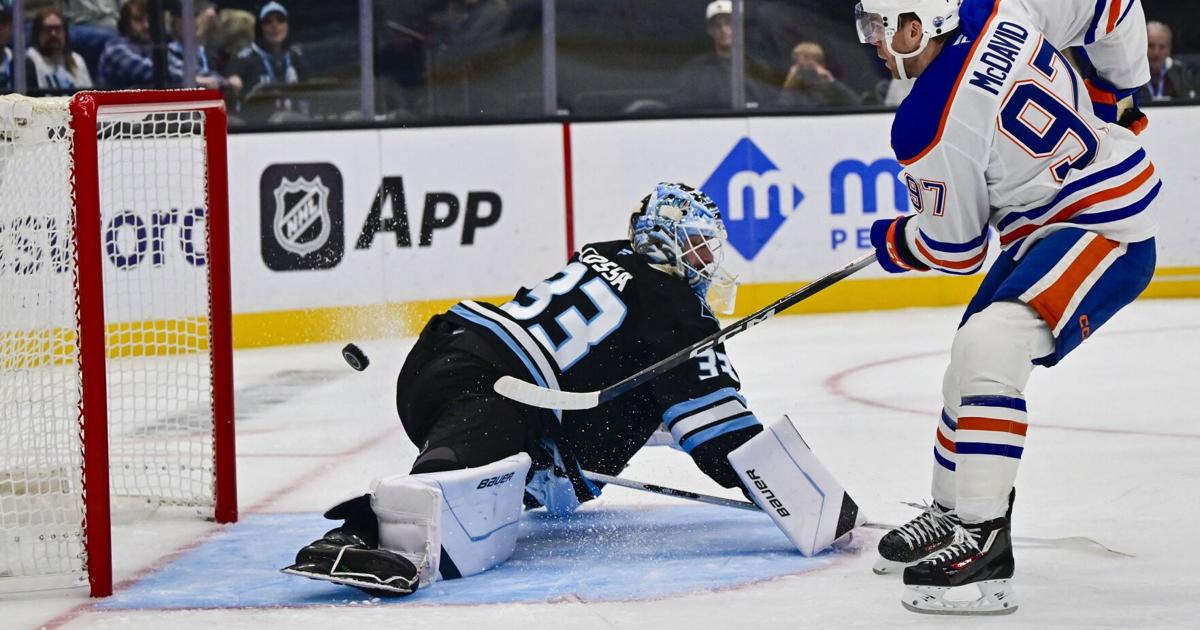
Edmonton superstar Connor McDavid, beating Utah Mammoth goalie Sebastian Cossa, is piling up points at a rate not seen since the Oilers’ golden age. He’s also the celebrity face of a sportsbook — another reason for goaltenders with dimming stats to loathe him.
Dave Feschuk is a Toronto-based sports columnist for the Star. Follow him on Twitter: @dfeschuk
Asked to explain the NHL’s ongoing downturn in save percentage, Maple Leafs goaltender Anthony Stolarz had a ready answer.
“Sports betting,” Stolarz said. “There’s no ifs, ands or buts about it.”
That might seem a counterintuitive answer. Heading into Friday night’s games, the league-average save percentage sat at a humble .890, on track for the lowest mark since 1992-93. And there’s plenty of evidence that an explosion of early-season offence has at least something to do with the trend. The peerless Connor McDavid, with 44 points in 17 games, is on pace for an unfathomable 217 points.
And if pucks still don’t get past goalies quite as frequently as they did in the 1980s, when Wayne Gretzky became the only player in history to eclipse the 200-point mark (and did it four times), they are going in at an awfully high rate. Before Friday, teams were allowing an average of 2.98 goals a game, on pace for the highest scoring year since 1995-96. We’re only about six weeks into the season, mind you, so maybe defence will catch up.
But why is Stolarz fingering sports betting? He’s among the goaltenders who have pointed out the NHL has put its statistical tracking methods under more scrutiny in an era where some of its partners take bets on shots-on-goal totals. Where once the tracking of shots was an inexact science relying on the eyes of a stat keeper in a press box, the process is now more stringent. Shots are audited during the game via video replay and information from puck-tracking chips. If the league didn’t keep more exacting tallies, surely they’d be hearing about it from outraged bettors.
As a result, it’s not uncommon to watch a team’s shot total fluctuate in real time.
“As a goalie, you look up and suddenly you go from 12 shots against to 10 shots,” Stolarz said. “They’re correcting that all the time.”
The effect appears to be significant. Just three seasons ago, NHL teams averaged 30.1 shots a game; this season, it’s 27.1. That affects save percentage. Allow three goals on 30 shots, after all, and you’re a .900 goaltender. Allow three goals on 27 shots and you’re at .889.
In a league where save percentages that start with an eight have long been synonymous with a minor-league future, the new normal is requiring a mind shift. As TSN analyst Jamie McLennan was saying last week on “Overdrive,” relaying a recent conversation with a goaltending coach: “There has to be a reset in everybody’s mindset about what good and great goaltending is today … With the amount of talent in the league, league average is (.891).”
Still, if betting is one factor, Stolarz acknowledged there are many others. There’s evidence players are choosier than ever about firing off shots. In a league where any shot used to be a good shot, there is now an emphasis on seeking out a better one.
“It’s insane,” Dallas Stars goaltender Jake Oettinger was quoted as saying late last season. “Guys will have it in the slot and they’re passing it, where I feel like 10 years ago it was just pucks on net.”
Perhaps as a reaction to conditions about a decade ago, when the league average peaked at a post-expansion high of .915 and there was a feeling a goaltender who was unscreened and set was unbeatable, many of today’s NHLers have been raised on at least one fundamental truth: The best way to beat a goaltender is to get him moving side to side. The best way to do that is with a cross-ice pass.
That puck was moving 🚀 #LetsGoOilers https://t.co/QWntgoIX4N
“When I was in Arizona, we called it the money line. It was an imaginary line from the middle of the net out to the blue line,” Oliver Ekman-Larsson, the Leafs defenceman, was saying this week. “And we were told if you got the puck across that line in the offensive zone, your odds of scoring went up like 21 per cent or something.”
The consequence: The game has become more lateral, which makes it harder on goaltenders. That’s just one of the many layers at play here. Another: The game is less physical than it’s probably ever been, in part because officiating geared toward offence has achieved the objective and handcuffed defencemen who, in previous generations, hooked and held and hacked with abandon to fewer whistles.
“I hate to say it, but I don’t think guys are scared to go to the net anymore,” said Toronto defenceman Troy Stecher.
Maybe more than anything, it’s hard not to acknowledge there’s been a leap in the skill of NHL skaters, perhaps in part because McDavid’s never-seen-before package of skills (now being showcased in his 12th NHL season) has allowed the trailing generation of pros to reimagine the game’s limits.
CONNOR MCDAVID WITH THE SHORTY 🗣️ https://t.co/bOJXc3AXu7
Stecher said he’s watched for years as younger and younger kids emulate McDavid’s preferred training protocols, specifically the Power Edge Pro system that couples high-speed puck handling with intricate edge work.
“I go home (to Vancouver) in this summer and there’s 14- and 15-year-olds that are way more skilled than I am,” Stecher said. “It’s amazing how good these kids are with their hands, their feet, and their vision.”
Seeing how McDavid is also the celebrity face of a sportsbook — he’s all about “responsible gambling content,” of course — there’s double reason for goaltenders with dimming stats to loathe him. Not that one player or one factor can explain a game’s evolution. There’s a lot at play. But lately it seems most of it is making it more difficult to be an NHL goaltender with a save percentage that begins with a nine.
Error! Sorry, there was an error processing your request.
There was a problem with the recaptcha. Please try again.
You may unsubscribe at any time. By signing up, you agree to our terms of use and privacy policy. This site is protected by reCAPTCHA and the Google privacy policy and terms of service apply.
Opinion articles are based on the author’s interpretations and judgments of facts, data and events. More details
Dave Feschuk is a Toronto-based sports columnist for the Star. Follow him on Twitter: @dfeschuk


