Costs jump for senior living project - Bangkok Post
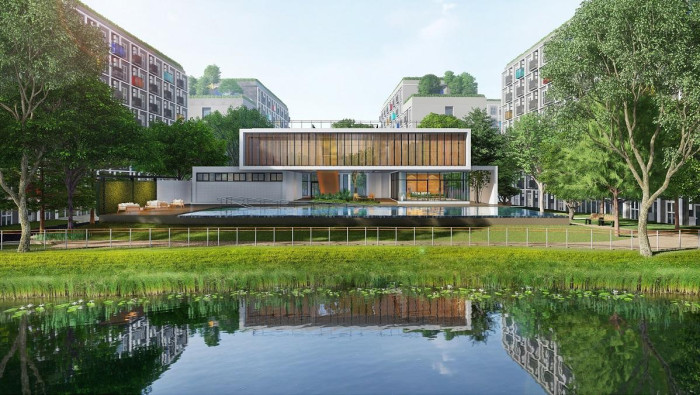
An artist's rendition of the Rama-Treasury senior living project in Samut Prakan. The Rama-Treasury senior complex project, a pioneering model for elderly housing in Thailand, expects construction costs to rise by 20-30% as a result of economic conditions, according to the chief of Dhanarak Asset Development (DAD).
DAD president Titus Suksaard said the company, which oversees project construction, began discussing the details in 2020.
The project's start date was significantly delayed because Ramathibodi Hospital, which jointly owns the project with the Treasury Department, subsequently revised and modified the project specifications, causing construction to be shelved for an extended period.
Due to the prolonged delay, material prices and construction costs have changed considerably, resulting in the 20-30% uptick in the construction budget, he noted.
Ramathibodi Hospital plans to request additional funding from the cabinet for the construction budget, said Mr Titus.
In addition, it may be necessary to reduce the project size, including the number of units.
No final decision has been reached yet, and further clarification is needed from the project review committee, which comprises representatives from Ramathibodi Hospital and the Treasury Department, he said.
In 2022, the cabinet approved the Treasury Department and DAD to jointly implement the "Rama-Treasury Senior Living Project" on state-owned land in Samut Prakan province, with an approved budget framework of roughly 1.35 billion baht.
Construction was scheduled to begin only after all residential units had been leased. At the time, 1,310 elderly individuals expressed interest in reserving the right to lease units in the project.
Residents receive various benefits, including the right to reside in their units for 30 years and access to healthcare benefits.
The original development plan comprised seven eight-storey residential buildings, with a total of 891 residential units.
The project's primary objective is to provide the elderly with suitable housing equipped with facilities and amenities that support their daily living needs.
The project makes use of vacant state-owned land while creating business opportunities and additional revenue streams for DAD and the government.
According to the National Economic and Social Development Council, Thailand became an aged society in 2024, with around 14 million people 60 or older, representing roughly 20% of the population.
By 2033, the elderly population is expected to reach 28%, moving Thailand into the ranks of a "super-aged" society.
Thailand Development Research Institute projects senior citizens will account for as much as one-third of the Thai population by 2050.
Meanwhile, the number of elderly people who are homebound or bedridden is expected to increase.
However, the responsibility for providing care continues to fall largely on women within families, particularly wives and daughters.
Although local administrative organisations currently receive support from the National Health Security Office of 10,442 baht per person per year to provide individual care for dependent older adults, access to these services remains limited.