
Commentary: Who keeps crashing China’s stock market? - CNA
Over the past decade, the domestic market has endured at least three bear runs that prompted emergency government bailouts, says Shuli Ren for Bloomberg Opinion.
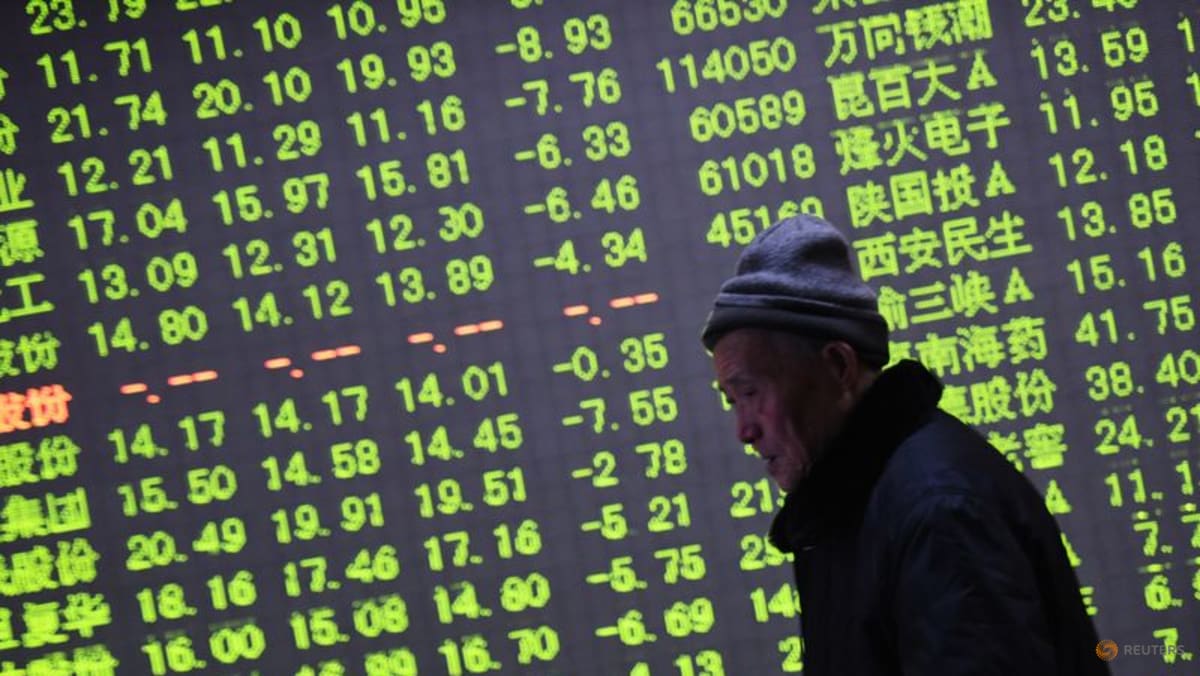
An investor walks past an electronic screen showing stock information at a brokerage house in Hangzhou, Zhejiang province, January 21, 2015. REUTERS/China Daily
HONG KONG: China is scrambling to contain a stock market rout only two years after the previous rescue.
Beijing is dusting off the market support playbook it deployed in 2024. The People’s Bank of China (PBOC) is providing low-cost funding for corporate share buybacks and liquidity for institutional investors. The shadowy “national team” appears to have stepped up its operations, while regulators are again resorting to window guidance – informally instructing institutional investors and brokerages not to sell.
In October, China’s stock market suffered its worst monthly decline in more than a decade. The blue-chip CSI 300 Index has fallen into a bear market from its late-June peak, while Shanghai’s semiconductor-heavy SSE Science and Technology Innovation Board 50 Index, or Star 50, has plunged as much as 48 per cent.
So who’s been selling? The blame game has already begun.
CNA Games Guess Word Crack the word, one row at a time Buzzword Create words using the given letters Mini Sudoku Tiny puzzle, mighty brain teaser Mini Crossword Small grid, big challenge Word Search Spot as many words as you can Show More Show Less FILE PHOTO: People walk past the headquarters of the People's Bank of China (PBOC), the central bank, in Beijing, China September 28, 2018. REUTERS/Jason Lee/File Photo Shiva Capital Group, one of China’s biggest hedge funds, has pointed the finger at insurers. In a recent letter to clients, founder Hong Liang accused the insurance firms of piling into technology stocks near their July peak, only to slash positions in late September. The behaviour was “truly baffling”, lamented the prominent investor, who has a large following on the mainland.
Liang certainly has reason to deflect blame. China has a long history of faulting private sector investors, from quant funds to foreign asset managers, for igniting selloffs. But he might just have a point this time.
China had already endured a bear market in July, when momentum-driven trades suffered their worst loss in history. The pattern mirrored markets in South Korea and the United States, where the red-hot semiconductor trade was hastily unwound.
Three months later, however, the usual suspects are harder to blame. Margin financing has already fallen, as has northbound turnover through the Stock Connect with Hong Kong, suggesting neither leveraged traders nor foreign hot money is behind the latest weakness.
That leaves a different potential offender: long-only institutional investors.
State-owned insurers have been steadily increasing their stock holdings in recent years. China Life Insurance, for instance, has scaled up artificial-intelligence-related bets and raised its equity allocation to 19.2 per cent of its portfolio by the end of June, from 16.9 per cent in 2025.
Beyond the hunt for higher returns, insurers have been responding to policymakers, who want them to provide more long-term capital to the stock market – a priority that the head of China’s securities regulator reiterated in a high-profile speech in mid-June. Talk about bad timing.
In recent days, authorities have issued window guidance to several major insurers, requiring them to report their equity holdings, refrain from cutting their losses, and align investment decisions with broader economic goals.
The government now appears to be grappling with an unintended consequence of its own policy.
Insurers may be more patient investors than hedge funds, but they still have to manage risk and meet claims and other liabilities. That limits their ability to sit indefinitely on mounting losses – and can force them to cut exposure during severe market downturns.
Insurers, in other words, cannot be as reliably countercyclical as the “national team”, whose primary purpose is market stabilisation.
On its latest earnings call, executives at China Pacific Insurance Group acknowledged that equity investing had become “complicated” and that portfolios needed to be managed so market volatility didn’t damage short-term returns. In the third quarter, profits at China’s five major listed insurers plunged, largely because of the decline in domestic stocks.
The experience points to an uncomfortable reality: For insurers, reliable dividend payers such as Bank of Jiangsu may ultimately be better suited to their liabilities than capital-intensive chipmakers.
Few in China – including Shiva’s Liang – are willing to say publicly that policy missteps themselves may be contributing to poor stock market performance. Instead, blame has fallen on everything from thin liquidity to indiscriminate selling.
But that raises a bigger question: Why does China keep suffering stock market routs? Over the past decade, the domestic market has endured at least three bear runs that prompted emergency government bailouts – in 2018, 2024 and now.
The next time the PBOC has to put out a fire, who will be left to blame? Foreigners, hedge funds and now even state-owned insurers have all had their turn.
An automated curation of our top stories to start your day.
Our chief editor shares analysis and picks of the week's biggest news every Saturday.
Our chief editor shares analysis and picks of the week's biggest news every Saturday.
