
China lifts secrecy on new key rate, sets it below old benchmark - The Business Times
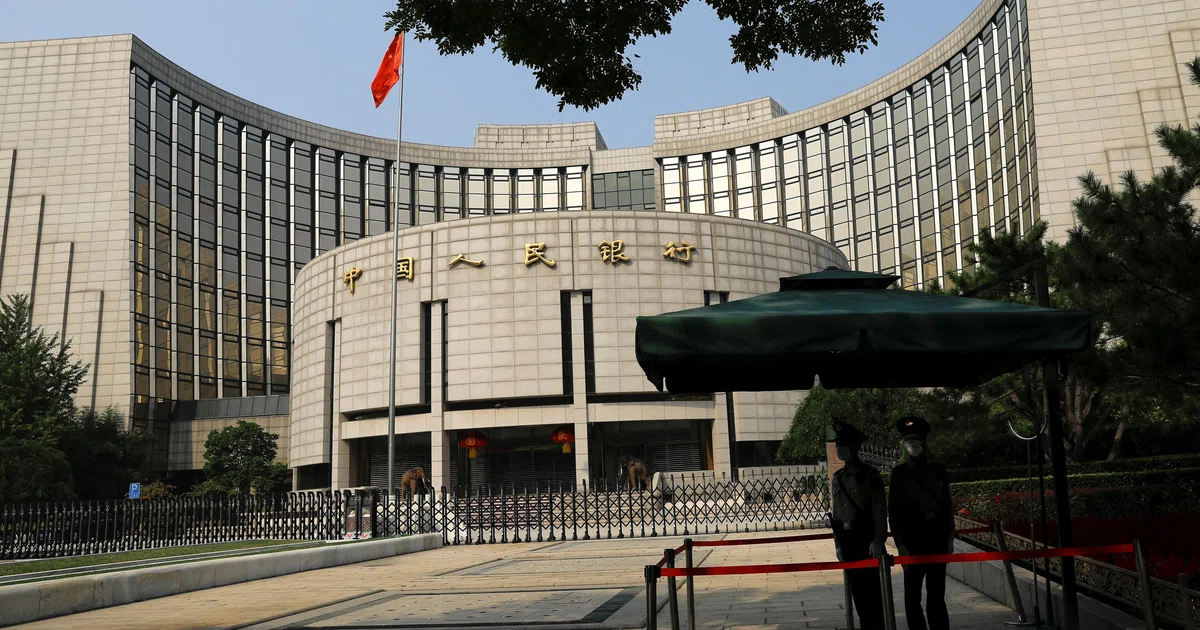
The rate on the overnight reverse repurchase agreements is 1.25%
[BEIJING] China announced the level of its new key rate after keeping it secret for four months, setting it below the old benchmark as the central bank takes the final steps towards making the overnight rate its main policy lever.
The rate on the overnight reverse repurchase agreements is 1.25 per cent, compared with 1.4 per cent on the current seven-day benchmark, according to a statement from the People’s Bank of China (PBOC) on Friday (Oct 30).
While PBOC hasn’t previously made public the rate at which overnight reverse repos were conducted, it was set at 1.25 per cent during the first such operation in June, Bloomberg News reported at the time.
The central bank will start to conduct overnight reverse repo operations every day starting from Monday, and switch the seven-day reverse repo transactions to multiple rates from a single fixed one, according to the statement.
China’s 10-year government bond yield slipped to 1.63 per cent from 1.64 per cent just before the decision.
The timing of the announcement caught many analysts by surprise. Economists at banks including Societe Generale previously predicted the switch could take months, since PBOC will likely need to gradually increase the frequency of its overnight liquidity operations.
Five decades of milestones and moments that shaped Singapore’s success story - told through our headlines.
“While this move is well telegraphed, the timing is a bit earlier than expected,” said Xiaojia Zhi, head of an economist at Credit Agricole.
“The PBOC could consider the switch now to help deliver lower short-end rates in the money markets,” Zhi added, possibly to dispel market unease over reports of state-owned developer Zhuhai Huafa’s missing payments on trust products.
Some investors see the transition as de facto easing, since the 1.25 per cent rate was lower than expected when it was first adopted in late June. But PBOC has refrained from associating the shift with looser policy, potentially out of concern that such interpretation may lead to frenzied buying in the Chinese government bond market.
“Although not a conventional 15 basis-point policy rate cut, the transition effectively increases interbank liquidity and lowers yields across the bond curve, all else equal,” Goldman Sachs Group economists led by Andrew Tilton wrote in a note.
While a further policy rate cut “looks unlikely in the near term”, they said “evolving domestic credit risk could increase the likelihood” of a reduction in lenders’ required reserves.
And “to contain risk spillovers”, PBOC may also opt to use its new instrument designed to help non-bank financial firms manage liquidity stress during bond sell-offs, according to Goldman’s economists.
Earlier in October, PBOC gave the clearest signal yet of plans to revamp its toolkit by moving from the seven-day reverse repo rate to the overnight one. The change is part of a decades-long effort to reform China’s interest-rate system from a centrally planned framework, and better align PBOC with other major central banks.
Financial News, a newspaper affiliated with PBOC, cited economists in a report earlier this month as saying that the market shouldn’t conflate the central bank’s reform measures as a rate reduction.
The frequency of the seven-day reverse repo programme will also be reduced, with such operations conducted only during stretches like tax payment times and end-of-month periods, according to the latest statement.
Other tools that used to be based on the old benchmark will be linked to the overnight rate going forward, PBOC said.
The sooner-than-expected announcement could be “a good strategy to get any further speculation out of the way”, according to Frances Cheung, head of rate strategy at OCBC.
“Given that there will be overnight reverse repo operations daily, market participants will be comfortable relying on the overnight liquidity with rollovers, even if the liquidity demand is for a multi-day period,” she said. “Effectively, this would lower the funding costs.” BLOOMBERG
Decoding Asia newsletter: your guide to navigating Asia in a new global order. Sign up here to get Decoding Asia newsletter. Delivered to your inbox. Free.
Who are some of the longest-serving CEOs among Singapore’s blue-chip companies?
China’s market is tougher than ever. Where can Singapore firms still find room to grow?
Singapore is designing for a hotter future, but can it beat the heat?


