Blue Wave Shakes Financial Markets, Boosts U.S. Stocks Over 3%, Gold Soars, Tech and Clean Energy Stocks Rise - Thairath English

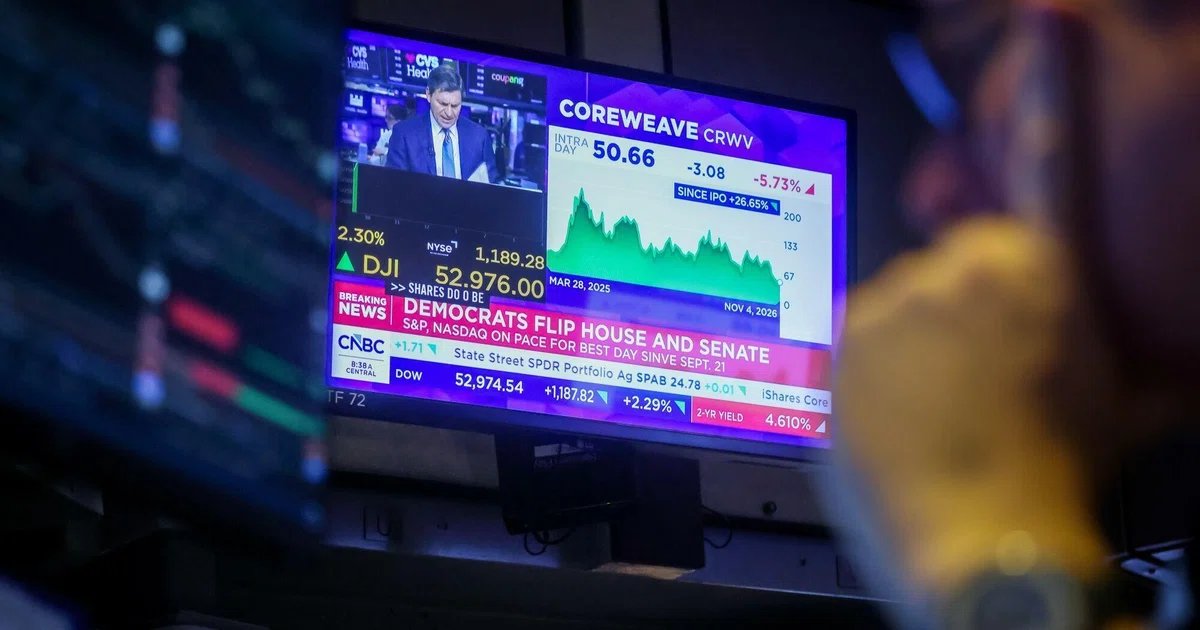
The Democratic Party's major victory in the 2026 U.S. midterm elections is becoming a pivotal moment in global financial markets after securing majorities in both the Senate and House of Representatives. This significantly shifts the balance of U.S. political power and places pressure on President Donald Trump's economic policies in the latter half of his term.
Financial markets reacted strongly to the election results, with the Dow Jones index surging over 1,500 points, or 3%, while the S&P 500 and Nasdaq also rose. Meanwhile, global gold prices climbed back above $4,100 per ounce as the U.S. dollar and Treasury yields declined.
However, within the overall rising stock market, clear winners and losers emerged. AI-related stocks of tech giants like Microsoft and Amazon rose over 6%, contrasting sharply with data center operators, which plunged as much as 23% amid concerns that Democrats might enforce stricter regulations on AI infrastructure expansion.
This midterm election represented a significant defeat for the Republican Party, as Democrats won in many long-standing Republican strongholds, including key states like Texas and Georgia, reflecting voter dissatisfaction with the Trump administration.
Although these changes make it harder for the administration to push policies, the capital markets interpret this as a positive factor.
A key reason is the onset of Political Gridlock, where executive and legislative branches hold different political powers, requiring more negotiation and oversight for major policies like tax cuts, increased government spending, and new economic measures.
Investors believe this balance of power may reduce risks from rapid policy changes and allow businesses clearer economic outlooks.
Terry Sandven, Chief Equity Strategist at U.S. Bank Wealth Management, said the stock market rose quickly because the election results reduced uncertainty, and political gridlock typically creates a favorable environment for stocks.
This was reflected in Wall Street's close on 4 November 2026, when all three major stock indices posted strong gains.
Dow Jones closed at 53,356.12 points (+3.0%).
S&P 500 closed at 7,688.62 points (+1.6%).
Nasdaq Composite closed at 25,736.51 points (+1.4%).
The Dow Jones increased by 1,569.40 points, while nine of the eleven S&P 500 sectors rose, led by luxury goods up 4.3%, contrasting with energy stocks which fell 4.8%.
Not only U.S. stocks reacted positively; global equity markets also advanced. The MSCI All-World index tracking global stocks rose 1.38%, and Europe's STOXX 600 jumped 1.82%, reaching a two-month high.
,Spot gold pricesin the global market rose 3.49% to $4,065.80 per ounce on 4 November, then continued climbing past $4,100. Other precious metals also gained, with silver up 2.1% to $53.34 per ounce and platinum up 1.7% to $1,525.78 per ounce.
The main factor driving gold prices is the shift in expectations for U.S. economic policy after the Democratic win raised the likelihood that Trump's plans for tax cuts and increased spending will face more limitations.
This expectation led investors to buy U.S. Treasury bonds, pushing the 10-year yield down about 6.62 basis points to 4.88%, while the U.S. dollar index weakened 0.23% on 4 November.
The drop in bond yields lowers the opportunity cost of holding gold, a non-yielding asset, while the weaker dollar makes gold cheaper for holders of other currencies.
However, ANZ analysts warned that U.S. government debt expansion has supported gold prices over the past year, so if the new political balance slows borrowing and spending, it could reduce gold's long-term support.
Despite the strong gains in U.S. stocks, AI group stocks showed a clear divide, especially between financially strong tech giants and data center operators who require huge investments to expand.
Microsoft shares rose 6.7%, Amazon up 6.1%, Alphabet (Google's parent) increased 3.2%, and Meta Platforms gained 1.4%, while data center operators faced heavy selling: Hut 8 dropped 23%, IREN down 11%, Core Scientific off 10%, and Applied Digital fell 6.7%.
The Philadelphia Semiconductor index, tracking semiconductor stocks, dropped 3.1% to a six-month low amid concerns Democrats might tighten AI industry regulations, especially on data center construction, which faces local opposition in several U.S. states.
Democrats' wins in Texas and Georgia increased investor worries since both states are strategic for AI infrastructure expansion, with Texas expected to host about 25-30% of new U.S. data center capacity according to analyst estimates.
If data center construction faces regulatory limits on energy costs, water use, or project approvals, AI infrastructure investments could slow down.
For tech giants with existing data centers and processing capacity, this may be advantageous by reducing pressure for rapid new investments and enhancing the value of current infrastructure. However, smaller firms needing loans or fundraising to build new data centers could see revenue, cash flow, and debt repayment capacity affected by project delays.
Scott Chronert, Head of U.S. Equity Strategy at Citi Research, noted that changes in data center construction speed could directly impact growth prospects for many supplier companies.
The post-election AI stock movements reflect investors beginning to differentiate companies likely to generate AI returns from those bearing huge costs to build supporting infrastructure.
The midterm election also affected other policy-sensitive industries, with clean energy stocks rising as investors expect Democrats' congressional majority to sustain clean energy support measures. The Invesco Solar ETF rose nearly 6%.
Conversely, traditional energy stocks fell with Brent crude oil prices plunging nearly 9% to close at $94.62 per barrel, below $100 for the first time since early October.
The sharp oil price drop reflects expectations that the political power shift in the U.S. may accelerate efforts to end the Iran conflict after Trump reduced the likelihood of renewed military strikes, easing energy supply risk fears.
Tesla shares fell 3.3% and SpaceX dropped 3.9% after Elon Musk spent nearly $500 million supporting Republican candidates in this election, including efforts to retain support in Texas, the business hub for both companies.
Defense industry stocks like Northrop Grumman, RTX, and Lockheed Martin also declined amid investor concerns that Trump's $1.5 trillion defense budget plan may face more obstacles in Congress approval.
Overall, financial markets post-midterms indicate investors anticipate Trump's economic policies will face more checks, potentially reducing fiscal and government policy uncertainty.
In the short term, this supports stocks and bonds, while the weaker dollar and bond yields bolster a strong gold recovery.
On the other hand, the Blue Wave could mark a turning point for AI industry investment, as data center expansion—once seen as a U.S. economic engine—is now questioned over energy costs, resource use, community impact, and massive investment returns.
Especially as tech giants increase AI investment spending, the market may focus more on cash flow generation and investment returns rather than solely expanding processing capacity.
However, the Democratic victory does not guarantee immediate new AI regulations or economic policy changes since legislative processes remain and Trump retains executive power.
Going forward, investors will watch congressional policy directions, Federal Reserve interest rate moves, and Middle East conflict developments to determine market trends.
https://www.thairath.co.th/money/economics/thai_economics
Follow the Facebook page: Thairath Money at this link https:// www.facebook.com/ThairathMoney