
Benefits for all: Frontier technologies tackle shared public-sector challenges across Asia-Pacific - CGTN
By continuing to browse our site you agree to our use of cookies, revised Privacy Policy and Terms of Use. You can change your cookie settings through your browser.
Across the Asia-Pacific, frequent extreme weather, uneven public service capacity and rising energy demand driven by growing computing needs present common challenges for many APEC economies.
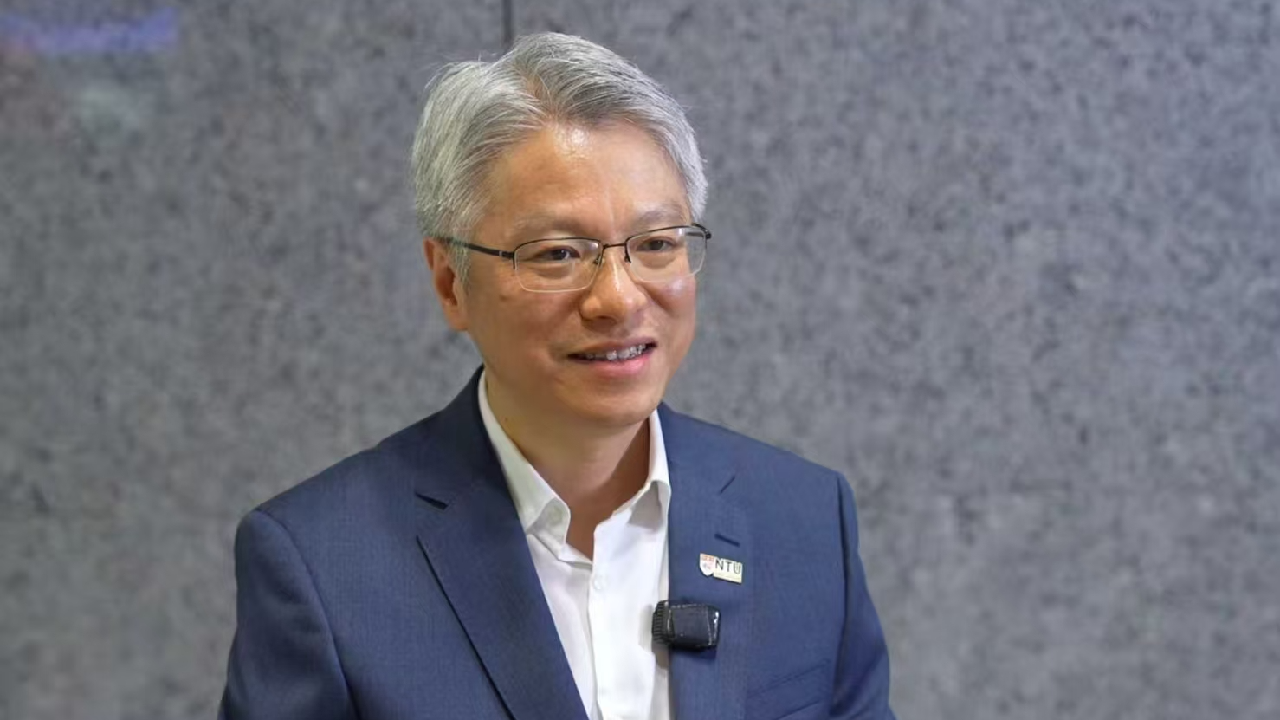
CGTN spoke with two experts in quantum computing and next-generation computing: Professor Lin Jing from City University of Hong Kong and Professor Wen Yonggang, associate provost at Nanyang Technological University and a fellow of the Singapore Academy of Engineering.
AI-powered meteorological early warning systems process real-time weather data to issue typhoon and flood alerts and support local disaster preparedness.
Open-source AI tools for public health are shared regionally to assist local medical teams in providing routine care.
Embodied intelligence prototypes showcased at humanoid robot competitions are seen as promising tools for elderly care and on-site emergency rescue, helping to fill service gaps where labor is scarce.
Professor Lin Jing from City University of Hong Kong. /CGTN
Professor Lin Jing, academic curator of the "Future Computing · Future Compute Power" forum at the 2026 World Artificial Intelligence Conference, said quantum-AI hybrid architectures offer unique research advantages for high-fidelity climate simulation and molecular-level drug development, yet the technology remains largely confined to laboratory research.
"Quantum computing is still in its foundational research phase. It is not yet ready for widespread deployment as standard digital infrastructure. While it offers theoretical advantages for modelling complex natural systems, it needs consistent investment from governments, universities and research bodies to move forward," Lin said.
"Hong Kong can serve as a regional hub for quantum collaboration in the Asia-Pacific, connecting talent and capital from across the globe. Partners can co-develop prototypes first, before testing suitable routes for local adoption and wider regional scaling."
She noted that open quantum cloud platforms and Asia-Pacific joint research laboratories offer a viable model for collaboration.
Rather than one-off technology transfers, these initiatives focus on shared computing resources, joint experiments and cross-border academic exchanges.
In her view, inclusive access to technology cannot be achieved overnight and requires voluntary, long-term collaboration among economies at different stages of digital development.
Professor Wen Yonggang, Associate Provost of Nanyang Technological University and Fellow of the Singapore Academy of Engineering. /CGTN
Sustainable computing is another shared regional challenge.
Surging AI workloads are driving up data center power consumption, creating particular pressure on land-scarce economies in Southeast Asia.
Wen's research examines space-based data center designs. He says space-hosted computing could harness greater solar irradiance and natural radiative cooling in space, while orbital resources could help ease land constraints on Earth.
"Many Southeast Asian economies have expanded their data center footprint rapidly. Some are drawing lessons from Singapore's regulatory framework: aligning data center growth with renewable power supply, rolling out regular energy efficiency audits and putting guardrails in place to pursue greener digital infrastructure," Wen noted.
He believes innovators in the Asia-Pacific may carve out distinct technical pathways for next-generation computing, similar to the divergent development trajectories seen in the global electric vehicle sector.
Both experts observed that the digital divide across APEC economies means that uniform, top-down technology rollouts do not suit regional conditions.
For regional cooperation on frontier technologies for the public good, voluntary knowledge exchange, joint laboratory research and capacity building are more practical approaches.
They said regional stakeholders aim to translate advances in AI, quantum simulation and sustainable computing into tangible outcomes: stronger climate resilience, more accessible healthcare and improved social services.
