Belleville synagogue shooting was a ‘wake-up call,’ Ottawa warned - Toronto Star
The Carney government is being urged to beef up counter-radicalization efforts as programs that fight extremism face expiring funds and resource constraints.
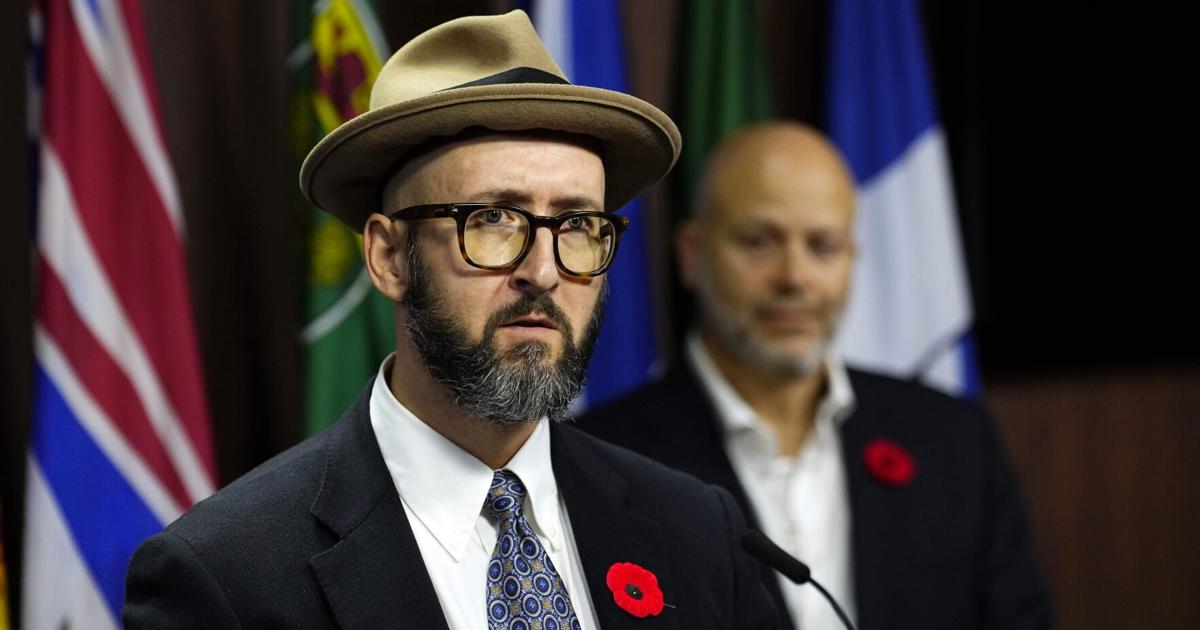
Shima Vigodda, vice-president of Sons of Jacob Synagogue and survivor of the Belleville synagogue attack, speaks during a news conference on Parliament Hill with fellow survivor and congregant Douglas Lobel, in Ottawa, on Nov. 2, 2026.
OTTAWA — Three months before a shotgun-wielding man opened fire outside a small Belleville synagogue during a Yom Kippur service, federal security officials were internally warning about rising threats against Canada’s Jewish community.
Now, the Carney government is being urged to beef up counter-radicalization efforts — and hinting a boost could come — as programs that fight extremism face expiring funds and resource constraints ahead of this week’s release of the federal budget.
“Violent extremist and criminal threats targeting Jewish communities in Canada and the West will likely continue at a steady rate over the next six months,” said a June report from the federal government’s Intelligence Threat Assessment Centre, one of several reports on the issue which were obtained by the Star.
“Over the longer term, an environment in which the targeting of the Jewish community as a group frequently occurs and becomes more normalized will likely influence some susceptible individuals towards violent extremist pathways, including by inspiring them to seek out more violent or extremist antisemitic content.”
But while that environment was driving “fear and uncertainty” in the Jewish community, particularly amid an uptick in harassment and other criminal incidents in the GTA, there had not been any foiled plots in 2026 at the time — and violent extremist attacks had not kept pace, the report said.
That was before Sept. 20, when Sean Ward — who reportedly espoused antisemitic COVID-19 conspiracies before being kicked out of the Canadian Armed Forces — shot at the Sons of Jacob synagogue before getting into a gunfight with police, in which he was fatally injured.
Members of the Belleville synagogue community were in Ottawa on Monday, describing the moment as a “wake-up call” as they urged the federal government to step up its protections for Jewish communities across the country.
Shima Vigodda, vice-president of Sons of Jacob synagogue, said the scenes he witnessed during the attack still play over and over in his head.
“Hearing the shots, yelling for people to get down, hearing the glass breaking, screams, watching parents hold their children, seeing the fear and panic on people’s faces, not knowing what the next moment will bring,” he told reporters.
“We came razor close to experiencing what could have been one of the worst mass casualty events in Canadian history, and the utter decimation of a small Jewish community.”
Noah Shack, head of the Centre for Israel and Jewish Affairs, said while Ottawa has made progress on federal security funding and hate laws, it should use Thursday’s budget as an opportunity to step up efforts to fight extremism before it turns to violence.
“Now is not the time to sunset resources for counter-radicalization,” he told reporters, referring to programs like the Community Resilience Fund, which funds organizations that counter violent extremism.
But the grants are project-specific and short-term, with much of the most recent funding set to expire in the coming months.
That has led to challenges staffing permanent team members and resource constraints even as extremist threats rise, according to a front-line Toronto clinic that deals with radicalized people.
“The funds are not keeping us above water at all,” said David O’Brien, the mental health director at Toronto’s Yorktown Family Services. “It’s way overcapacity in terms of the work we do, but also that you’re always on edge in terms of not knowing when the funding ends.”
He described a “pretty substantial increase” in recent years of online radicalization, particularly young people.
He said that typically, 30 to 40 per cent of the people referred to the program are radicalized to the point of violence, and trends point to more sporadic, random and decentralized threats, a diversion from the traditional “command and control” structure associated with terrorism that has presented challenges for law enforcement.
It’s certainly not just antisemitism, he said, although the age-old hatred of and conspiracies about Jewish people is a “baseline of entry into extremism.”
A recent Canadian government report on combating antisemitism said the issue “can be a matter of national security,” as it hinted a boost in counter-radicalization efforts was coming.
“Future efforts will focus on prevention, early intervention, victim support, and improved reporting,” the September report said. “New initiatives will enhance support for victims, expand alternative reporting options, and strengthen intervention programs aimed at individuals at risk of radicalization.”
O’Brien said conversations with government officials, in which his organization has requested more stable funding and earlier intervention, have so far left him feeling “positive.”
Appearing alongside the Belleville synagogue members and Shack on Monday, Liberal MP Chris Malette said he’s confident the federal government will step up.
“At budget time, this request I know didn’t just come today. It’s being considered,” said Malette, who represents the Bay of Quinte riding where the attack happened. “The government is listening.”
Error! Sorry, there was an error processing your request.
There was a problem with the recaptcha. Please try again.
You may unsubscribe at any time. By signing up, you agree to our terms of use and privacy policy. This site is protected by reCAPTCHA and the Google privacy policy and terms of service apply.
Mark Ramzy is a federal politics reporter in the Toronto Star’s Parliament Hill Bureau. Reach him via email: mramzy@thestar.ca