App maps Brazil nut trees, guides harvesters through forest - Valor International
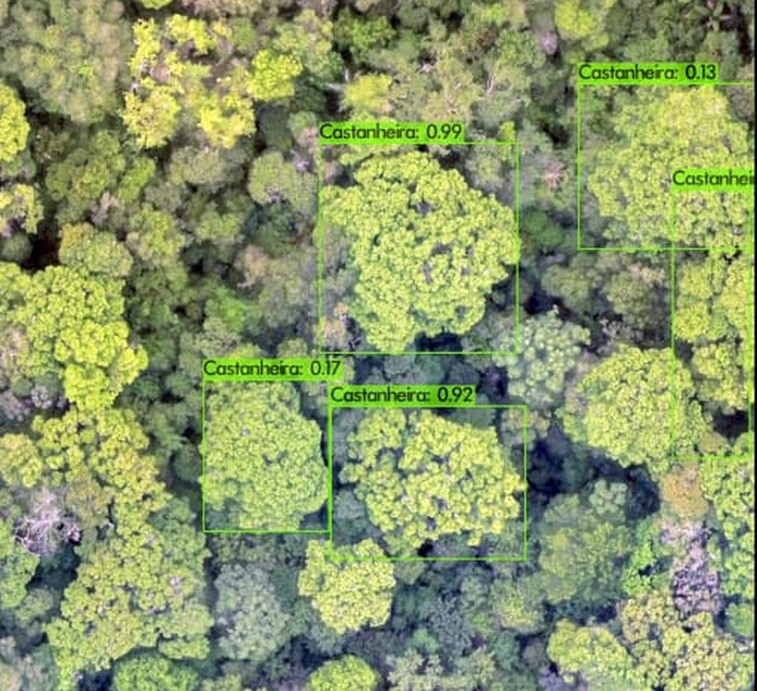
Forest harvester Eliane Santos, 34, was astonished when she saw a map of the Brazil nut trees in the area where she works in Lábrea, Amazonas, displayed on her mobile phone. Accustomed to working with her family among the same 60 trees, NetFlora, Embrapa’s tree-species identification application, showed her that she could work with more than 150 trees in her area.
“I didn’t know there were so many Brazil nut trees,” Santos said. She was so surprised that she had to verify the results herself. She looked at the map and found an area where five Brazil nut trees were supposed to be. “I took my phone and went into the forest. I looked around, and the five little dots were exactly where the Brazil nut trees were,” she recalled.
According to Embrapa Acre researcher Luciano Ribas, NetFlora is 98% accurate and was originally developed to identify timber species. Using a database and an artificial intelligence system, it can create complete forest inventories in just a few minutes. Over the past year, the application has been tested to optimize the work of forest harvesters.
“It is highly advanced technology—an innovation. But for us to call it an innovation, it has to be useful to everyone. In this case, we intend to adapt it for use by harvesters so that it can make their lives in the forest easier,” Ribas said.
When harvesters travel along forest trails, their field of vision lets them spot Brazil nut trees up to 70 meters away. NetFlora’s drone-based mapping extended that range to as much as 200 meters. In 15 days, Embrapa’s technology had already mapped 28,000 hectares.
The broader range allows harvesters to plan their work more effectively. In years of low production, they can organize their activities across a larger area to offset the lower yield per tree. In years of abundant harvests, they can enter the forest in larger groups, increasing their collection capacity.
The mapping also improves harvesters’ productivity. According to Santos, routes that previously took more than an hour can now be completed in no more than 20 minutes, with the application indicating shorter paths. After one year of using NetFlora, she has increased her production by 62% and consequently raised her income.
Ribas said identifying more Brazil nut trees from the trails could increase nut collection by as much as 197%. Realizing that potential, however, depends on harvesting families’ ability to expand their workforce, either by mobilizing more people or using draft animals, he added.
“We now intend to bring this technology to harvesters’ cooperatives to show them that it is available and can be accessed free of charge on Embrapa’s website,” Ribas said.