6 things to watch for on election night
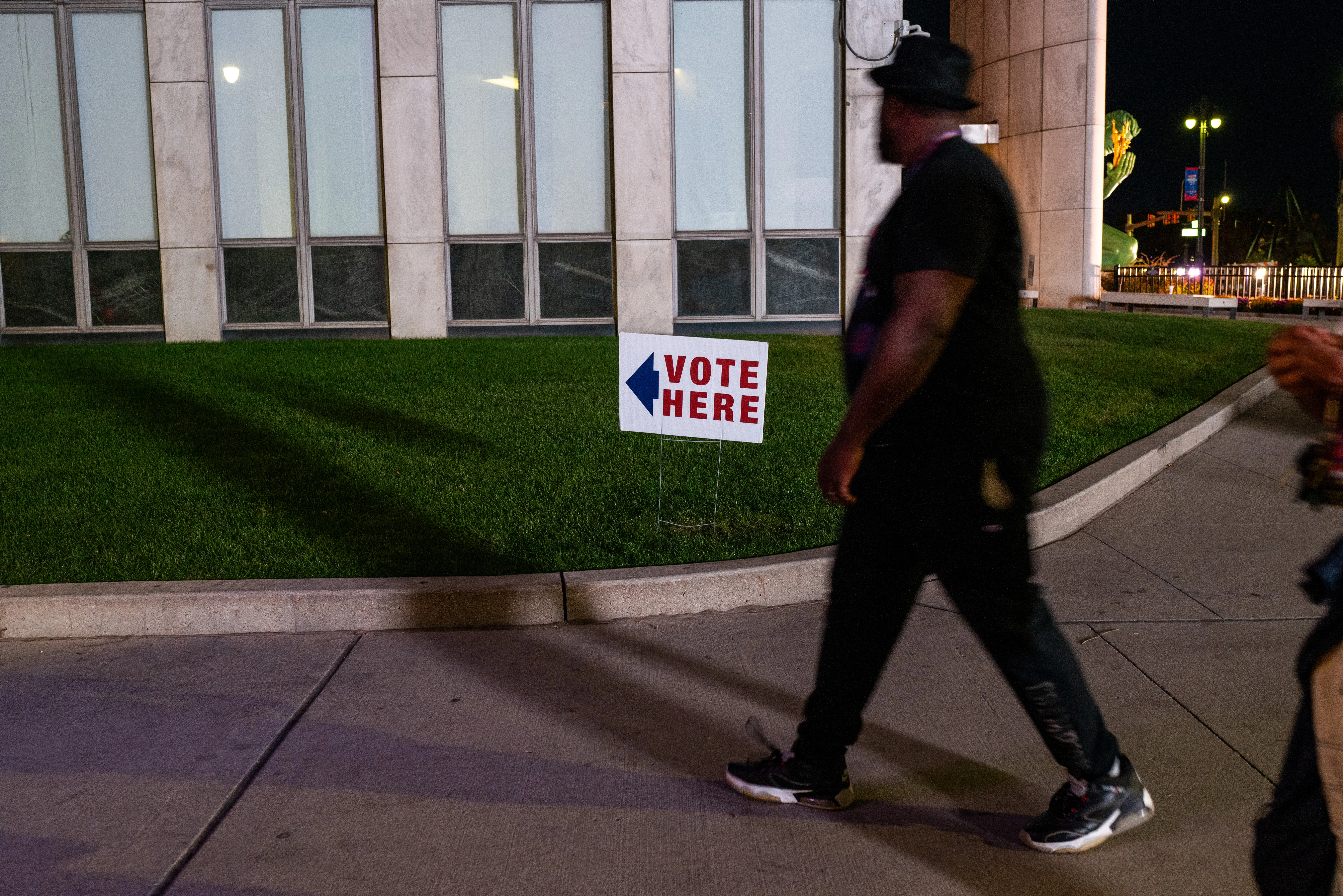
People walk by a sign for voting on November 1, 2026, in Detroit, Michigan. Michigan has become a focal point in the upcoming midterm elections, with a close race between Republican Senate candidate, former U.S. Rep. Mike Rogers (R-MI), and Democratic candidate Abdul El-Sayed that could decide who controls the chamber. Spencer Platt/Getty Images hide caption
It can be hard to know what to focus on in midterm elections. There are so many races, from elections for governor and senator to the House and state legislatures. For a better idea of how the night might go to see which party might control Congress, here are six things to watch:
There are two states, Indiana and Kentucky, that will see results in the 6 p.m. ET hour. And then there's Florida, which is split between the Eastern and Central time zones. But most of the state is on Eastern time. So lots of House race results will be coming in during the 7 p.m. ET hour, even if statewide contests like the Senate and governors races won't be called at the earliest until 8 p.m. ET.
Some races to watch for early indicators of what might come later in the evening — Indiana's 5th Congressional District, Kentucky's 6th and Florida's 22nd and 27th. Indiana's 5th and Kentucky's 6th are seats held by Republicans that are more competitive now than at the beginning of the cycle. If these are close or tipping to Democrats, it could be a sign of low Republican turnout and a bigger Democratic wave.
Florida's 22nd is held by a Democrat but redrawn to tip in Republicans' favor. Trump won Florida's 27th by double-digits so this heavily Latino district could be an indicator of how this key subgroup votes.
Independents are a key swing group, but they are also a lower-propensity voting group in midterms.
It used to be that Republicans had to win a bigger share of independents before the Trump era. Mitt Romney, for example, won 55% of independents in 2012 but lost the presidential election. But there's been a political realignment in this country with blue-collar white voters trending toward Trump, fewer people identifying as Democrats and better-educated white voters shifting toward Democrats.
So in the decade since Trump has been on the political scene, Republicans have done well when they win at least 46% of independents. When they haven't, they've lost.
The Michigan Senate race is important for control of the Senate. If Republicans flip it, the magic number for Democrats goes from four to five, meaning Democrats would have to win five seats held by Republicans to win control of the Senate.
For Abdul El-Sayed (D) to win in Michigan, a key is going to be Black voters in Wayne County. If he runs up the score in and around Detroit, he has a path to victory, but if he doesn't, it becomes that much harder — and it's been an area of vulnerability for him.
During the Trump era, Democrats have needed 68% or more in Wayne County to win Michigan unless, like Sen. Elissa Slotkin in 2024, they can overperform in the suburbs.
Voters 18 to 29 see a drastic drop off in turnout between presidential and midterm elections. During presidential races since 1992, 43% of registered young voters cast ballots. But in midterms, that falls to 21%, just 1 in 5 who show up at the polls.
But they are crucial to Democratic success. In the last 20 years, when Democrats won this group by more than 20 points, they have done well, winning presidencies or making gains in midterms. The only exception was 2022, but arguably, the strong margin Democrats won with young voters that year, helped them stem what could have been a much larger Republican tide. That year, Democrats lost nine House seats, but gained a Senate seat.
Given past polling errors in Texas that underestimated the Republican vote, there's a healthy skepticism that Democrat James Talarico's margin of error lead in polling averages is enough to win.
There was lots of enthusiasm in 2018 for Beto O'Rourke's (D) 2018 bid against an unpopular Republican senator in Ted Cruz, but Cruz still won, although by less than 3 percentage points. No Democrat has won statewide in Texas since 1994, and no Democrat has been elected to the Senate from Texas in 38 years.
For it to actually happen in this state Trump won by 14 points in 2024, two groups are key – Republicans and Latinos. Ken Paxton (R) is unpopular. Republican Gov. Greg Abbot is also facing a tight race, but he's thought to be in better shape than Paxton. In 2018, Cruz won about 400,000 fewer votes than Abbott, but Cruz still won by more than 200,000 votes. So watch if the difference between Abbott and Paxton is more than 400,000 for Talarico.
Voters cast their ballots in Anchorage, Alaska on November 1, 2026. Christian Moorman/AFP via Getty Images hide caption
The second part of Talarico's path to victory runs through South Texas. Statewide, O'Rourke won 64% of Latinos in 2018, and they were 26% of the electorate, according to exit polls. If Talarico is north of both of those, that's how he wins the seat. Talarico would need to improve on O'Rourke's totals in these Latino-heavy counties: Cameron 63%, Hidalgo 69%, Webb 71%, Nueces 51%. As a bonus, watch the fast-growing and heavily populated Dallas suburbs – Collin 47%, Denton 46%, Tarrant 51%.
Because of the political realignment that's taken place in the Trump era, watch how people identify in exit polls.
The percentage of those saying they were Democrats hit a low in 2024 at 31%. That trend is happening as the base of the Democratic Party has become more liberal and more disaffected with their own leadership. This year, though, Democrats were among the highest in enthusiasm levels, according to the latest NPR poll, but they are likely going to have to be far higher than 31% as a share of the electorate to do well.
That's quite possible given the opposition to Trump in this election is sky high – 53% of likely voters in the latest NPR poll said they strongly disapproved of the job he's doing. That is very likely to be a unifying force for the left in this election. As the saying goes, the enemy of my enemy is my friend.
Along these lines, it's going to be important to watch races like the Michigan Senate race and the contest for Michigan's 7th Congressional District, both of which have very progressive Democratic candidates trying to win in purple places. Democratic unity – and the party's ideological future – is going to be a key storyline of the 2028 presidential primary and could define the American left for years to come.
NPR does not offer or accept money for coverage or interviews. Anyone who makes such an offer or request is not an NPR employee and does not represent NPR.